



Two tapestries, two records
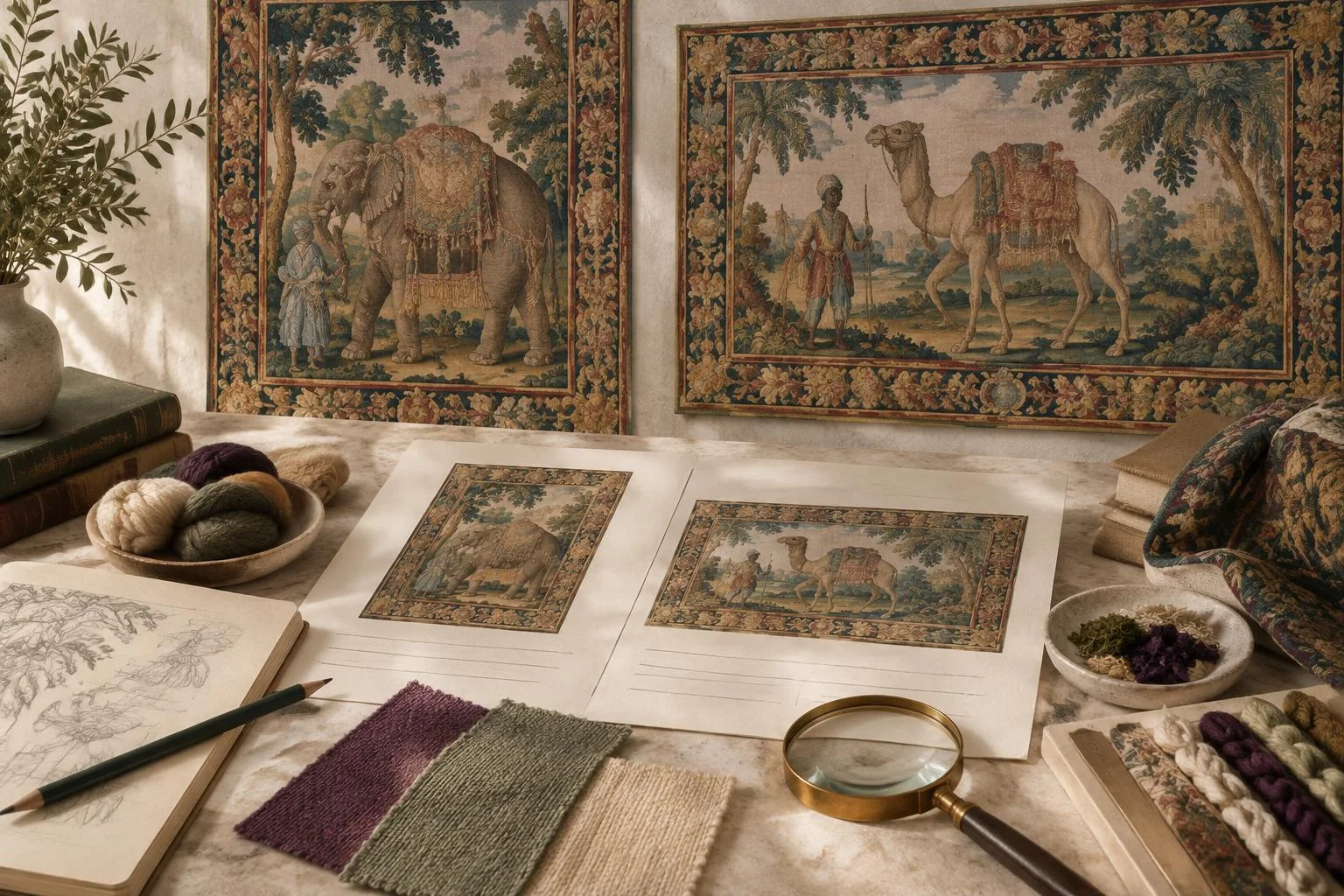
How can two Beauvais tapestries be compared without turning their records into a shared history? The answer is to keep each fact tied to its object and put side by side only the fields documented in the records. The Elephant, at the Art Institute of Chicago, and The Camel from a set of five Grotesques, at the Metropolitan Museum, share references to Beauvais, wool and silk; their dimensions, chronologies and attributions, by contrast, belong to different works. [1] [2]
The Chicago tapestry is listed under number 2102; the Met tapestry under accession number 1977.437.1. The phrase “from a set of five” belongs to the latter’s catalogue title. It helps identify how the work is named, but does not in itself prove that every historical realization of the series was limited to five pieces.
When taking notes, preparing a label or writing a comparison, it helps to write the title and collection first, then add each fact. The unit of comparison is each object, not a combined biography of the two. This simple order prevents a measurement, attribution or scene description from inadvertently migrating from one record to the other.
Dimensions: keep each pair as listed
The catalogued dimensions are 461,1 × 306,4 cm for The Elephant and 299,7 × 529,6 cm for The Camel. Both records use centimetres, but their figures should not be reordered to create an apparently equivalent orientation. The most faithful way to compare them is to keep each pair alongside the title of its work. [1] [2]
| Work | Catalogued dimensions | Record identification |
|---|---|---|
| The Elephant, Art Institute of Chicago | 461,1 × 306,4 cm | Object listed under number 2102. |
| The Camel from a set of five Grotesques, Metropolitan Museum | 299,7 × 529,6 cm | Object listed under accession number 1977.437.1. |
The table shows that the listed proportions are not the same. It does not tell us how each tapestry is installed, how much room it occupies in a gallery, or which might look larger at a glance. Those questions require information about display and context that these dimensions do not provide. Nor do they describe weight, thickness, hanging method or physical condition.
Editorial example: for a brief exhibition label, the title and institution could be copied before transcribing the dimensions, without changing the order of the figures. If a visual comparison is added, it should be distinguished from the catalogued data: the measurements provide a numerical pair, not an observation about the installation.
The dates do not describe exactly the same stage
For The Elephant, Chicago gives “ca. 1688/1732.” The record also lists alternative periods of manufactory direction: the Behagle family (1684–1711), the Filleul brothers (1711–22) or Noël-Antoine Mérou (1722–33). These intervals refer to periods of direction listed in the record; they are not individually established weaving dates for this example. [1]
The Met distinguishes two moments for The Camel: design of ca. 1688 and weaving of ca. 1690–1711 at Beauvais. This separation between conception and weaving is not interchangeable with the formula used for The Elephant, nor should it be transferred to that tapestry. [2]
For that reason, a chronological comparison should not reduce both entries to a single approximate year. The form of the dating matters too: preserve the distinction between an interval, an approximation and different stages of a work. Turning any of them into an exact date would remove a qualification that is present in the record.
Editorial example: a label can retain “ca. 1688/1732” for The Elephant and distinguish the design of ca. 1688 from the weaving of ca. 1690–1711 for The Camel. If the record does not clarify a stage, filling the gap with the chronology of the other work would create false precision.
Design, style and border are different credits
The question “Who made the tapestry?” can oversimplify the catalogue fields. For The Elephant, Chicago records the design by Jean Baptiste Monnoyer (1636–1699), the style of Jean I Berain (1640–1711), and the border design also by Jean I Berain. The record also lists the manufactory at Beauvais and the alternative periods of direction already noted. These details describe different roles and associations, not a single authorship of every part. [1]
For The Camel, the Met records the design by Jean-Baptiste Monnoyer, the style of Jean Berain and the border design by Guy Louis Vernansal the Elder. The border credit differs from the one listed in Chicago. One record should not be used to complete, correct or modify the attribution in the other. [2]
It is also worth preserving the spellings shown in each entry: Chicago uses “Jean I Berain” and “Jean Baptiste,” while the Met lists “Jean Berain” and “Jean-Baptiste.” Keeping these forms avoids assuming that the records use identical nomenclature.
A functional comparison can be organized around specific questions:
- Who is associated with the design? Monnoyer appears in both records, with differences in the spelling of his name.
- What name is listed for the style? Jean I Berain in Chicago and Jean Berain at the Met.
- Who designed the border? Jean I Berain for The Elephant and Guy Louis Vernansal the Elder for The Camel.
- What information accompanies the weaving? Chicago lists alternative periods of direction; the Met gives an approximate interval for the weaving.
Separating the questions makes it possible to compare credits without turning them into an oversimplified answer about who “made” each work.
The composition is described unevenly
The Met record describes The Camel with musicians, acrobats and animals within fantastic architecture. That description refers to this work. The documentary material available for The Elephant does not provide an equivalent description of its composition: the title identifies the tapestry, but on its own it does not allow us to reconstruct a detailed scene. There is therefore no basis here for assigning the same motifs to both or filling in the missing description. [2] [1]
This asymmetry does not mean that one tapestry is visually more complex or that one record provides less information in every field. It means only that the composition is described concretely in one entry and has no equivalent in the other. A rigorous comparison can note this difference without turning it into an aesthetic judgment.
Editorial example: a gallery text could describe the Camel scene using the recorded elements and present The Elephant by its title and collection, without attributing musicians, acrobats, animals or fantastic architecture to it. The useful principle is simple: describe only the composition documented for each work, rather than manufacturing symmetry between the records.
Shared materials and specific technical detail
Both records list wool and silk. For The Elephant, Chicago adds the slit and double interlocking weave structures. This technical detail belongs to that entry and should not be attributed to The Camel without specific documentation. [1] [2]
To organize these details, it helps to distinguish three levels: named materials, listed technique or construction, and description of the image. In this case, wool and silk appear in both records; the weave structures mentioned appear in the Chicago record; musicians, acrobats and animals appear in the Met description.
The shared materials do not prove that the tapestries have the same construction, feel or finish. Nor do they provide information about their present physical condition. The detail is useful when kept within its scope: it records catalogued materials, but does not answer questions that would require another kind of documentation.
A credit is not a complete provenance
The record for The Elephant includes the credit “Robert Allerton Endowment,” while its provenance field is blank. The credit is not a chain of ownership and does not establish an acquisition date. Distinguishing the two concepts avoids turning an institutional mention into a provenance narrative that the record does not provide. [1]
Similarly, the title of The Camel refers to a set of five grotesques, but that wording does not prove that every historical realization of the series had exactly five pieces. The title identifies the work as catalogued; on its own, it does not establish the full extent of the series. [2]
What the records actually allow us to compare
The two records allow identity, measurements, catalogued chronologies, attributions and materials to be set side by side. The Met record also provides a description of the Camel composition. They do not establish how the tapestries feel to the touch, whether they have been restored, what treatments they have received, their current condition, or how they respond to light and use. Those questions fall outside the information available here.
For a brief comparison, this checklist helps keep each statement in its proper place:
- Identify each work by title, collection and record number when available.
- Transcribe the dimensions beside the corresponding object and keep the figures in their listed order.
- Retain chronological formulations without turning approximate intervals into exact dates.
- Separate design, style, border, weaving and manufactory direction.
- Describe a composition only when the record for that work documents it.
- Distinguish listed materials from specific techniques and from any conclusion about feel or conservation.
- Do not turn an institutional credit into an ownership history or a series title into a claim about all its realizations.
The most useful comparison does not try to make the tapestries equivalent or resolve what their records leave unspecified. Its value lies in showing what can be placed side by side and what remains tied to each work’s particular history: the measurements of one, the chronological stages of the other, credits that coincide only in part, and fields with no equivalent descriptions. Preserving these differences makes it possible to discuss both works precisely, without blending their histories or asking their records to document more than they do.