



The first question is not how to clean it
How can you care for gemstone jewellery without assuming that all stones can withstand the same things? The answer starts with identifying what might affect each part of the piece: the gem, any treatment, the setting and the components that hold it in place. A general recommendation is not enough to choose a cleaning method if you do not know the specific piece.
It also helps to separate three risks that are often confused: scratching, breakage and deterioration due to environmental conditions. A stone may resist one and be vulnerable to another. And the gem’s condition does not guarantee that the setting or clasp is sound. Thinking first about the type of risk helps avoid care based only on appearance or on a rule that applies to a different piece. [2]
Scratching, breakage and the environment are different risks
Resistance to scratching refers to the possibility of a surface being marked by contact with another surface. Resistance to breakage concerns the possibility of a gem fracturing or chipping under an impact or other stress. Environmental conditions raise a different issue: certain changes or exposures may affect a gem, a treatment or other components.
These categories are not interchangeable. The fact that a stone stands up well to everyday use in terms of scratches does not mean it can withstand an impact, and a gem that has not been scratched may still be vulnerable to another kind of damage. That is why an assessment based only on what you can see leaves important questions unanswered. [2]
A practical way to look at a piece is to ask which component might be affected first:
- If it may come into contact with other jewellery or surfaces, consider the risk of rubbing and scratching.
- If the piece could be knocked or put under pressure, consider its fragility and the shape of the setting.
- If you are thinking of exposing it to heat, cosmetics or other conditions, do not assume that the gem and its treatments will react in the same way.
- If the jewellery has moving parts or components that hold stones in place, look at the clasp and setting as well as the gem.
These are not tests of durability and do not replace identifying the materials. They are questions that help show why care instructions need to be specific to the piece, not just to the broad category of “gemstone jewellery”.
The gem is not the only component that matters
Care also depends on whether a gem has been treated and on the vulnerabilities of that material. Without knowing these details, you cannot infer an appropriate method from the colour, lustre or informal name used to describe the stone. The same recommendation may not be suitable for different gems or for stones whose treatments are unknown. [2]
The setting deserves separate attention. You may need to consider how the gem is held in place, whether the piece has a clasp and which components are exposed to rubbing or impact. A stone that appears intact does not, by itself, show that its setting is secure. Conversely, a setting that appears stable does not identify the gem or determine how it will tolerate a particular cleaning method.
A care decision needs to take in the entire piece of jewellery. If you do not know what the stone is or whether it has been treated, it is more prudent to look for information specific to that piece before applying a cleaning method. The information available here is not enough to diagnose damage, identify materials or prescribe a universal procedure.
Keeping pieces apart avoids unnecessary rubbing
When several pieces of jewellery are stored together, they may come into contact. That matters because surfaces and components do not necessarily have the same resistance to scratching. Avoiding contact between pieces is therefore a simple storage principle that reduces one avoidable kind of contact, without requiring you to know the identity of every gem in advance. [2]
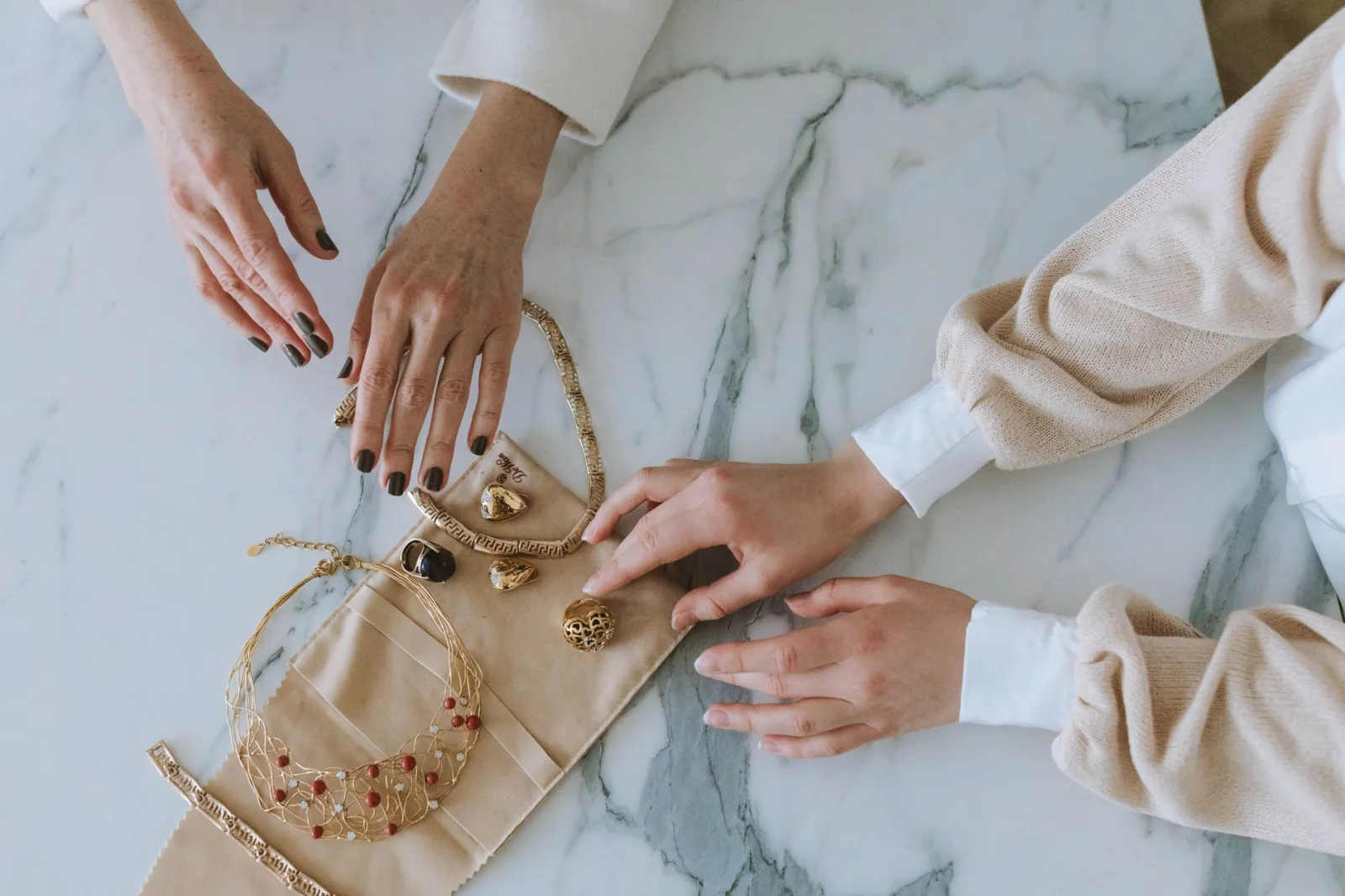
To decide how to organise them, check whether the pieces can touch inside the case, whether they have protruding elements and whether one might press against or rub another when moved. Keeping them apart is especially useful when you do not know the materials’ relative resistance: instead of assuming one stone will protect another, you avoid direct contact.
Checking clasps and settings addresses a different risk. A clasp can affect whether the jewellery stays fastened during wear; a setting holds the gem. Looking at these parts helps you notice that they may need attention, but a visual inspection alone does not confirm that a setting is properly secured. If something looks loose or has changed, treat that observation as a reason not to assume the piece is securely held.
Pearls call for specific precautions
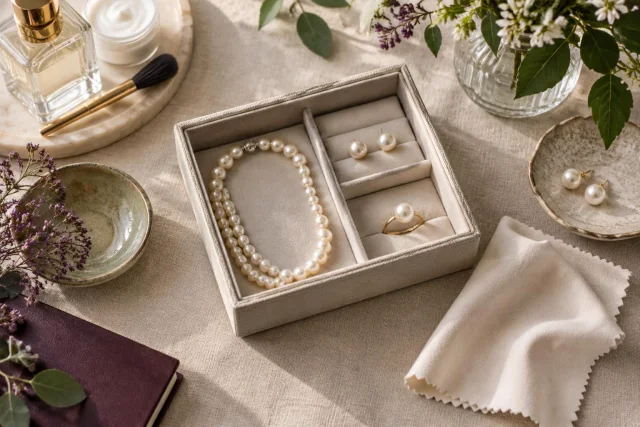
With pearls, contact with cosmetics and exposure to heat are factors worth considering. That caution should not become an undifferentiated rule for all gems: each material and treatment may have different vulnerabilities. Information about pearls highlights one specific consideration; it does not identify other stones or establish a general cleaning method. [2]
In practice, if a piece includes pearls, consider exposure to cosmetic products and sources of heat separately, alongside storage and the condition of the setting. Do not infer a specific tolerance or suitable cleaning product just because the piece looks durable. If details about its composition or care are unknown, a general recommendation will not resolve that uncertainty.
A watch is not a care manual for jewellery
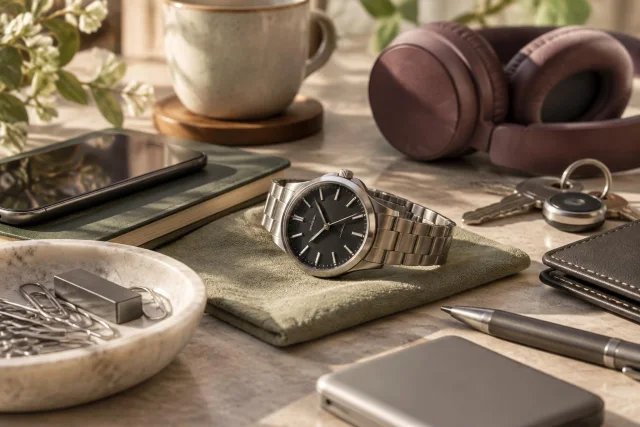
Documentation for a watch can be useful in showing why care depends on the product, but its instructions apply to that specific watch and the entity that publishes them. In Tissot’s case, the precautions cover strong magnetic fields and explain both the nature of water-resistance testing and the ageing of seals. These points belong to its watch documentation; they do not provide instructions for gemstone jewellery. [1]
This distinction also helps avoid extrapolating from one watch to another. Limits, service intervals, warranty conditions and related procedures for a brand or model do not automatically establish what to do with a different watch. Much less do they identify the gem, treatment or setting of a piece of jewellery.
A shared category does not mean shared instructions. For a watch, consult the documentation applicable to the specific model. For jewellery, look for information about that piece or guidance that takes its materials into account. A technical instruction may be rigorous within its scope and still be irrelevant outside it.
A useful checklist before deciding
Before cleaning, storing or wearing gemstone jewellery, gather the information that could change your decision:
- What is known about the gem: its identification, if confirmed, and any documented treatment.
- What parts make up the piece: the gem, setting, mount and clasp, insofar as they are known.
- What exposure is a concern: rubbing, impact, heat, cosmetics or another environmental condition.
- Which instructions apply specifically to the jewellery: avoid transferring recommendations from another gem, another piece or a watch.
- What you can observe about how it is held: distinguish looking at a clasp or setting from professionally confirming that it is secure.
The checklist does not determine a cleaning method or replace specific information. Its value is in organising the question: what risk am I trying to reduce, and what do I actually know about this piece? If your answer depends on identifying the gem or its treatment, it is worth resolving that uncertainty before choosing a method.
Caring for gemstone jewellery starts with distinguishing its vulnerabilities, not applying a universal formula. Keeping pieces apart, checking clasps and settings, and taking special care with pearls’ exposure are concrete principles; choosing a cleaning method, by contrast, requires information about the particular piece. That distinction keeps each recommendation within what can genuinely be supported.