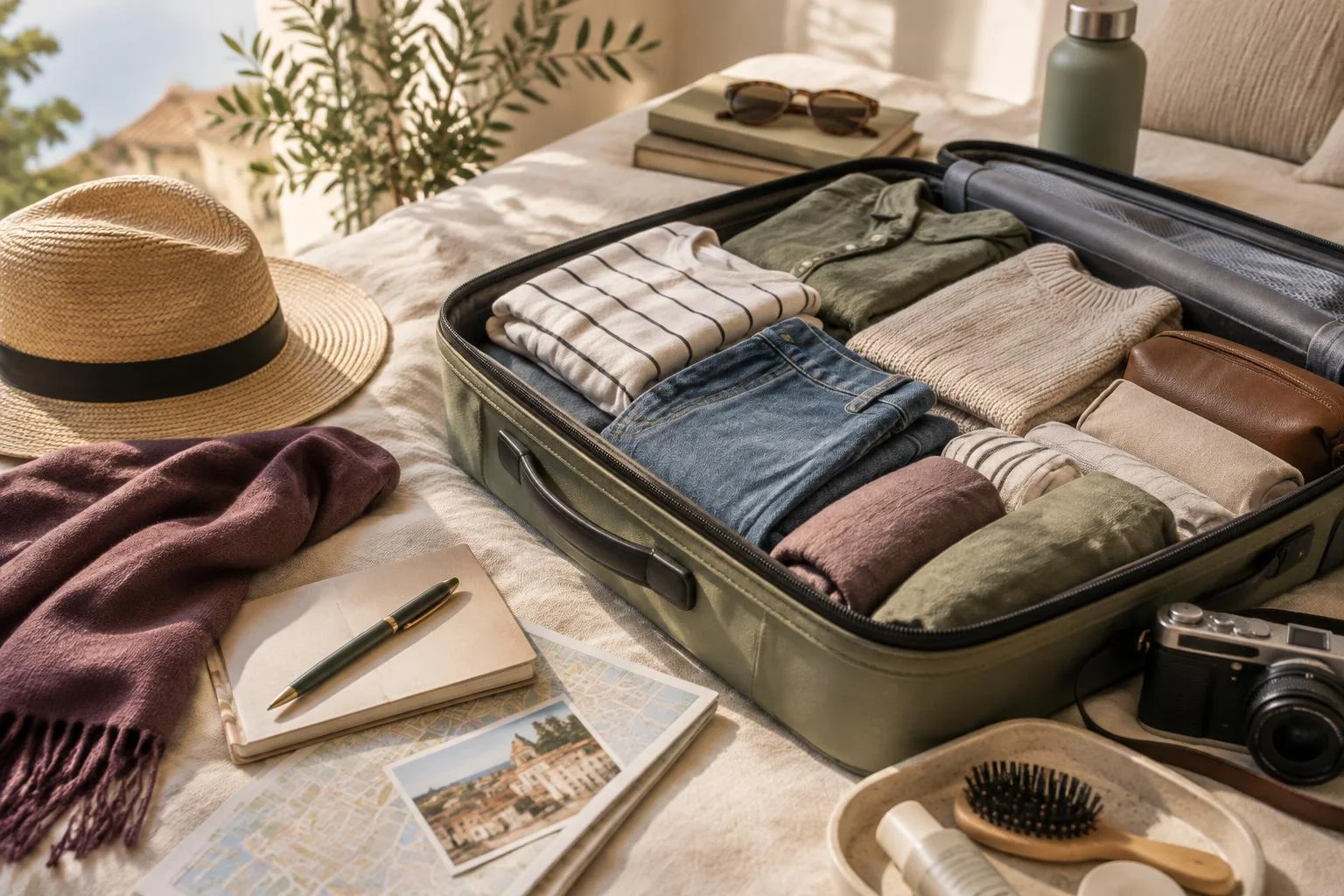
The useful question is not only what to bring, but what is worth deciding before packing and what needs to be checked with the airline and airport. For a trip within the EU, clothes, activities and personal needs can be planned in advance; the size and amount of cabin baggage depend on the specific transport conditions, while restricted items should be checked for the relevant airport. There is no universal allowance that can replace those checks. [1]
The most practical way to avoid confusion is to work on two levels: first, prepare a personal list that suits the trip; then, verify that the luggage and its contents meet the applicable conditions. A light-packing proposal can offer inspiration, but it does not make a fixed number of garments a rule for every person or destination. [2]
Decide what your trip needs before choosing a suitcase
Start by describing the trip, not by copying someone else’s list. Duration matters, but it is not enough: needs also change if the destination has a different climate, if there are outdoor activities, meetings or plans that call for other clothes, or if you will be able to do laundry during your stay. The list should answer to specific occasions, not to a predetermined number of garments.
A brief outline can help turn your itinerary into clothing decisions:
- Activities: note what you will do and whether any activity calls for specific clothes, footwear or accessories.
- Weather: check the forecast close to departure and consider layers that can be adjusted to expected conditions.
- Laundry: count on this option only if it will genuinely be available during the trip.
- Personal needs: reserve space for work, accessibility, equipment or anything that cannot be replaced with a generic alternative.
This exercise avoids two extremes: bringing clothes “just in case” without an identifiable purpose, and relying on a pared-down list that overlooks the actual reason for the trip. A trip of the same duration may call for different combinations if the weather, activities or opportunity to do laundry change.
Build outfits that work together
With the activities clear, choose garments that serve a purpose and can form more than one outfit where practical. Rick Steves’s list includes mix-and-match clothes, layers and personal items, along with optional pieces chosen according to the needs of the trip. It is a personal light-packing proposal, not a universal number or proof that the same selection works for everyone. [2]
Try the idea with clothes you already own. Write down two or three possible combinations for the planned activities and see whether one garment can serve more than one. If you add a layer, a formal piece or a second pair of shoes, ask yourself what specific situation it addresses. An extra piece is justified by its use, not by meeting a style quota or the pressure to minimize luggage as much as possible.
Coordination can matter more than quantity, too. A useful layer may adapt to more than one situation; by contrast, a garment chosen for just one vague possibility may not be worth the space it takes up. The decision depends on the trip and the traveller’s needs, not on whether an editorial list looks tidier with fewer pieces.
Keep your personal list separate from cabin-baggage conditions
A clothing list does not determine what baggage the journey accepts. In the EU, cabin-baggage size and quantity limits should be checked with the specific airline and ticket conditions. The institutional information for travellers points to those conditions rather than establishing an allowance that applies to every airline. [1]
Before closing your suitcase, find the current conditions that apply to your booking. Check both the measurements and the permitted quantity, and confirm which piece those conditions refer to. If you are carrying more than one bag or a bulky item, do not assume that everything is counted in the same way: use the information that applies to your ticket and airline.
Measure the luggage you will actually take and compare it with those conditions. A suitcase advertised as cabin size, or one that worked on another trip, does not prove that it meets the rules for this booking. If you cannot verify this, do not finalise your list on the assumption that the bag will be accepted.
The check may change your clothing decisions. If the available space is smaller than expected, revisit your outfits and remove additions without a clear purpose first; do not automatically remove what is needed for an activity, a personal need or work. If the permitted baggage leaves enough room, there is still no need to fill it by default: the selection should continue to suit the trip.
Check items against the airport’s conditions
Suitcase size and the items you can carry are separate checks. Restrictions on items should be checked for the relevant airport and in line with the conditions that apply to your journey. The European institutional reference directs travellers to airport conditions for this check; a personal packing list or a previous experience does not replace them. [1]
Carry out a specific review of the contents before closing your bag:
- Identify items that may be subject to restrictions and consult the relevant airport information.
- Check the specific requirements affecting the items you plan to carry, rather than relying on a rule remembered from another trip.
- Also review any relevant changes to transport conditions before departure.
Do not apply a rule from one airline, airport or previous trip to a different context. Nor should you treat general baggage guidance as an answer for a specific item if it does not cover that case. When a belonging has special transport conditions, look for official, relevant information about it. Medicines and their transport conditions require appropriate professional and official information; this guide does not offer clinical advice.
Make a functional list, not a fashion-category list
A personal list helps you check that essentials are planned without dictating how many garments everyone should bring. You can organise it by function: clothes for activities, layers for the weather, necessary footwear, personal items and accessories you will genuinely use. Steves’s proposal includes different categories and options, but its value lies in the selection criteria, not in turning the list into a mandatory template. [2]
For each optional item, ask a specific question: what plan, need or condition makes me bring this? If the answer is “maybe”, consider whether that possibility matters and whether another piece could already serve the purpose. If the item meets a work, accessibility or personal-equipment need, do not remove it just to fit an abstract idea of light packing.
A simple list might group:
- Documents and reservations you need to have available.
- Clothes and footwear linked to planned activities.
- Necessary personal items and accessories.
- Items that require a specific transport check.
This is not a universal contents list or a recommendation about quantities. It is a structure for spotting anything forgotten and separating clothing decisions from transport checks.
Close your suitcase with one last check
Before leaving, review your booking and the airline’s current conditions; measure the piece you will take and compare its size and quantity with what is permitted. Then check restricted items against the relevant airport information. These checks answer different questions, so completing one does not mean the other is done as well. [1]
Finally, revisit your personal list: are outfits for your actual activities included? Is there a layer or pair of shoes that addresses a specific need? Is there an addition without a clear purpose? Are essential items accounted for? If you need to reduce volume, return to the list rather than removing pieces at random. The aim is luggage that suits you and meets the conditions you have checked, not proving that every trip can be made with very little.
When you return, note what you used and what you missed. This review may help you tailor a future list to your own circumstances; it is a practical suggestion, not proof that one formula works for other trips. That way, planning starts with the itinerary, is completed with the specific transport rules and leaves room for needs that need not look like anyone else’s.