Six study strategies
Megan Smith and Yana Weinstein present six learning strategies on The Learning Scientists: spaced practice, retrieval, elaboration, interleaving, concrete examples, and dual coding. They also note that the amount and limitations of the evidence are not the same for all of them. That distinction matters: a list of strategies can inspire decisions, but it is not a universal recipe for mastering a hobby.
This article offers a simple editorial adaptation, not an academic evaluation. It is suitable for content you want to remember—for example, vocabulary in a language, the names of techniques, or concepts related to an activity—and does not replace the practice specific to each discipline. The central idea is to alternate periods of study with attempts to recall, check the answer, and decide what would be useful to review next.
The six strategies offer different starting points. Here, retrieval means trying to bring something learned to mind; spaced practice means returning to content on separate occasions. The other four—elaboration, interleaving, concrete examples, and dual coding—are also part of the framework, although the available information does not justify attributing identical effectiveness to them or turning them into precise instructions for every hobby.
Turn a session into a useful question
To apply the idea without complicating the activity, choose a small portion of content and formulate a question you can answer without consulting the material. There is no need to design a test. A specific question helps identify what you are trying to remember: the meaning of a word, the name of a technique, or an explanation of a concept.
Then set the source aside and try to answer in your own words. Next, return to the book, notes, or reliable resource you chose and check your answer. If something is missing, note what you need to consult again. That result is practical information about the content, not a score for your ability or a label for how you learn.
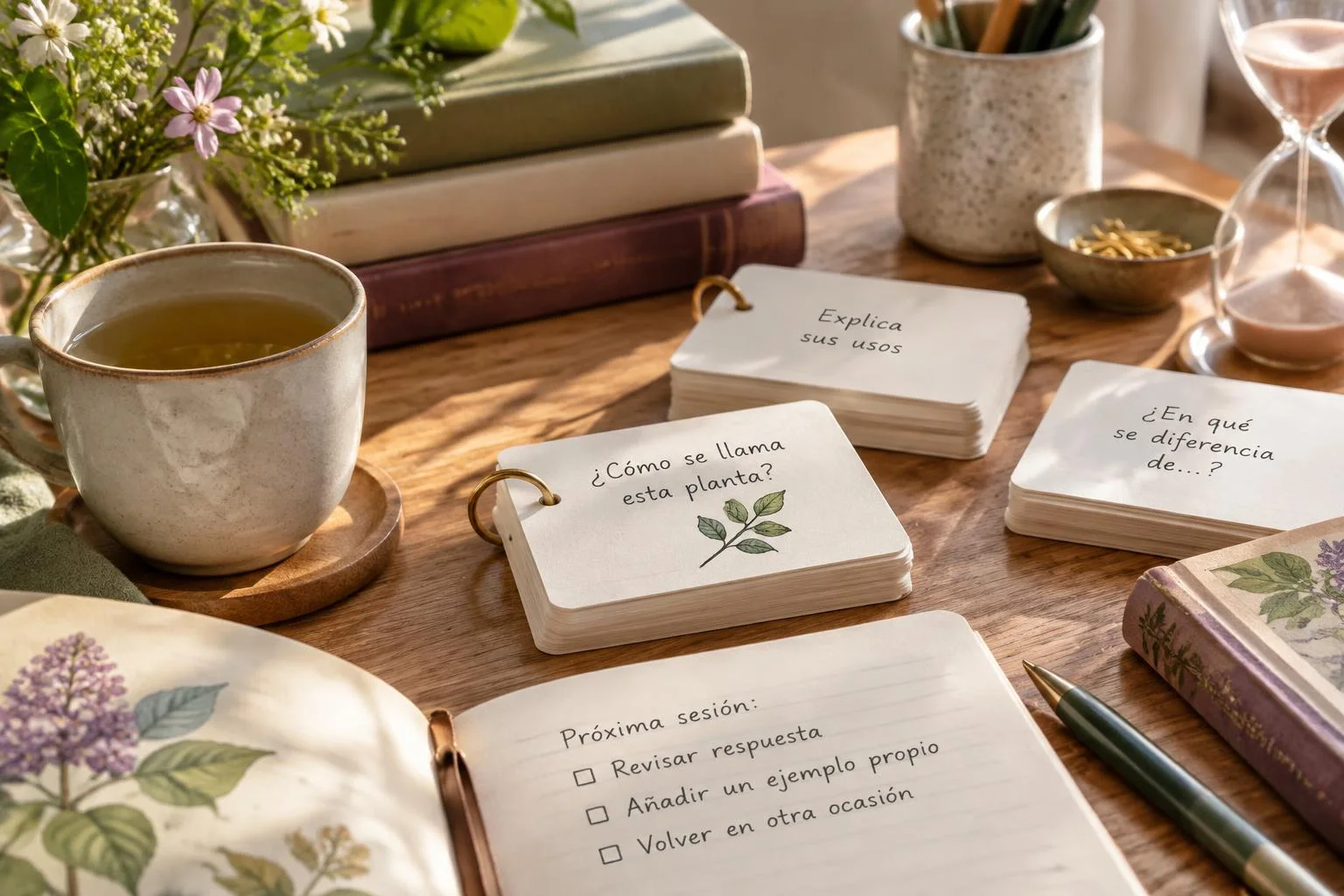
Editorial example: if you are learning vocabulary, a flashcard can show a word on one side and leave space for you to try to recall its meaning on the other. Then check the answer in the material you are using. If you cannot remember it, you can review that word another time. The example illustrates one possible application; it is not a guarantee of learning or a recommendation supported as the sole method.
This sequence is more useful when the question has an answer that can be verified. If the subject allows for several interpretations, you can write down which part is your own opinion and which part comes from the source. Separating them helps avoid confusing a personal explanation with a verified fact, and makes it easier to return to the content with a specific question.
Use a flashcard as a map, not a scorecard
A brief flashcard can bring together three elements: the content you worked on, a question to answer without consulting it, and a reliable link for checking the answer. If useful, add an example of your own, clearly identifying it as yours and keeping it separate from the original material. The flashcard organizes your next review; it does not need to become an exhaustive record of every session.
Editorial example: for a hobby that includes the names of techniques, the flashcard could list the name you want to remember, a question such as “What does this technique describe?” and the link or reference where you can check it. If your answer does not match, note which detail you will look at again. There is no need to add a numerical score or compare your result with someone else’s.
It helps to make the question specific enough to check. “What did I learn?” may be too broad; asking for a definition or the difference between two terms usually gives your attempt clearer boundaries. If a question stops being useful because it no longer guides your review, you can replace it. The flashcard serves your curiosity, not the other way around.
Return to the topic on separate occasions
Spaced practice is one of the strategies presented in the framework, and it inspires another adaptation: returning to content on different occasions instead of limiting yourself to rereading it repeatedly in a single session. The guide does not set optimal intervals or durations, because the available information does not offer specific guidance for every person, hobby, or topic.
In everyday practice, you can end a session by leaving a question for next time. When you return, try to answer before opening your notes, then check the result. If the question feels too easy, change it to one that asks you to explain a relationship or recall a step. If you get stuck, consult the material and choose a more manageable question for another time.
Editorial example: after reading about several concepts related to a hobby, you can note which one you would like to explain without looking. In a later session, try to reconstruct the explanation and check which details are missing. This example prescribes no schedule: when you return to the topic depends on your routine and what you are learning, without presenting it as an optimal interval.
The goal is to create simple continuity. A well-chosen question may be enough to pick up where you left off without rereading everything from the beginning. If an activity starts to feel like an obligation to complete flashcards, it is reasonable to reduce them or stop using them. A useful tool should help sustain your interest, not become another goal you have to meet.
Choose among six strategies without turning them into a recipe
The six strategies are options for thinking about how to study, not a list you have to apply in full. In this adaptation, retrieval and returning to the topic on separate occasions are the practical focus: try to remember and check; try again later. The other strategies are also part of the framework, but the available material does not specify how to adapt them to each hobby or allow us to declare any universally superior.
| Strategy | Practical question to help decide if it works for you |
|---|---|
| Spaced practice | Does it help to leave the topic and return to it another time? |
| Retrieval | Can I try to explain or remember something before consulting the material? |
| Elaboration | Is it useful to develop an explanation in my own words? |
| Interleaving | Does it make sense to alternate between the content I am reviewing? |
| Concrete examples | Does relating the topic to a specific example help clarify it? |
| Dual coding | Does representing the content in more than one way help me? |
The table offers editorial questions to help guide a choice; it does not describe guaranteed results or add technical instructions that are not documented. You can try one idea, keep it if it makes reviewing easier, and set it aside if it does not fit. You do not need to combine all the strategies to learn something about a hobby.
Distinguish what you remember from what you can do
Remembering a definition or the name of a technique is not the same as carrying out a manual, musical, or physical skill. A retrieval attempt may help you review concepts, but it does not by itself demonstrate that someone can perform an activity. Practical skills require forms of practice and guidance specific to each discipline.
Editorial example: knowing the name of a technique used in a hands-on activity does not, by itself, show how to perform it. A flashcard question can help you remember what the term means; to learn how to perform the technique, you may need instructions suited to that practice or specialized teaching. These are different goals, and it is best to choose a resource based on which one you want to address.
This distinction keeps the proposal within its scope: an informal way to review content you want to remember. It is not a method for assessing mastery of a skill, nor does it allow us to promise general benefits for health or creativity. If a hobby requires specific guidance to practise, seek instruction appropriate to that discipline rather than treating a flashcard as a substitute.
Checklist for preparing a gentle review
- Choose a specific piece of content you want to remember, not the whole hobby at once.
- Write a question you can try to answer without consulting the material.
- Use a reliable source to check your answer afterward.
- Note which part would be useful to review, without turning the result into a personal score.
- If helpful, add an example of your own and make clear that you created it.
- Leave a question to return to the topic another time, without imposing a universal interval.
- Adjust the difficulty: make it more specific if it feels too easy, or more manageable if you get stuck.
- Distinguish remembering information from performing a practical skill, and seek guidance specific to the activity where appropriate.
A flexible way to keep learning
The strategies Megan Smith and Yana Weinstein present offer a vocabulary for thinking about learning; they are not a template that promises mastery of any hobby. A modest adaptation can begin with a question, an attempt to remember, a check, and another opportunity to return to the topic. The suggested flashcard helps organize that cycle, but it is optional and can be as simple as a note.
The important thing is for each decision to have a clear purpose: know what you want to review, check it against a reference, and decide whether it is worth returning to. You can change the questions, stop using the flashcard, or return to reading if that is more useful to you. This way, practice retains its place within the hobby: a way to nurture your interest, not a race to perform.