




What the product information says—and what it doesn’t
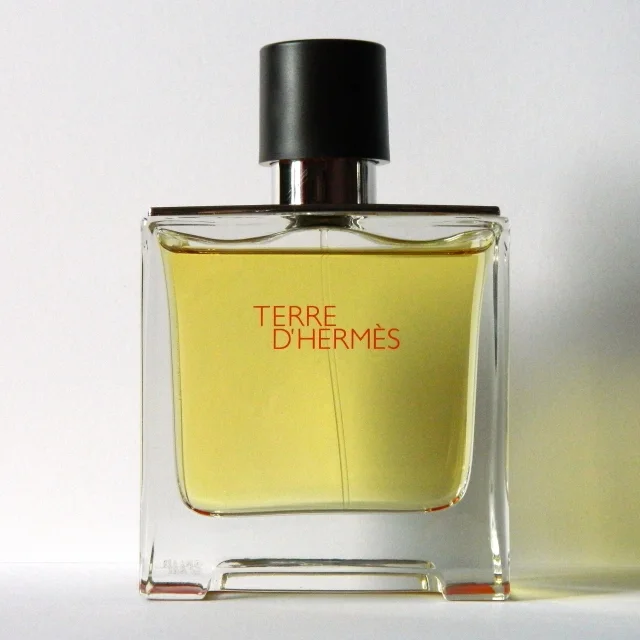
Terre d’Hermès Eau de toilette is presented as a mineral and woody fragrance, with grapefruit, cedar, and flint highlighted. These details describe how this particular version is communicated. The product information documented here does not offer a universal description of what every person will perceive or allow you to predict how long it will last or how it will project when worn.
The distinction matters because perfume descriptions mix recognizable names with evocative language. Grapefruit and cedar can shape an olfactory expectation; “mineral” suggests a character or association; flint appears as a highlighted note. None of these mentions should, on its own, become a complete ingredient list. In particular, highlighting flint does not establish that flint is present as a material in the formula.
To read the product information critically, it helps to separate three layers: the commercial identity, the olfactory story, and the impression a person forms when trying the fragrance. All three can be useful, but they answer different questions. The name tells you what to look for; the description presents how the fragrance is communicated; trying it yourself lets you see whether you find the proposition pleasant or interesting.
Identify the version first
“Terre d’Hermès” may function as a general name in conversation, but the product identified here is Terre d’Hermès Eau de toilette. Before comparing descriptions or searching for a fragrance, check the full name and concentration shown in the product information or on the packaging you are consulting. This helps you avoid attributing information to a version that the available material does not document for it.
This step does not require you to know complex perfumery categories. Simply read the name carefully and keep it with your notes or when asking about the product. If the description you are reading is for Eau de toilette, do not assume it automatically explains another presentation that shares part of the name. The information confirmed in this article is limited to the version identified in U.S. product information.
Editorial example: imagine someone mentions Terre d’Hermès in a conversation, and you find a product page titled Terre d’Hermès Eau de toilette. You can write down the full name before comparing your impressions. If you are shown another presentation later, check its name again instead of assuming the highlighted notes and description are identical. This example suggests a way to organize your search; it does not claim that specific differences exist between versions.
What “mineral” might mean
“Mineral” is part of the language used to present the fragrance. It is not a measurement or a promise that everyone will recognize the same scent. Nor does it require you to interpret the term in just one way. For one person, it may evoke a dry association; another may not find a clear word for their impression. These responses are matters of perception and vocabulary, not proof that someone has misunderstood the product information.
An olfactory description can be a starting point, not a test. Instead of asking yourself whether you correctly detected a note, you can explore what feeling the overall fragrance evokes and whether you are interested in paying closer attention to it. If “mineral” feels abstract, set it aside for now and describe what you can put into your own words, even if that is “I like it,” “I find it hard to name,” or “I want to smell it again.”
Editorial example: before trying it, you could write down what the word “mineral” suggests to you, without looking for an official answer. Then, if you have the opportunity to try it, note whether your impression matches, changes, or does not help you describe it. The exercise compares your expectation with your perception; it does not attempt to prove what the term means to everyone.
Highlighted notes are not the same as ingredients
Grapefruit, cedar, and flint are the notes or associations highlighted for Terre d’Hermès Eau de toilette. These mentions describe the fragrance; saying that a note appears in its olfactory story is not the same as claiming that a particular material is included in the formula.
This distinction is especially clear with flint. Its appearance among the highlighted notes does not establish that the product contains flint as an ingredient. The word may function as part of the descriptive language; the evidence available here does not allow it to be turned into a claim about material composition. It is also best not to present the three mentions as an exhaustive account of every element in the formula.
Editorial example: if someone asks, “Does it contain flint?”, an answer faithful to the available information would be: “Flint is highlighted in the description, but that mention does not confirm that it is an ingredient.” This preserves the useful detail without going beyond what the product information supports. The same care applies to grapefruit and cedar: you can explain that they are highlighted without turning the description into a complete composition list.
Turn the description into personal questions
The product information can help you prepare to try the fragrance without dictating what you should feel. Before smelling it, decide what you want to find out: whether the highlighted associations appeal to you, whether the mineral language makes you curious, or whether you would rather trust your first impression. Having a simple question makes the experience more useful than trying to recognize every note at once.
Afterward, use your own words. You can distinguish what you expected from what you perceived, and leave room for an uncertain answer. If you smell it again at another time, record that impression separately rather than forcing yourself to stick with the first one. The product information does not establish a correct answer or let you infer how it will perform on your skin; this method helps you organize your observations, not predict results.
Editorial example: a brief note could say: “Before trying it, I expected something I associate with mineral; when I tried it, I couldn’t identify that idea, but I can still say whether the overall fragrance interested me.” This sentence separates expectation from experience without pretending to be precise. It is also valid to note that a word in the product information does not help you, or that you need more than one occasion to decide whether you want to explore it.
A practical comparison of the three layers
| Layer | What you can record | What not to conclude |
|---|---|---|
| Name and version | Terre d’Hermès Eau de toilette, as identified in U.S. product information | That a description available here automatically covers another presentation |
| Descriptive language | Presented as mineral and woody, with grapefruit, cedar, and flint highlighted | That these words predict the same impression for everyone |
| Personal impression | Your associations, uncertainties, and preferences when trying it, if you have the opportunity | That an individual perception confirms the composition or general performance |
The table is not intended to classify the fragrance or assign it a score. Its purpose is to make clear what kind of information you have in front of you. If a brand statement and your impression do not match, there is no need to force them into equivalence: you can keep both as separate observations.
A checklist for before and after trying it
- Check that you are consulting information for Terre d’Hermès Eau de toilette, the version identified in the material used here.
- Remember that “mineral” and “woody” are descriptive terms, not measurements of your perception.
- Note the mentions of grapefruit, cedar, and flint as descriptive elements.
- Do not interpret flint as a confirmed ingredient or the highlighted notes as a complete list of the composition.
- Before trying it, write down an expectation or a question of your own, if that is useful to you.
- When trying it, describe what you perceive in your own words; you do not need to recognize every note.
- If you decide to smell it again, record the new impression separately and compare without looking for a supposedly correct answer.
- Decide whether the description helps you explore the fragrance, without inferring longevity, projection, or compatibility with your skin from the product information.
What the available information allows us to conclude
The documented information is for the U.S. market. It identifies Terre d’Hermès Eau de toilette and presents it as a mineral and woody fragrance, with grapefruit, cedar, and flint highlighted. It does not document a use test, a professional evaluation, or observations from other people. Therefore, it cannot support claims about longevity, projection, compatibility with a skin type, or a universal wearing experience.
The practical conclusion is simple: use the notes to understand the descriptive story, not to impose an interpretation on your experience. Verify the version, distinguish olfactory associations from ingredients, and let trying it yourself answer the question that really matters to you: whether you are interested in how you perceive this fragrance. The description can open up that exploration; it does not have to decide for you.