




A perfume can suggest a landscape
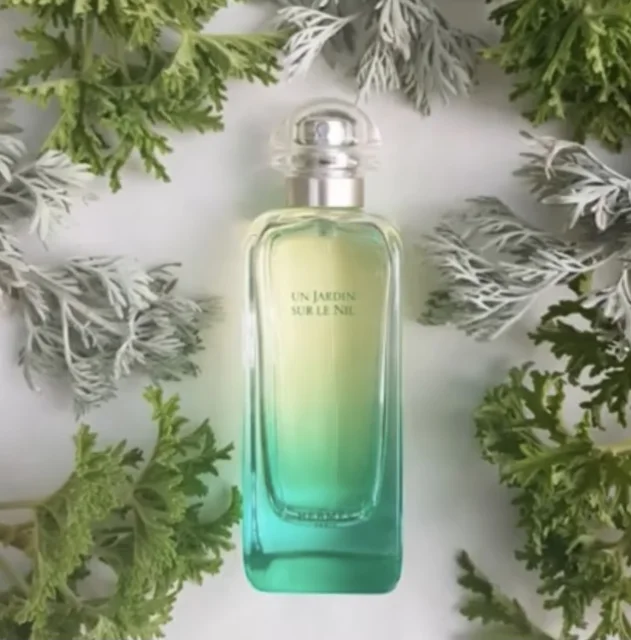
A perfume description does more than introduce a fragrance: it also offers a way to imagine it. In the case of Un Jardin sur le Nil Eau de toilette, the olfactory story is set on the garden islands of Aswan and highlights three references: green mango, lotus and sycamore wood. These are details from the product’s official presentation, not a travel account or a complete explanation of the formula.
That distinction is useful when reading about a perfume attentively. The product page separates its narrative description from the ingredient list. So the words that evoke a garden and those that identify formula components belong to different registers. An association can help guide the imagination without, by itself, saying which specific substance produces a sensation or how the perfume will behave on a person.
Three references, three points of entry
Green mango, lotus and sycamore wood make up a small narrative vocabulary. They can be read as references pointing, respectively, to ideas of green freshness, a floral dimension and a woody presence. This is an editorial interpretation of the chosen words, not a verified sensory description of how the product develops.
The distinction matters because the names evoke familiar objects. On reading “mango,” someone might imagine a ripe, sweet fruit; the word “green” shifts that expectation and suggests a different association. “Lotus” may suggest an aquatic landscape or a floral image, while “sycamore wood” introduces a botanical and material reference. None of these images, on its own, allows you to deduce the exact scent, its intensity or the order in which its facets might be perceived.
Editorial example: before trying a fragrance, a reader might note “green: fresh; flower: aquatic; wood: dry.” The note does not predict how the product smells. It helps identify the ideas the words evoke and distinguish them from impressions that may arise later, if the reader decides to try it.
The evoked place is not a documented visit
The reference to the garden islands of Aswan is part of the house’s story. It can provide a visual and emotional frame for reading the description: water, vegetation and a specific place come together in the imagination. But the page is not evidence that the person writing or recommending it has visited that landscape, nor does it make the perfume a geographical guide.
It is also worth avoiding the assumption that the evocation proves a literal correspondence. The place name and botanical references tell us how the product is presented; they do not document a scene observed on location. Nor are they a travel recommendation. For someone choosing a fragrance, the most practical approach is to treat the place as part of the narrative and ask whether that frame appeals to them, without expecting it to function as a description of a real experience.
Editorial example: if the story of Aswan sparks curiosity, that reaction can be noted as an affinity with the concept. If the main criterion is how the perfume is perceived, it is best to keep that question separate and base the impression on a personal test, not on the place name.
Narrative notes and ingredients answer different questions
The description of green mango, lotus and sycamore wood speaks the language of evocation. The ingredient list, which the official page presents separately, is a different kind of product information. A technical list should not be replaced with the words used to tell an olfactory story, and those words are not a chemical recipe.
This distinction helps frame more precise questions. “What landscape is the description trying to suggest?” can be answered by reading it. “Which ingredients appear on the list?” requires consulting that list. “How will I perceive it?” can only be answered through personal experience, if you decide to try the fragrance. These questions are related, but they are not interchangeable.
The available material lets us describe the perfume as an evocation of the garden islands of Aswan and note the three references. It does not establish a detailed formula, describe performance, predict how it will develop on skin or offer an independent sensory assessment. Keeping within that limit does not diminish the story’s value: it simply clarifies what kind of information it provides.
A practical comparison to organise your reading
| Aspect | What it offers | How to use it when choosing |
|---|---|---|
| Place narrative | The fragrance evokes the garden islands of Aswan. | Ask whether that narrative frame interests you, without treating it as a documented visit. |
| Olfactory references | Green mango, lotus and sycamore wood are highlighted. | Translate each word into your own expectations and keep them as hypotheses. |
| Ingredient list | The ingredient list appears separately from the narrative description. | Consult that section when you need information about the declared ingredients. |
| Personal impression | A personal impression is not established by the story. | Record your own perception separately if you try the perfume. |
| Choosing for a collection | The choice depends on each person’s criteria. | Decide what matters most: the concept, the associations or the experience of trying it. |
The table does not classify the perfume or assign performance qualities to it. Its purpose is to separate sources of information and turn that distinction into a simple reading guide.
Questions that can help you decide
You do not need to decide first whether a description is literally “accurate.” It may be more useful to identify what you are looking for and what kind of evidence you need to choose.
- Are you drawn to the narrative combination of green, floral and woody references, or do you prefer a description centred on other associations?
- Does the story of the garden islands add interest for you, or is it a secondary detail compared with the impression of the perfume?
- Do you want to know the concept, the declared ingredients or how it feels to try it? These are different reasons to consult different information.
- If you already know other fragrances from the Un Jardin line, would comparing their official descriptions be useful? Keep comparisons between texts separate from any sensory comparison you have not made.
- What would you note before trying it, and what would you change afterwards? That difference can help you recognise the weight of your expectations.
These questions are an adaptable editorial tool, not a purchase recommendation. Their purpose is to prevent the appeal of a story from being confused with a promise about how the fragrance will perform.
A brief note-taking approach
You can use a simple personal note without assigning scores or trying to predict results. First, write down the three references as they appear on the page: green mango, lotus and sycamore wood. Then, write beside each what it suggests to you. That first note records expectations, not verified characteristics of the perfume.
If you decide to try it, add a second part in your own words: what impression it left and whether that matched what you imagined. You do not need to use the vocabulary in the narrative or turn a subjective impression into a universal description. If you do not try it, the note can still help you assess the concept and narrative alone.
Editorial example: a note might say: “Before: I expect a green, botanical image from the mango and sycamore. After: I’ll record only what I personally perceive.” The first sentence describes an expectation; the second sets out a method for not presenting it as fact. It does not attribute any particular development, longevity or intensity to the perfume.
Checklist for reading the description critically
- Identify the claims: the link to the garden islands of Aswan and the three highlighted references.
- Treat the note names as part of a narrative, not as an ingredient list.
- Consult the ingredients section separately when that is the information you are looking for.
- Separate the image of the place from any real travel experience.
- Note your associations before trying the perfume if you want to recognise the role of expectations.
- Record a personal impression only if you have had the opportunity to form one.
- Avoid deducing from the description how it will develop, how long it will last or what intensity it will have.
Conclusion: enjoy the story without confusing its purpose
Un Jardin sur le Nil Eau de toilette is presented through a story that brings together an evoked place—the garden islands of Aswan—and three references: green mango, lotus and sycamore wood. This concept allows you to imagine a landscape and may be part of the fragrance’s appeal. At the same time, it is not equivalent to a documented visit, a chemical recipe or a sensory experience shared by everyone.
Reading critically does not require dismissing the narrative. It is enough to recognise its purpose, consult the ingredient list separately and reserve personal impressions for your own experience. In this way, the landscape can enrich your approach to the perfume without becoming a claim about what it contains, how it develops or how it should smell to everyone.