



A toiletry bag is more than just a container
When organizing personal care products, it is easy to think first about space: what fits, what you use every day, and what can be stored separately. But being organized can serve another purpose too: helping you preserve the information that comes with each product. Knowing which container you have, which instructions apply to it, and where to check its identification means you do not have to rely on memory alone.
Follow the specific instructions for each product. Containers that allow direct contact with the contents also call for care when handling them with dirty hands. These are documented recommendations; the sorting and record-keeping suggestions that follow are practical editorial tools for using them at home, not an official protocol.
What information should stay with the product
The original packaging is not a decorative detail. It is what allows you to identify the product and consult the information provided for its use. If the contents are stored in another unidentified container, it may no longer be clear what the product is, which instructions apply, or which identifying details belong to it.
The safety assessment of a cosmetic is not limited to a list of ingredients: it also takes into account how it is applied, its labeling, and its intended population. This perspective helps explain why it is useful to keep the context of use with the product, rather than trusting that its name or appearance alone will be enough to identify it.
As a practical rule, try to keep the label and batch number legible when they appear on the container. Also keep the instructions for use associated with the product. If some information is on outer packaging that you plan to discard, first check whether you need to retain it somewhere accessible; do not assume that you will be able to reconstruct it later.
The original container as a reference
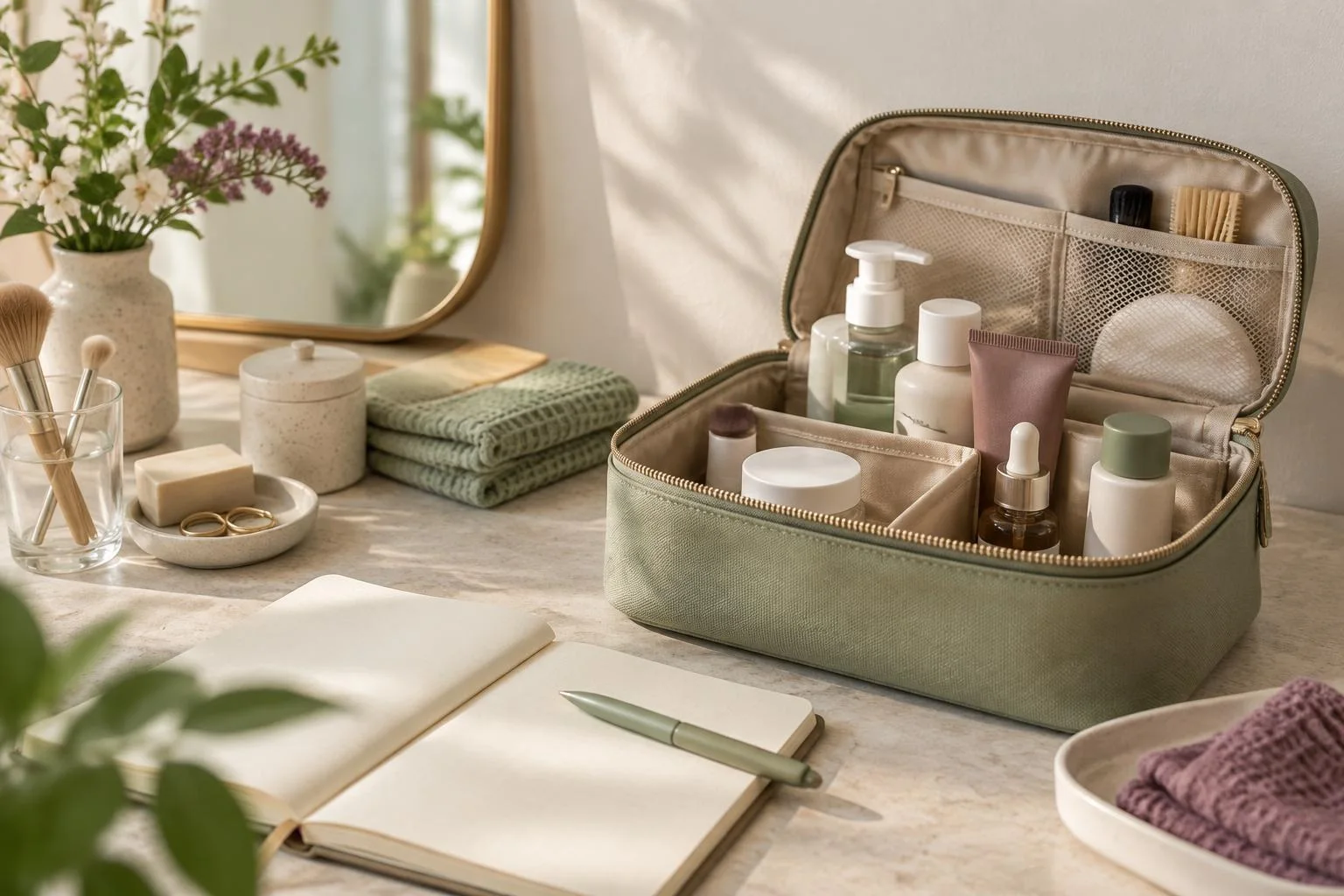
An organizer can separate products by use, size, or frequency, but it should do so without obscuring their identity. Keeping each product in its original container makes it easier to link the contents with the label and directions. If moving it is unavoidable because of space constraints, the editorial recommendation is not to leave the new container without clear identification and to keep the relevant original information separately.
This does not mean that every alternative container is automatically unsuitable in all circumstances: the available information does not establish that general rule. It does support the importance of following product-specific instructions and avoiding the loss of identification. So, when deciding what to do, start by checking what the product says rather than assuming that all products can be decanted or handled in the same way.
Editorial example: imagine storing a product in an unlabeled travel bottle. Although you may remember its name today, someone else might not recognize it, and later you could mistake it for another similar-looking container. A more organized option is to keep it in its original container if its directions allow, or to keep unmistakable identification and the information from the original packaging with the alternative container. This example illustrates an organizational practice; it does not claim that a specific system of household labels is recommended.
Keep instructions close at hand, not just in your memory
Routines change: a product may go unused for a while, move to a different shelf, or leave the toiletry bag for a trip. In these situations, remembering how to use it is less reliable than being able to consult the instructions that come with the product. The aim is not to create a complicated record for every item, but to avoid separating useful information or making it hard to find.
You can keep the containers you consult most often in one place and set aside an area for products you use occasionally. If you store documentation separately, clearly identify which product it belongs to. A note that just says “cream” or “cleanser” may not be enough if you have several products of that type; using the name shown on the container makes the connection clearer.
Editorial example: if you have two personal care products in similar-looking containers, place them in separate spaces or make sure their labels remain visible. The separation is a visual aid suggested by this guide, not a documented recommendation. Its practical value is that it reduces confusion when choosing which one to check or use.
Handling and applicators: organize without improvising
Containers that allow direct contact with the hands may be compromised by handling them with dirty hands. In practice, it is worth distinguishing between products and formats instead of applying one rule to the entire toiletry bag. Pay attention to how you access the contents and follow the container’s instructions.
If the product includes or requires a specific applicator, keeping it with the product helps preserve the connection between them. As an editorial suggestion, you could set aside a compartment or a clean bag for them, separate from other items. This is a useful household organizational choice for keeping the set together; it does not replace the manufacturer’s directions or add an official cleaning recommendation beyond the documented concern about contact with dirty hands.
The central idea is simple: do not handle the contents without considering the format and instructions. A container that opens one way does not necessarily need to be treated like another. Follow what is specific to each product, starting with its label and instructions rather than a general habit.
A short, useful household record
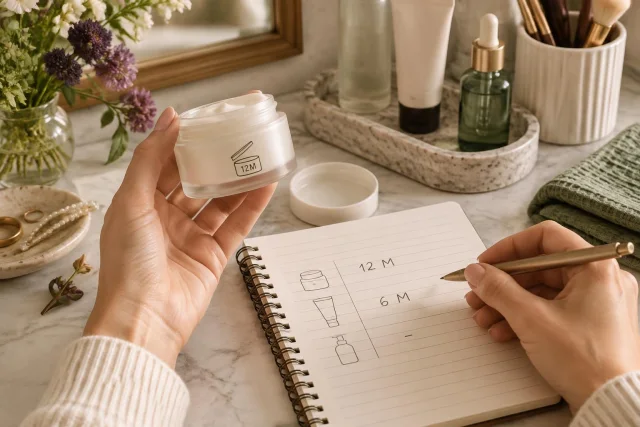
A record does not have to become a database. It could be a note on paper or a device that helps you identify the exact product, note its opening date if you choose to track it, and remember where to find its instructions. The opening date is a personal tracking suggestion in this guide’s approach; it should not be mistaken for a universal recommendation or a replacement for the information on the container.
For the record to be useful, each entry must be clearly linked to the product. You can use the name as it appears on the label and add a brief description of the format or where you store it if that helps you distinguish it. If you can no longer read the identification or do not know which container a note refers to, the record is no longer serving its main purpose.
Editorial example: a simple entry could say: “Name on the container: [name shown on the label]. Opened: [date I noted]. Instructions: check the original container.” The brackets indicate fields for each person to fill in; they are not product details or an official template. The value lies in making clear what you know and where you can confirm the rest, without inventing missing information.
Comparing organizational options
There is no single arrangement that works for every toiletry bag. The choice may depend on what you need to check, whether the containers remain identified, and how you access their contents. This table compares practical editorial criteria; it does not classify products by safety or represent an assessment.
| Organizational option | What it makes easier | What to check |
|---|---|---|
| Keep products in their original containers | Linking the contents with their label and instructions | That the information remains legible and accessible |
| Group by frequency of use | Quickly finding what you use regularly | That moving items does not hide the name or batch number |
| Keep applicators and other items separate | Keeping each accessory with its product | That the connection between them is not lost |
| Use a supplementary record | Remembering the identification and the opening date you noted | That each note corresponds unambiguously to the exact container |
| Transfer contents to another container | Adapting storage to a specific need | That the identification and relevant instructions remain connected |
The most organized option is not necessarily the one that takes up the least space. If a compact solution makes a label illegible or confuses two products, it does not solve the problem of preserving information. A simple separation, on the other hand, may be enough if it keeps the details visible and lets you recognize each container.
Checklist for reviewing your toiletry bag
You can use this list for an occasional review without turning it into a daily task. The questions are editorial tools for spotting organizational problems, not a professional assessment of the product.
- Can I identify the exact product from the information on its container?
- Can I check its specific instructions without relying on memory?
- Is the batch number still legible if it appears on the container?
- Have I noted the opening date, if tracking it is useful to me?
- Have I transferred any contents to a container without clear identification?
- Do I know which original information belongs to each alternative container?
- Do the applicators stay with the products they belong to?
- Have I considered how each format is handled, especially if it allows direct contact with the hands?
- Can I tell apart products with similar containers or names?
If any answer is “no,” start with the simplest adjustment: make a label visible again, put an instruction back with its product, or clarify an identification. You do not need to reorganize the entire toiletry bag to fix one specific mix-up.
Information limits and conclusion
This guide distinguishes documented good practices from editorial suggestions for storage and record-keeping. It does not determine whether a particular cosmetic is suitable for an individual or assess product combinations. Nor does it allow you to conclude that a product is safe or unsafe based on an isolated change in smell or color: a comprehensive assessment cannot be replaced by a household test based on a single sign.
An organized toiletry bag can work like a small archive, preserving the connection between a product, its container, and its directions. Keeping identification legible, instructions accessible, and applicators together are practical steps for preserving that context. The useful measure is not how many records you accumulate, but whether you can recognize what you have and check the specific information before using it. That way, being organized becomes more than a matter of space: it becomes a simple way to preserve the information that comes with each product.