



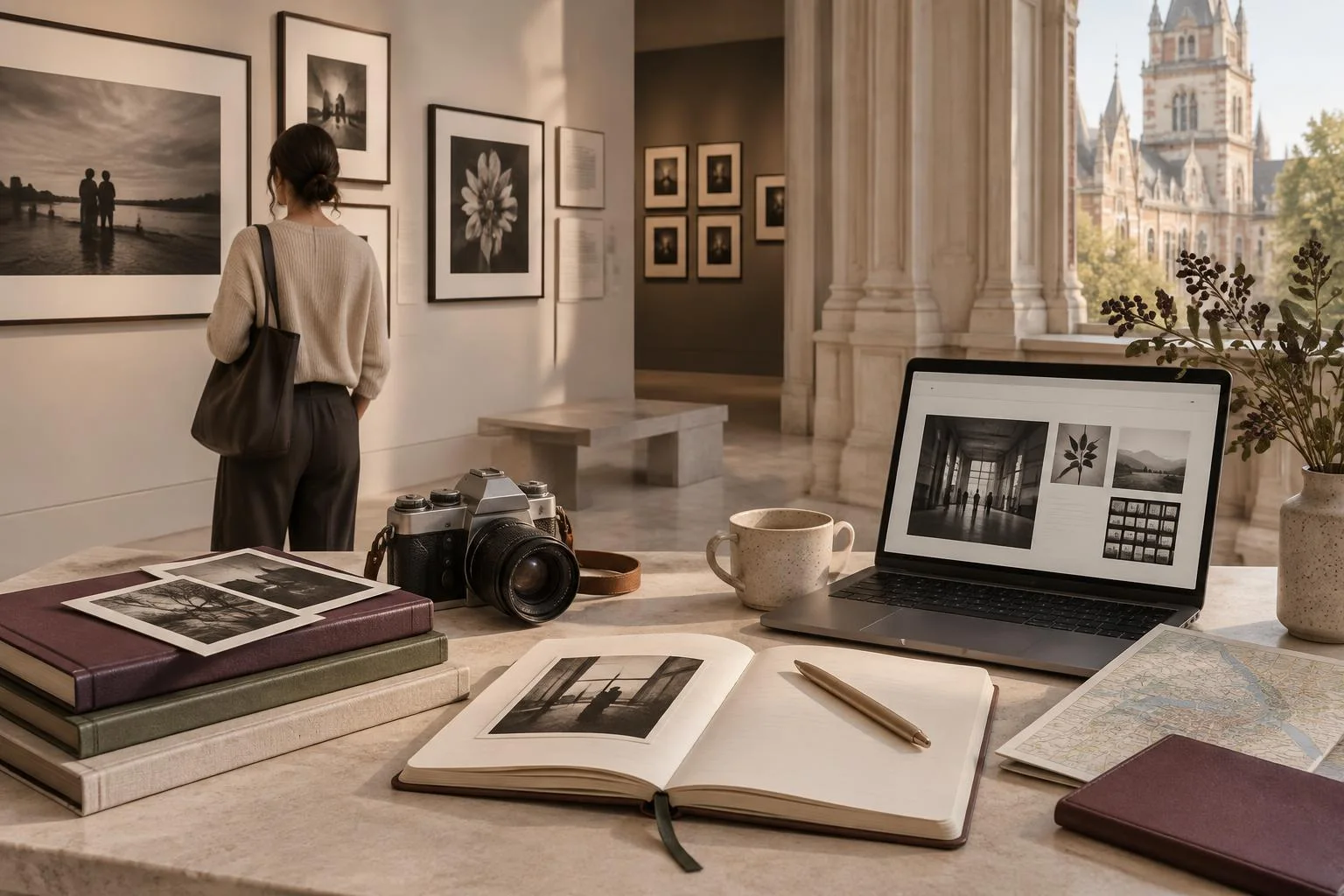
A Centre for Exploring Photography
The Victoria and Albert Museum (V&A) Photography Centre is in South Kensington, London, and is dedicated to the history and practices of photography. It brings together seven galleries, research resources and links to related activities. The Royal Photographic Society collection was incorporated in 2017.
These facts help explain the centre’s institutional scope, but they cannot predict which works will be on display on a particular date. The collection and the visible exhibition are different things: a work can be part of the holdings without being on view during a visit. For that reason, it is more useful to prepare a way of looking than to rely on finding a specific photograph.
This article’s proposal is simple: approach each image not only as a scene that represents something, but also as an object with particular material characteristics and a specific presentation. This shift in focus turns a visit—or a digital search—into a more attentive practice of observation.
From Scene to Object
When looking at a photograph, it is easy to focus on who appears, what is happening or what emotion the image conveys. The editorial question “what changes if I look at it as an object?” opens up other avenues: How large is it? What support does the museum mention? How does the work relate to its label and to nearby pieces?
There is no need to answer everything or attribute an intention to the photographer without evidence. The point is to separate what is seen from what is known. For example, an image may look old because of its tone or the clothing depicted, but its visual appearance alone does not confirm its date or technique. If the label identifies a process, it is best to use that term; if it does not, it is better to describe what is observed without turning an impression into a fact.
Editorial example: looking at a photograph of a street, you could first note what is visible—people, buildings, shadows—and then look at the edge, the stated size and the label text. The first observation describes the scene; the second helps consider the photograph as an object. This separation keeps interpretation open without inventing information about how it was made or its context.
Three Layers of Observation
To structure the visit, it can be useful to distinguish three layers. These are not official V&A categories, but an editorial tool for organising attention.
- The image: what appears and how shapes, people or spaces are arranged. It is best to describe before interpreting: “there is a figure in the foreground” is more verifiable than attributing an emotion or intention to them.
- The object: what material characteristics are mentioned, what dimensions are given and how the piece is presented. If this information is unavailable, you can note the question instead of guessing the answer.
- The information: what the label or digital record tells you about authorship, title, date or technique. Each fact should be attributed to the source that provides it, and missing information should not be filled in with conjecture.
Editorial example: when comparing two portraits, a visitor could first focus on the distance between the figure and the edge of each image, then check whether the labels provide information about their makers or techniques. The comparison does not need to decide which is “better”. It can reveal what questions each piece raises and what information can answer them.
Comparing Without Turning the Visit into a Test
Comparison helps you notice differences that might go unnoticed when viewing each work in isolation. To make it useful, simply choose one criterion at a time: scale, composition, the presence of people, the relationship between figure and background, or the information available on the labels. The aim is not to evaluate the quality of the photographs, but to recognise which elements can be described and which require more context.
| Criterion | What to observe | How to note it carefully |
|---|---|---|
| Scale | The relationship between the size of the image and the person looking at it | Record the dimensions if the museum provides them; do not infer them from a digital reproduction |
| Composition | The position of figures, lines and spaces | Describe where the elements are without attributing undocumented motives |
| Support | The material information given in the gallery or record | Use the museum’s terminology; leave the question open if it is not specified |
| Label | The information accompanying the work | Distinguish stated facts from personal questions or interpretations |
| Relationship between works | Visible similarities or contrasts between pieces | Explain what is being compared, without assuming an undocumented historical relationship |
The table works as a guide to attention, not as a form to complete in every gallery. Choosing a single point of contrast can be enough to give the experience a clear yet flexible direction.
Preparing for Access and the Programme
Before travelling, it is worth checking the V&A’s current information on opening, accessibility and the programme. These details can change; therefore, a documentary guide should not present hours, prices or activities as current information without checking them first. The Photography Centre page links to resources and activities, but specific availability should be verified on the museum’s website before planning the day.
It is also worth distinguishing between preparing and booking. Reading an information page can help you formulate questions, but it does not confirm a place at an activity or the presence of a work. Likewise, the fact that the centre has seven galleries does not allow you to anticipate how each exhibition will be arranged on a future date.
Editorial example: someone planning a visit around a photograph seen online can note its title and then check whether the museum’s information says it is on display. If no confirmation is available, they can keep the visit open to exploring other works instead of making the plan depend on a particular piece.
Using Digital Resources with Purpose
Digital resources make it possible to begin exploring before visiting the museum or to continue if travelling there is not possible. The Photography Centre’s online page can help with research and locating materials related to photography. A digital record can also help you prepare vocabulary and questions: what information it provides about a work, how it names a technique or what details are left unspecified.
An online search does not necessarily replace viewing a work in person. A reproduction can make it easier to examine the composition, but should not be treated as a sufficient reference for judging the actual size or materiality of a piece. This difference can become a productive question: what can be understood on screen, and what would need to be observed in person?
Editorial example: before visiting, you can read a record and write down a question about the image. Afterwards, if you find the work, compare the record with what you observe in the gallery. If it is not on display, the question is still useful for exploring another photograph or looking for additional information among the available resources.
Saving References and Respecting Their Context
At the end, it can be useful to save a few references with the maker, title and link, as well as a question to follow up on. Saving three references is an editorial suggestion for keeping a manageable selection, not a V&A guideline. If a record does not provide a maker or title, there is no need to fill in those details by deduction: note what it actually says and indicate what is missing.
Images available on a website are not automatically authorised for copying or reuse. If you want to include a photograph in a piece of work, publication or presentation, check the relevant credits and permissions for that resource. Being able to view it online and having permission to reproduce it are different matters.
Preparation Checklist
- Check the latest information on opening, accessibility and the programme.
- Choose a visual question, such as “what do I notice when I pay attention to size and support?”
- Decide whether to focus on one layer—image, object or information—or compare two pieces using a shared criterion.
- Separate visible observations from information provided by labels or records.
- Avoid inferring dates, techniques or intentions solely from the appearance of an image.
- Treat a digital record as a resource for preparing questions, not as confirmation that the work will be on display.
- Save references with the information the museum actually provides and check permissions before reusing images.
A Flexible Way of Looking
The V&A Photography Centre offers a documented context for approaching the history and practices of photography: it brings together seven galleries, research resources and related activities, and the Royal Photographic Society collection was incorporated in 2017. These facts help situate the centre, while the exhibition on view and practical details require up-to-date checking.
For someone preparing to visit, having a personal visual question can be more useful than making a list of works they hope to find. Looking at a photograph as an object means attending to the scene as well as the presentation, scale and information accompanying the piece, without confusing observation with certainty. And if the visit takes place at home, digital records make it possible to continue exploring using the same approach: note what is known, what is seen and what is worth investigating next.