Preparing a session that fits your visit
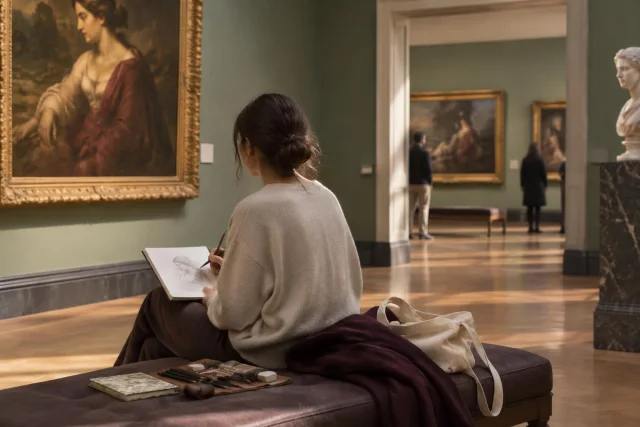
Drawing in a gallery can be a quiet way to observe an artwork, as long as the activity fits the venue’s conditions and the flow of visitors. At London’s National Gallery, the information consulted allows drawing under specific rules: paper or a sketchbook must not exceed A3 size; you must not spend more than ten minutes in front of a painting; and drawing is not permitted in entrances or passageways. The museum also lists the materials allowed and notes that staff may ask visitors to move when the gallery is busy.
These guidelines are a practical starting point, not an invitation to bring elaborate equipment or complete an artwork. A simple session might involve choosing one piece, observing a visual feature, and making a few notes. Before setting out, it is worth checking the official page to confirm the current conditions and avoid relying on rules remembered from an earlier visit or attributed to another museum.
Editorial example: Someone who wants to draw during part of their visit could prepare a sketchbook that does not exceed the permitted size and choose a pencil listed among the allowed materials. The final choice of material should be made by checking that list; do not assume that every commonly used tool is accepted.
Check the rules before filling your bag
Preparation starts with two separate questions: what size of support is permitted, and which materials are allowed. The information consulted sets a maximum size of A3 for paper or a sketchbook and provides a list of permitted materials. Since that list is not reproduced here, do not assume that a particular pencil, pen, charcoal, or other tool is authorized without checking it.
Bringing only a few things can make for a lighter visit, but this is an organizational suggestion, not an additional rule. The useful principle is to bring only what you have confirmed is permitted and can use without taking up unnecessary space. If the available information does not clearly say whether the material you want to use is allowed, the prudent option is to check the museum’s page before travelling rather than discovering the uncertainty on arrival.
The stated size applies to the paper or sketchbook. Do not turn it into an invented rule about the size of a bag or other items that the information does not mention. For this activity, simply distinguish clearly between what is documented and personal preparation choices.
Editorial example: Anyone who prefers to make only minimal notes can leave at home materials they do not plan to use and bring just the support and a permitted tool they have verified. This is a way to simplify what you carry, not a National Gallery requirement.
Choose a detail you can observe
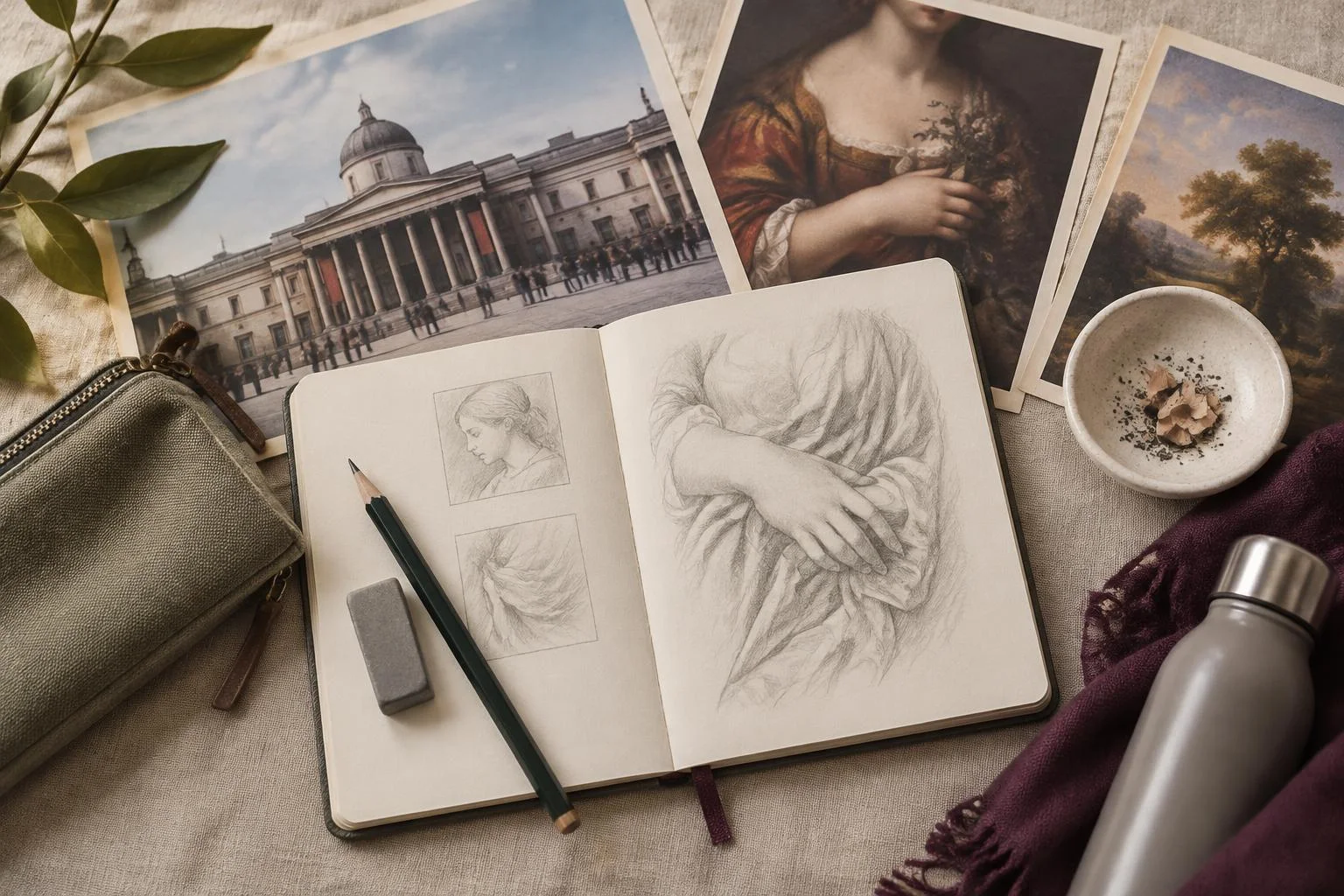
Trying to copy an entire painting during a visit can turn drawing into a performance task. A more manageable alternative is to choose one specific element: the outline of a figure, a fold in a piece of fabric, or the relationship between several shapes. These are suggested approaches for the exercise, not descriptions of specific works in the collection.
Take a moment to look before you draw. Which shape stands out? Where does a line change direction? Which elements seem close together or apart? Choosing a single visual question gives the sketch a clear purpose. Then you can draw a simple structure, without trying to record every detail or complete a reproduction.
The session does not need to produce a finished page. An outline, a composition of shapes, or a visual note that helps you remember what you observed may be enough. This is one possible way to pay attention to an artwork; it is not an official activity or a measure of artistic skill.
Editorial example: Looking at a figure wearing clothes, someone might draw only the direction of a fold and the silhouette around it. Another person might set the figure aside and sketch how two or three shapes are grouped in the composition. Both options keep the exercise focused and leave room to look at the artwork instead of concentrating solely on the page.
Use the time limit without turning it into a goal
The official information says not to spend more than ten minutes in front of a painting. This maximum can help you plan the activity; you do not need to use every last minute or treat it as a challenge. You can look and draw for less time, put your sketchbook away whenever you like, and continue your visit.
A flexible sequence can help: first choose a visual question, then observe it, and finally make a brief sketch. If the gallery is busy, other people are waiting to get closer, or staff ask you to move, pausing your drawing is part of the plan. Your page does not take priority over other people’s access to the artwork.
Editorial example: If someone has only managed to sketch an outline when they decide to move on, they can close the sketchbook as it is. An unfinished drawing does not mean the activity has failed: the suggested goal was to observe and record a detail, not produce a finished copy.
Share the gallery and keep routes clear
The rule about entrances and passageways sets a clear limit: you must not draw in these areas. Also, when the gallery is busy, staff may ask visitors to move. Position yourself so other people can come over to look, without assuming that the same spot will remain suitable throughout your visit.
If a group gathers, someone needs to pass, or a member of staff asks you to move, the practical response is to put your materials away and change position or choose another artwork. There is no need to wait until the situation becomes uncomfortable or to think the session is lost. In a gallery, a good drawing plan also includes knowing when to make room.
Editorial example: If several people arrive to look at the painting, you can put your sketchbook aside, let them come closer, and then decide whether to continue the sketch from somewhere else. If staff ask you to move, follow their instruction and reorganize your visit without blocking the way.
| Aspect | Practical guideline | What is documented |
|---|---|---|
| Paper or sketchbook | Choose a support that does not exceed the stated size | The stated maximum is A3 |
| Drawing materials | Check the list and bring only a confirmed material | Permitted materials are listed |
| Time in front of an artwork | Keep the exercise brief and stop sooner if appropriate | Do not spend more than ten minutes in front of a painting |
| Where to draw | Avoid entrances and passageways; let other people approach | Drawing is not permitted in entrances or passageways |
| Changing location | Be prepared to move if staff ask | Staff may request this when the gallery is busy |
Check your visit and the current conditions
Check the drawing rules alongside the visitor and accessibility information before travelling. This step does not guarantee that a gallery will be open, that a particular artwork will be on display, or that conditions will be identical on a future date. Check the information currently provided to confirm what is available.
These conditions apply to London’s National Gallery and should not be applied to other museums, even if they have similar galleries, collections, or activities. Each institution may set its own rules, so if you plan to draw elsewhere, consult that museum’s specific guidelines.
The suggestions to choose a detail, bring few materials, and make a brief sketch are editorial guidance for organizing the activity. They do not replace official instructions. The distinction is straightforward: the maximum size, time limit, restricted spaces, list of materials, and possibility that staff may ask you to move are facts from the information consulted; the observation method and visual questions are practical suggestions.
Checklist before you leave
- Consult the National Gallery’s drawing page and review its current conditions.
- Confirm that your paper or sketchbook does not exceed the stated maximum size of A3.
- Check that every material you plan to bring is among the permitted options.
- Choose a visual detail in advance, without setting yourself the requirement of copying an entire artwork.
- Remember the ten-minute limit in front of a painting and treat it as a maximum, not a goal.
- Avoid drawing in entrances and passageways, and be prepared to step aside or move elsewhere.
- Consult the visitor and accessibility information before travelling.
- If you are visiting another museum, check its own rules rather than assuming they are the same.
An alternative for observing at home
If you are not travelling to London, you can try the same visual question with an object at home: observe a silhouette, a fold in fabric, or the relationship between several shapes, and make a simple sketch. This is a personal adaptation of the exercise, not an official National Gallery activity. It keeps the focus on looking before drawing without confusing a practice at home with the museum’s visitor conditions.
Conclusion: a simple sketchbook, a shared visit
Preparing for a drawing session at the National Gallery is less about planning a reproduction than about adapting the activity to the rules and the shared space. Checking the permitted size and materials, choosing a visual detail, and keeping the way clear help you plan a brief, flexible activity. The stated conditions set the boundaries; each visitor can decide how much to draw within them, stop whenever they like, and change plans if the gallery requires it. The visit is better planned when the sketchbook supports observation rather than displacing those who have also come to look.