Look before you explain
How can you approach a work of art without having to identify it straight away or turn your first impression into fact? An observation notebook offers a simple answer: note visible details, ask questions, and hold interpretations open until you find information to support them. There’s no need to complete a collection or know specialist terms. Just choose an artwork and give it your attentive gaze.
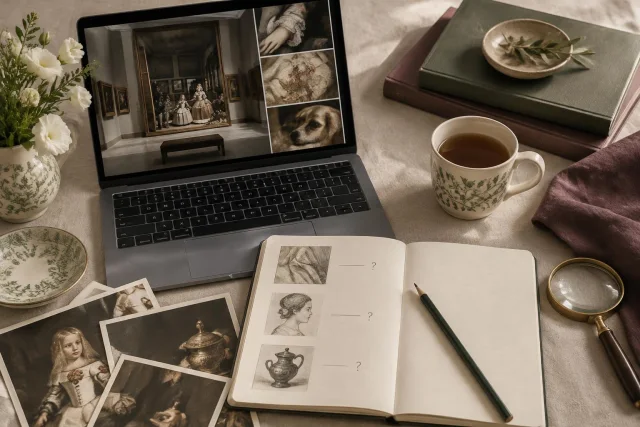
This proposal brings together an educational observation exercise from Getty and the Museo Nacional del Prado’s virtual tours. The first encourages careful looking, asking questions, and distinguishing what appears in the work from what is inferred; the second lets you explore digital resources from the collection and selected exhibitions. The method in this article is an editorial invitation, not an official Prado activity or an in-person visit guide. [1] [2]
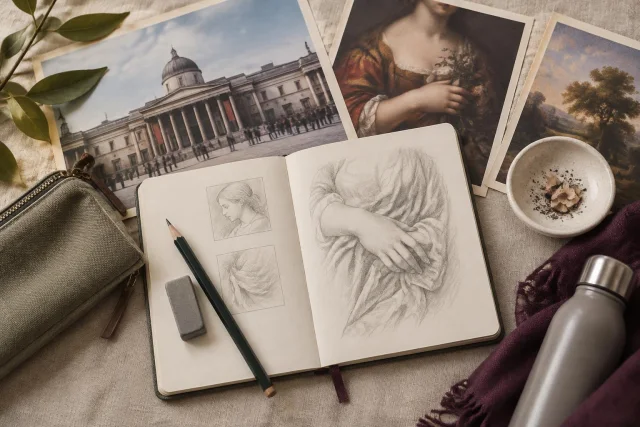
Your notebook could be a sheet of paper, a digital note, or a few lines beside the artwork’s link. The aim isn’t to produce a complete analysis, but to keep a question that helps you look more closely. For example: what fabric is depicted? The answer can begin by describing its appearance, without deciding yet what material it is made from.
From a visible detail to a question
Before writing an explanation, it helps to gather specific observations. Which colours take up the most space? Where does the light fall? Which shapes recur? Which figure is standing, sitting, or leaning? Getty’s educational activity specifically invites viewers to practise looking slowly and distinguish visible details from interpretations. It also encourages consideration of other perspectives: two people may notice different elements without one observation cancelling out the other. [1]
A useful note is brief and descriptive. “The figure is wearing a dark garment with pronounced folds” records what can be made out in the image. “The garment means the figure is in mourning” is already an interpretation that would need context. Writing these down on separate lines helps you remember what you observe and what you are assuming.
Try these open-ended questions:
- Which part of the image first draws your eye, and what detail emerges when you look again?
- What kind of fabric seems to be depicted: smooth, heavy, shiny, fine, or pleated? Which visual feature gives you that impression?
- How is a pose constructed? Which way are the face, hands, or body pointing?
- Which everyday object catches your attention? Where is it placed, and what can you describe about its shape?
- What visual relationship is there between the figures and the space around them?
These questions don’t call for a definitive answer. “It looks heavy because of the way the folds fall” can be a reasoned observation; identifying the exact material on the basis of that impression would be a different step. The difference between describing and concluding lets you enjoy a hypothesis without mistaking it for a historical fact.
Three prompts for a short notebook entry
To keep the activity manageable, choose one artwork and follow three prompts: fabric, posture, and everyday object. These aren’t official categories or a checklist to complete; they’re ways to focus your attention. If one doesn’t suit the image, leave it blank and move on to another.
Fabric: note what the appearance of the cloth allows you to describe. Does it have defined folds? Does it seem to reflect light? Does it hang loosely or fit closely around the body? You can write “shiny” or “with a texture that seems pronounced” if that’s what you see; avoid turning that appearance into a definite identification of the material.
Posture: notice how the body is arranged. A figure might lean towards another, turn their face, or rest a hand on an object. These spatial relationships can be described. Explaining why the figure adopts that posture — because of fatigue, authority, or sadness, for example — is already an interpretation: you can note it as a question, not a conclusion.
Everyday object: choose a small element that might otherwise have gone unnoticed. Describe its shape, position, and relationship to the figures: “an elongated object beside the hand” or “a vessel on the floor”. If you want to name it, note your uncertainty first. The artwork’s record may help verify the identification when relevant information is available.
A simple format helps keep each entry clear:
| Note | What to record |
|---|---|
| Artwork | The title and artist, as they appear in the available information. |
| Visible detail | A shape, colour, posture, fabric, or object you can point to in the image. |
| Question | Something you’d like to find out without anticipating an answer. |
| Information consulted | Information in the artwork’s record, if it answers your question. |
Your note doesn’t need to be more than a few lines. Its value lies in preserving your own way of looking and distinguishing it from the information you consult, not in sounding like an academic commentary.
Turn an impression into an open question
An open question leaves room for several answers. “What makes the fabric look heavy?” starts with a visual impression and looks for clues. “Why is the person wearing that fabric?” assumes the reason is known and may require information the image alone cannot provide. Reframing your questions this way keeps a quick association from becoming a claim about the period, identity, or intention of the person depicted.
It can also help to record your degree of certainty in simple words: “I see”, “it seems to me”, and “I’m not sure whether”. For example: “I see deep folds; the fabric seems thick to me, but I don’t know what material it represents.” That sentence preserves your curiosity and shows precisely where observation ends.
If someone else is taking part, each person can first note a different detail and then compare notes. Getty’s educational exercise includes the possibility of hearing other perspectives; in this adaptation, comparing notes helps reveal which elements were missed in the first reading, not to vote on a single correct interpretation. [1]
When the conversation turns towards a historical identification, the question changes: it’s no longer just about what seems to appear in the image, but about what documented information exists about the artwork. That’s when its record, if available, can be useful. Keep separate what the record confirms and what remains your own hypothesis.
Choose a Prado digital tour
The Museo Nacional del Prado’s virtual tours offer a way to explore the collection and a selection of exhibitions from home. The page notes that high-resolution technology makes it possible to see details in some artworks and that certain tours include audio. This doesn’t mean every image offers the same level of zoom or that every tour includes sound; check the options available for the resource you choose on its corresponding page. [2]
To use your notebook, choose a tour that interests you and pick one artwork rather than trying to see everything in one session. If the image lets you zoom in, look for a specific detail: a fold, a hand, or an object. If the available zoom doesn’t help with your question, you can move on to another work or read its record. Your choice depends on the image and the question, not on completing an itinerary.
A digital visit and the physical arrangement of artworks aren’t necessarily equivalent. In the collection’s virtual tour, the museum cautions that the artworks’ physical locations change and don’t have to match the digital order. The tour is therefore a useful structure for exploring online, not a reliable guide to finding the artworks in the galleries. A virtual resource also isn’t a reservation and doesn’t guarantee in-person access. [2]
The digital offering may change. The virtual visits page is the place to check which resources are available when planning the activity; there’s no need to assume an exhibition or tour will remain accessible without changes.
From a question to the artwork’s record
The record is useful when an observation becomes a question that needs context: what the title is, who is listed as the artist, or how an element is identified. Write down the question first, then consult the available information. If the record answers it, note the detail as information you consulted. If it doesn’t, leave the question open: there’s no need to fill your notebook with an invented answer.
A note might read: “I see a figure with their arm resting on something; I wonder what object is beside the hand. The record identifies the artwork as X and attributes the object to Y.” In an actual note, names would only be added if they were documented. The first part preserves what you saw; the second, what you verified. If the record doesn’t identify an object, it’s more accurate to write “object not identified in the information consulted” than to guess.
This order is especially useful for fabrics and objects. A texture may remind you of a familiar material, but that association doesn’t prove what the depicted object is made of. Similarly, recognising a general shape isn’t always enough to give it a precise name. The record is there to help you verify, not to force you to resolve every question.
Images, notes, and terms of use
Consulting an artwork online doesn’t mean you can reproduce its image in any context. You can do this activity with a digital tour and your own notes; screenshots and downloaded images aren’t needed. If you’re preparing something to share that includes a reproduction, first check where that file came from and what conditions apply to its use. Its availability on a page doesn’t in itself grant permission.
Keep three elements distinct: the image you consult, your personal note, and the information in the artwork’s record. Your note can describe what you observed without presenting an interpretation as though it were a museum fact. If you share the result, you can also clarify which parts are personal impressions and which have been verified in the artwork’s information.
A short practice, with no final exam
You can close your notebook once you have an observation and a question worth keeping. Choose an artwork; describe a fabric, posture, or object; ask an open question; and consult the record only if you need to verify an identification. The activity still works if your question remains unanswered.
The result doesn’t need to be a conclusion about the artwork. It could be a sentence such as “I noticed the way the fabric falls and want to know if the record identifies the material” or “the posture caught my attention, but I don’t know what it means”. This way of looking keeps curiosity and caution together: first, what you see; then, what you ask; and, when documentation is available, what can be confirmed. The virtual tour offers a starting point; the notebook turns it into a personal, unhurried, open-ended exploration.