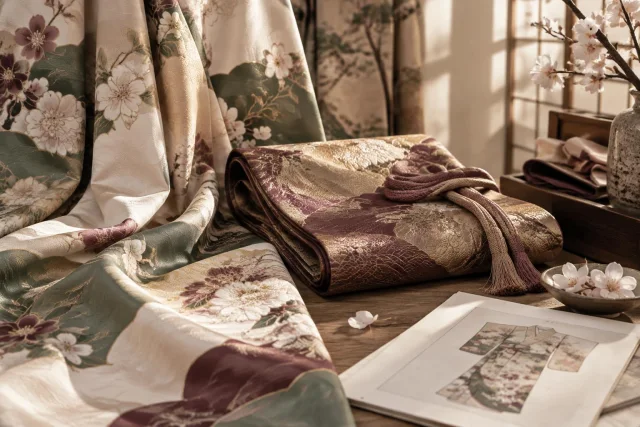




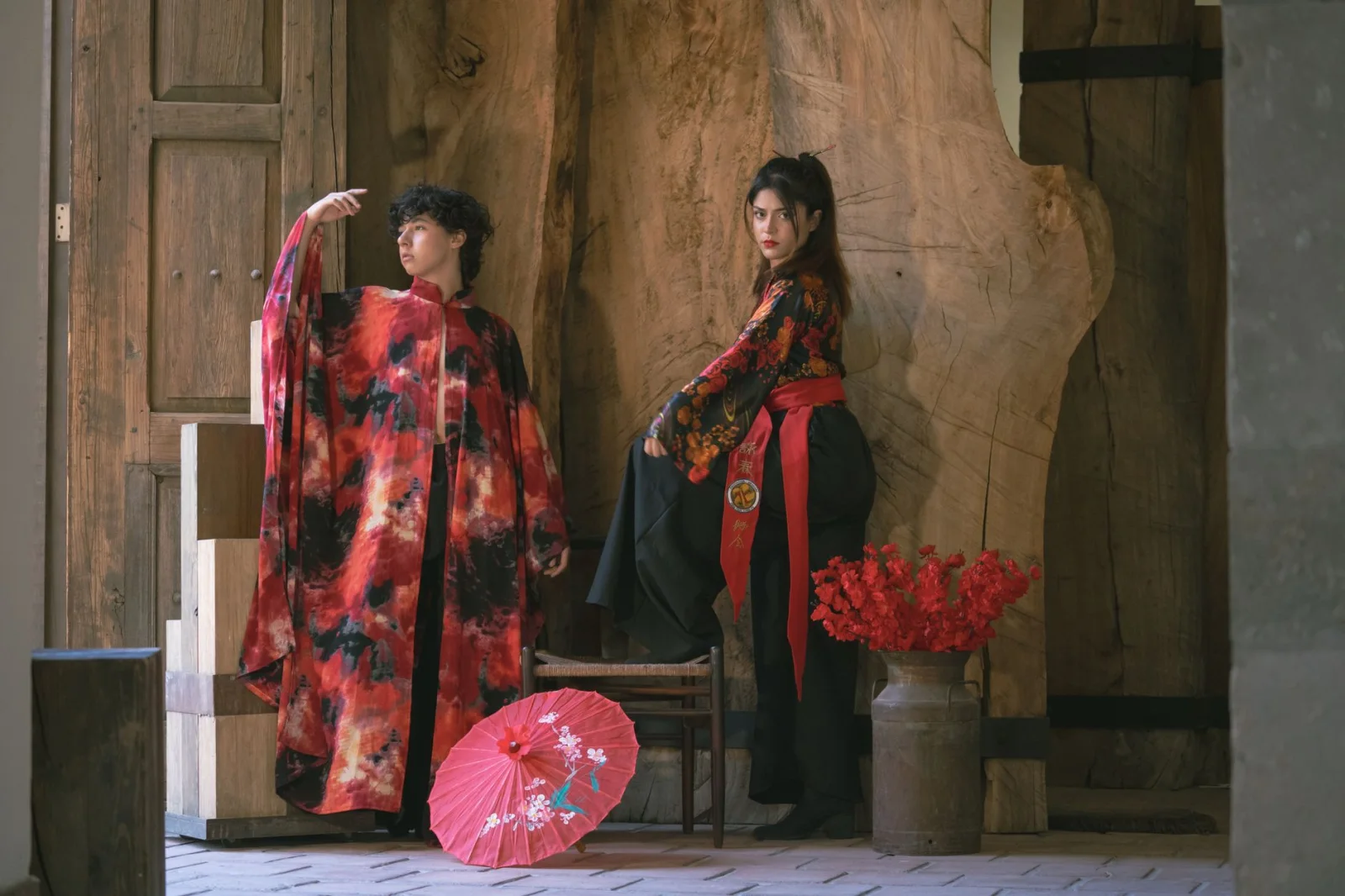
A repeated motif does not tell the whole story
How can a print be described attentively without assigning it an origin, technique or meaning that cannot be verified at a glance? The answer lies in separating two tasks: observing how the design is arranged and documenting the garment’s history. The educational resource on William Morris textiles offers a way to think about preparatory drawing and repetition as related parts of design. The Metropolitan Museum of Art’s historical presentation of the kimono, in turn, broadens the view to the changes in a garment’s form, use and meaning over time. [2] [1]
These approaches complement one another, but they are not interchangeable. One helps raise questions about composition and repetition; the other situates the kimono within a documented cultural history. Neither makes it possible to identify a contemporary garment by resemblance alone. A design of branches and flowers may suggest a visual rhythm; it does not prove who created it, when it was produced or how it was printed.
The distinction is useful both when dressing and when talking about clothes. A description can be precise and evocative without turning an impression into a fact. To do so, move from what is visible towards what can be documented: first describe the forms and their arrangement; then, if there is evidence connected to the piece, explain its provenance or manufacture.
From preparatory drawing to the rhythm of the textile
The educational material from The Huntington discusses textile designs associated with William Morris, preparatory drawings, blocks and the arrangement of repeated motifs. This combination invites us to understand a print not as an isolated image, but as a composition intended to extend across a surface. [2]
When looking at a pattern, you can observe how the forms interact, what spaces remain between them and how one unit seems to continue alongside another. The repetition may be immediately apparent, or it may emerge only as you take in the whole. In either case, a specific question is more informative than simply naming what is depicted: what holds the design together when the motif appears again?
The idea of a preparatory drawing is a reminder that the visible result may reflect prior compositional decisions. The reference to blocks in the material on Morris makes it possible to connect design and execution in that context. It does not, however, justify claiming that a contemporary garment with a similar appearance was made using blocks or derives from a specific design.
A visual resemblance guides the eye, but does not establish provenance. Supporting an attribution requires information connected to the object: design documentation, production information or a verifiable record of the piece. Without that connection, the strongest approach is to describe what is visible and leave open the question of how it was made.
What to look for in a print without guessing how it was made
Visual interpretation can be rigorous without becoming a technical claim. When looking at a garment, it is useful to focus on observable features and express them in concrete terms:
- The repeated unit: a flower, a branch, a geometric figure or a combination of elements.
- The direction of the whole: whether the forms seem to grow, tilt, alternate or spread without a dominant orientation.
- The intervals: whether there are open areas, points where motifs meet or a relatively consistent visual density.
- Continuity: whether the design seems to link across the surface or gather into separate units.
- Visible scale: how the size of the motifs relates to the part of the garment that can be seen.
These are criteria for discussing appearance, not for reconstructing the manufacturing process. Regular repetition alone does not prove which tool was used, how many stages were involved or what material served as the base. Different processes can produce surfaces that look alike; however precise a visual description may be, it does not replace technical documentation.
For example, saying “the print features intertwined branches” communicates a perceptible feature. Saying “it is made with blocks” presents a technique as fact and requires specific evidence. The vocabulary of textile history can enrich a description, provided it is not used to authenticate a contemporary garment without proof.
The kimono as form, use and history
The presentation Kimono: A Modern History explores changes in the form, use and meaning of the kimono through documented pieces. Its contribution is not a universal key for decoding every print, but a reminder that clothing has a cultural history that goes beyond decoration. [1]
This perspective broadens the questions we can ask. In addition to observing motifs, we can consider the garment’s form, its construction and any documented contexts of use. Silhouette and decoration are not separate matters: both shape how a garment is presented. At the same time, a historical exhibition is not sufficient evidence about the history of every contemporary piece that visually recalls the kimono.
It is also worth resisting the temptation to assign a fixed meaning to a colour or motif. The presentation provides context through documented objects, but it does not establish a rule that can automatically be applied to every garment with a similar appearance. If an interpretation depends on a particular period, person, occasion or use, information linking the piece to that context is needed.
Context broadens the reading; it cannot be inferred from the print alone. This makes it possible to appreciate a decorative surface without reducing a clothing tradition to a repertoire of decontextualised motifs.
Two scales of analysis that can speak to each other
The study of repeated design and the history of the kimono both recognise that clothing brings together visual choices and context, but they address different questions. The material on Morris helps us consider how a textile design is arranged and how preparation relates to repetition. The Met’s presentation places the kimono within historical changes in form, use and meaning. [2] [1]
| Question | What it allows us to explore | What it cannot establish on its own |
|---|---|---|
| How is a repeated motif arranged? | Rhythm, continuity, units and the relationship between drawing and repetition in the material on Morris. | That a contemporary garment uses a historical technique or has a particular attribution. |
| How can the way we read a garment change? | The relationship between form, use and meaning in the documented history of the kimono. | The specific meaning of a colour or motif on any garment with a similar appearance. |
| What does a visual resemblance show? | Features that can be described and compared precisely. | Authorship, date, provenance, technique or cultural context. |
The comparison is more fruitful when its two scales remain distinct. The analysis of a print focuses on composition: where the forms repeat, how they link up and what rhythm they create. The history of the kimono directs attention to a form of dress situated in time, with changes in use and meaning. The two perspectives do not need to be collapsed into one to enrich each other.
As an editorial example, a blouse with repeated flowers can be described in terms of how its motifs are arranged and how the pattern continues. If its silhouette also visually recalls the kimono, that comparison can be expressed as an impression of form. Neither observation proves that the blouse is a kimono or belongs to a particular tradition: documentation about that piece would be needed to establish that.
How to describe a contemporary garment precisely
When its origin is undocumented, there is still plenty to say. The key is to distinguish observation, comparison and attribution rather than presenting them as though they carried the same degree of certainty.
- Start with appearance: describe the motifs, their arrangement, visible scale and silhouette.
- Frame resemblance as resemblance: “recalls a composition of botanical motifs” is not the same as assigning authorship or period.
- Distinguish appearance from technique: name a printing method only when information confirms it.
- Avoid automatic meanings: a colour or figure does not, on its own, establish an occasion, identity or tradition.
- Look for information tied to the piece: a label, design documentation, a collection record or production information may offer details that appearance alone cannot provide.
Editorial example: for a garment where branches and flowers intertwine, a careful description would be “features a continuous repeating botanical pattern”. If its silhouette recalls the kimono, you can add that the form visually evokes that garment, without claiming Japanese provenance or a historical connection. The wording preserves the observation and makes clear where the comparison begins.
This way of describing does not diminish style; it makes it more precise. It also helps distinguish a personal impression—for example, that the print feels dynamic because of the direction of its branches—from a verifiable claim about authorship or manufacture.
What information is needed to identify origin and technique
The evidence required depends on the claim being made. An attribution of authorship requires documentation connecting the design to its creator; a date needs a dated record; a claim about technique requires information describing the process. Interpreting a use or meaning requires a link between the piece and the relevant context.
The references on Morris and the history of the kimono provide useful frameworks, but do not by themselves identify who created a contemporary garment, when it was produced or how it was made. The distinction between contextual information and identification of an object is crucial: a source may explain a design or a tradition without documenting the piece in front of us.
When reviewing the available information, it is useful to ask: does it refer to this specific garment or to a general subject? Does it support exactly the claim I want to make? Does it describe an appearance, or document a date, authorship, technique or use? These questions help prevent a relevant reference from becoming evidence that it does not provide.
A practical checklist for looking and describing
Before attributing an origin or technique, this checklist helps keep observations within clear bounds:
- Have I first described what I can actually see?
- Can I explain how the forms repeat, what rhythm they create and what spaces they leave?
- Have I separated visual resemblance from historical identification?
- Is the technique I mention documented for this specific piece?
- Is the meaning I propose linked to a verifiable context?
- Does the source support the exact claim, rather than just a related topic?
If the answers are limited to what is visible, the description can stop there: there is no need to fill the gaps with a plausible story. If documentation exists, you can specify what information it provides and how far it goes.
Look closely, contextualise carefully
A repeated motif makes it possible to observe composition, continuity and intervals; preparatory drawing offers a way to think about how a design might be arranged before it appears as a textile surface. The history of the kimono, in turn, shows why a garment is more than its motifs: form, use and meaning also shape how it is read, and may change over time.
The answer to the opening question is therefore twofold. To describe a print, observe and name its visual structure. To identify its provenance or interpret its context, look for documentation connected to the garment. The pattern can be observed; the history must be supported by evidence. Keeping that distinction allows us to compare without confusing, appreciate clothing without reducing it to decoration, and reserve attributions for when there is evidence to support them.