



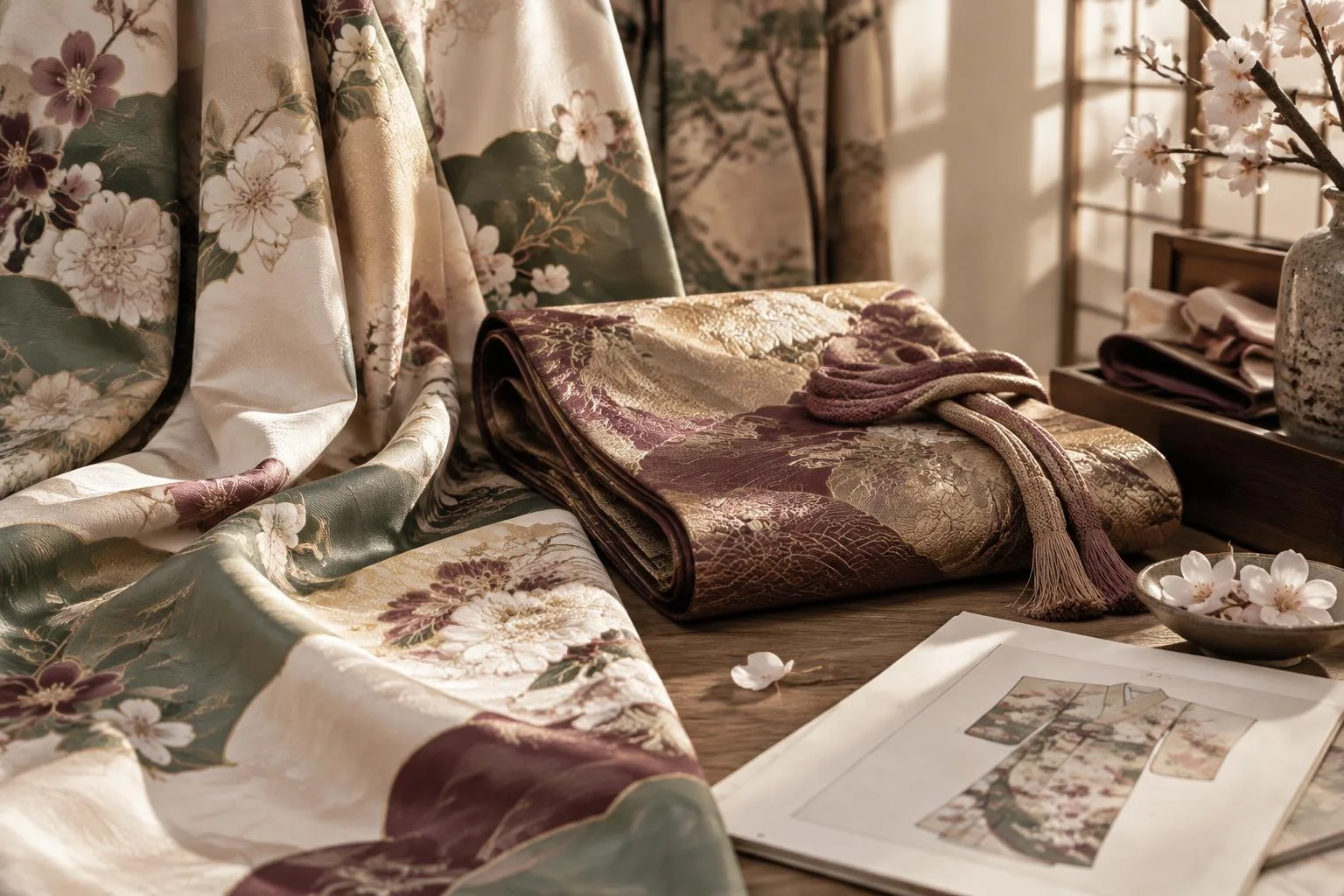
Look at the Whole Before the Motif
A kimono may catch your eye because of its color, a design, or the way it is presented on the body. However, focusing only on the most striking detail leaves out part of the relationship created by the garment: its form, the obi that holds it in place, and the decoration across its surface. The kimono has straight seams, wraps across the body, and is secured with an obi. Color and decoration can express context and identity, and certain motifs have specific seasonal and cultural meanings.
These details allow for attentive interpretation, but they do not provide a universal key for decoding every piece. The same design does not necessarily mean the same thing on every kimono or in every situation. It is therefore helpful to distinguish between what is visible and what is interpreted: describing a form is different from assigning it a story, intention, or symbolism that we do not know.
The approach of this guide is simple: start with the structure, observe how the parts relate to one another, and look for contextual information before explaining the decoration. This is an editorial method for looking and talking about the garment, not a rule about how to wear it or an interpretation of any specific kimono.
Form as a Starting Point
Straight seams and the way the garment wraps across the body invite us to consider how the kimono is organized as a whole, rather than treating it as a flat canvas. You can notice the direction of the wrap, the drape you perceive in the piece, and how the garment occupies the visual space around the body.
Here it is important to separate documented information from the question someone might ask while looking. The kimono’s construction with straight seams is documented; deciding which aspect of that construction is most visible to you is a personal exercise. There is no need to turn every feature into a hidden meaning. Sometimes an observation can be purely descriptive: “I see a line where the garment wraps across the body,” “the decoration is concentrated in one area,” or “the whole seems organized around the obi.”
Editorial example: When looking at an image or a piece, first note three visible elements—the wrap, the drape, and the placement of the design—without yet explaining what they “represent.” Then ask what additional information you would need to move from description to interpretation. This exercise is an editorial tool, not documented guidance, for keeping observation and inference distinct.
The Obi Is Not an Isolated Detail
The kimono is secured with an obi. This makes it useful to observe the relationship between the two parts: the obi contributes to how the garment is worn and to how the ensemble is read visually. Looking at it only as a decorative accessory can obscure that function in the description of the piece.
When looking at an ensemble, you can ask where the obi is positioned, how it relates to the wrap, and what place it occupies in relation to the color or decoration. These questions describe an observation practice; they do not claim that there is only one correct way to wear it or that the obi has the same meaning in every case. The available information does not provide detailed instructions on styles, tying techniques, or conventions of use, so it would not be appropriate to invent them.
Editorial example: Imagine comparing two images of kimonos, both showing an obi. You can describe whether, in each image, it seems to stand out through contrast, blend visually with the garment, or draw the eye toward one part of the ensemble. These words express a visual impression, not a claim about its cultural meaning or how the piece should be worn.
Color and Decoration Need Context
Color and decoration can express context and identity. Some motifs also have specific seasonal and cultural meanings. The key word is “can”: this does not authorize automatically assigning an identity or meaning to any color or design. Nor does it allow us to infer the context of a specific piece by looking at it alone.
A careful way to approach decoration is to ask questions before offering answers. Is the provenance of this piece known? Is there information about the time or situation for which it was used? Does the explanation of the motif refer to this particular piece or to a generalization? If we do not have reliable answers, we can describe the design—its shapes, colors, or arrangement—without turning it into a universal symbol.
Editorial example: If someone sees a motif that reminds them of a particular season, they can say, “This design makes me think of a season,” as a personal impression. They should not turn that association into “This motif always means a particular season” without supporting information. This distinction protects accuracy as well as the possibility of appreciating the surface without reducing it to a quick translation.
A Practical Comparison to Organize Your Observations
The following table brings together editorial questions, not official categories. It helps you decide what to observe and what information to seek before interpreting a piece.
| Aspect | Direct observation | Useful contextual question | Avoid assuming |
|---|---|---|---|
| Form | The wrap, straight seams, and visible drape | Which features describe the construction and silhouette? | That a line or shape has a fixed cultural meaning in itself |
| Obi | Its presence and visual relationship to the garment | What role does it play within this ensemble? | That it is purely decorative or that its function is identical in every situation |
| Color | The shades you perceive and how they relate to one another | What information accompanies this piece and its use? | That a color always expresses the same identity or idea |
| Decoration | The placement, shapes, and visible combination | Is there a reliable, specific explanation of the motif? | That all motifs have a universal meaning |
| Context | The available documented information | Does the explanation refer to this piece or to a generalization? | Filling gaps with an assumed story |
The comparison helps separate three levels: what the piece shows, what a source documents, and what the observer proposes. Keeping them distinct does not make looking less interesting; it prevents a personal impression from being presented as an established fact.
Choosing or Appreciating a Kimono with Care
If you are considering a kimono to wear, you can start with what attracts you: perhaps the form, color, obi, or decoration. Then think about the occasion and how you want to approach the garment. These are personal criteria for choosing, not cultural instructions. If the context of a motif on the piece is unknown to you, describing what you see is more precise than assigning it a symbolism.
It can also be useful to separate an aesthetic decision from contextual research. You can appreciate the color combination while acknowledging that you do not yet know what it expresses in a particular piece. You do not need to answer every question to have a visual response; you should, however, avoid confusing personal taste with documented knowledge.
Editorial example: Someone looking for a piece for an occasion can note what interests them—the silhouette, a color palette, or the relationship between the obi and the decoration—and, separately, which cultural aspects they would like to understand better. This list does not prescribe a purchase or claim which garments are appropriate for a situation: it helps formulate specific questions and recognize the limits of the information available.
Questions That Improve Interpretation
Before sharing an explanation about a kimono, it is worth checking where it comes from. Does the information refer to that piece or discuss motifs in general terms? Does it distinguish between seasonal and cultural meanings? Am I describing something visible or assigning an intention? What information is missing to support my interpretation?
These questions also help guide respectful conversations. Instead of asking, “What does this design always mean?” you can ask whether there is information about the motif on that piece or in that context. If there is none, it is reasonable to leave the interpretation open. Uncertainty should not be filled with claims that sound convincing but lack support.
A brief checklist can be useful before publishing, choosing, or commenting:
- Have I first described the form, color, obi, and decoration I actually observe?
- Have I distinguished documented information from my personal impression?
- Does information about a motif apply to this piece, or is it a generalization?
- Am I assigning a universal meaning that the available information does not support?
- Have I avoided presenting an assumption about provenance, use, or identity as fact?
- If I do not know the context, can I ask a question or limit myself to describing what is visible?
Limits of This Guide and Conclusion
This guide draws on documented details: the construction with straight seams, the way the garment wraps across the body, its fastening with an obi, and the possible relationship between color, decoration, context, and identity. Some motifs may have specific seasonal and cultural meanings. These details do not interpret a specific piece, establish the meaning of every color, or provide detailed instructions for use.
In short, a more complete reading starts by viewing the kimono as a whole: form, obi, color, and decoration in relation to one another, rather than as isolated elements with automatic translations. The documentation raises questions about context and identity; it does not resolve them universally. Looking attentively, describing before interpreting, and seeking specific information make it possible to appreciate the piece more fully without claiming more than is known.
Documentary source: [1].