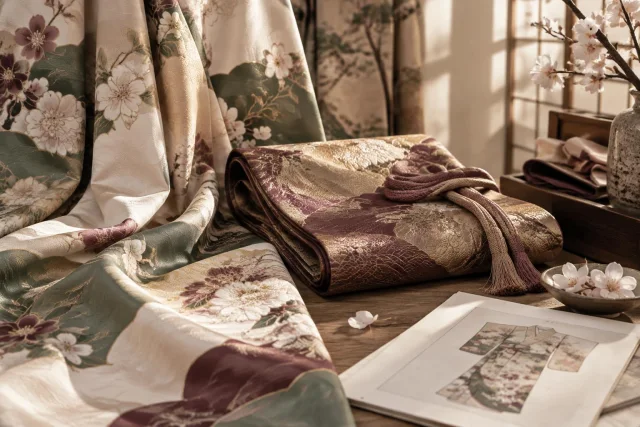





A broad perspective begins by letting go of the idea of a single style
Talking about “Indian textiles” can be useful for defining a subject, but it does not describe a uniform aesthetic. Documented examples cover materials, techniques, exchanges, and uses and include embroidery, woven fabrics, and different types of thread. These include metals worked into ribbons or fine threads. This diversity invites us to look at each piece through the information available, rather than searching for a feature that supposedly represents them all.
This shift is also important for anyone approaching textiles through fashion. A surface may draw us in because of its sheen, contrast, the density of an embroidery, or the way a motif is arranged. These impressions are valid aesthetic responses, but on their own they do not establish where an object was made, who produced it, what technique was used, or what it meant.
The documented approach supports attention to materials and context, not a universal classification of every design that resembles a familiar image. The guide that follows combines this documentary perspective with original editorial exercises: practical ways to record what a museum record states and separate that information from what each person appreciates.
Look at the piece first, not the broad label
When a description is limited to a broad category, it is tempting to fill in what is missing with associations. A motif, color, or texture may remind us of a region, a tradition, or an image we have seen before. But visual resemblance is not enough to confirm that connection. It is best to begin with more focused questions: What material is mentioned? What technique does the record state? What place is attributed to this particular object?
A materials-and-techniques approach is useful because it brings together different dimensions. Materials and techniques help describe how a piece is made; uses and exchanges open up the context considered relevant in the documentation. None of these aspects should be automatically inferred from appearance. If the record does not specify something, the clearest approach is to note it as “not specified” in your own notes.
Editorial example: Someone saves an image of a garment because they are drawn to its high-contrast embroidery. They can note, “I’m interested in the contrast between the embroidered areas and the base,” as an aesthetic observation. If the record does not identify the technique, they should not turn that impression into “traditional embroidery from such-and-such a place.” The first sentence describes what they see and prefer; the second attributes an origin or technique that would need documentation.
How to read a museum record without asking it to say more than it does
A museum record is a documentary starting point, not necessarily a complete story. To read it systematically, you can record the object name as it appears, the place indicated, and the technique stated. Keeping each detail close to its original wording helps prevent a limited description from becoming a broader claim when retold.
This record-keeping does not require a complicated template. A simple table separates information in the documentation from personal notes and honestly identifies what remains open:
| Aspect | What to note | How to interpret it carefully |
|---|---|---|
| Object name | The name given in the record | Do not replace it with a broader category if the documentation does not do so |
| Place | The place attributed to the object in the record, if provided | Do not infer it from the motif, colors, or appearance alone |
| Technique | The technique stated in the description | If it is not indicated, note “not specified” |
| Material | The materials mentioned in the record | Do not infer a fiber or component from an image alone |
| Personal preference | Color, texture, contrast, sheen, or visual rhythm that appeals to you | Present it as your own response, not as historical fact |
The table is an editorial suggestion for organizing your reading, not an official museum tool. Its purpose is to make the differences between description, missing information, and personal interpretation visible. It also prevents a correct fact about one piece from being extended without basis to an entire tradition.
Materials and techniques: describe precisely without turning them into stereotypes
Documented examples of Indian textiles include embroidery, woven fabrics, and different types of thread, including metals worked into ribbons or fine threads. These details can expand the vocabulary we use to observe a piece. Instead of simply calling it “ornamented” or “exotic,” you can look for the material element described and maintain the level of precision the documentation offers.
Even so, a technical category does not tell the whole story. Knowing that a description mentions embroidery does not authorize you to automatically attribute a region, community, use, or meaning. Nor is visual recognition of a finish enough to assert that it is a particular material. A record may include more details in some cases and fewer in others; responsible reading preserves that distinction.
Editorial example: While gathering references for an outfit, someone might keep two notes separate: “the record mentions metallic threads” and “I like the luminous effect of the surface.” The first is a documentary fact if it appears in the record; the second describes a preference. If the available information does not identify how the effect was achieved, there is no need to invent an explanation in order to enjoy it or use it as visual inspiration.
Exchanges and uses: context without an invented story
Textiles can be understood through their materials, techniques, exchanges, and uses, rather than as isolated images. That perspective is a reminder that an object may be better understood in context. However, recognizing that context matters does not mean knowing the context of any given piece in advance. Check what the specific record says rather than fill in the gaps with an appealing but undocumented story.
In practice, this means recording separately what a source states and the questions it leaves open. For example, you could write, “the description considers use as part of the context,” followed by, “this record does not specify how the piece was used,” if that is the case. The second note does not contradict the first: it distinguishes a general perspective from the information available about a particular object.
Editorial example: A visual reference may inspire someone to choose a texture for a contemporary outfit. They can explain that decision as a personal affinity, without presenting the current garment as a replica, continuation, or faithful representation of a tradition. This distinction makes it possible to learn from a source and, at the same time, speak clearly about one’s own choice.
A short practice for separating documentation from impression
The following exercise is an adaptable editorial suggestion, not a prescribed method. It can be useful for saving museum references, images from a documented exhibition, or records consulted online:
- Copy the object name exactly as it appears in the record.
- Note the place only if it is indicated for that piece.
- Record the technique and materials at the level of detail provided in the description.
- Mark missing information as “not specified” rather than filling it in by intuition.
- In a separate section, add the features that catch your attention: color, texture, contrast, sheen, embroidery, or finish.
- Phrase any unsupported interpretation as a question: “Does the record explain this motif?” is more precise than asserting a meaning.
- If you share the reference, make clear which details come from the record and which express your preference.
Editorial example: A note might say: “The record gives the place and describes a technique; I’m drawn to the motif’s visual rhythm. I haven’t found an explanation of its meaning in the description.” This is deliberately specific: it communicates interest without turning an impression into a historical identification.
Useful questions to ask before saving or choosing a reference
You do not need to resolve every question in order to appreciate a textile. It does help to ask what you know and what you like, without confusing the two. Before saving an image, sharing it, or using it as inspiration, consider the following:
- What material or technique does the description mention, if any?
- Does the place explicitly refer to this object, or am I assuming it from its appearance?
- Am I describing a visible quality or attributing an origin and meaning?
- What specifically appeals to me: the color, texture, contrast, embroidery, or finish?
- Does the source discuss this piece or a broader subject?
- Have I preserved uncertainties and details that are not specified?
These questions are especially useful when an image circulates separately from its record. The further a reference moves from its original context, the easier it is for a broad label to seem like a complete explanation. Returning to the description, when it is available, helps avoid presenting resemblance as proof.
Limits of this guide and conclusion
This guide considers materials, techniques, exchanges, and uses, while recognizing the variety of textiles described. It does not identify individual pieces or provide a comprehensive history of India’s textile traditions. Nor does it offer a universal meaning for a motif or technique. When discussing a particular object, the specific information in its record should carry more weight than an association based solely on appearance.
The practical suggestion is simple: record the name, place, and technique when they are documented; clearly mark what is missing; and reserve a separate space for personal preferences. In this way, looking at a textile can be both attentive and open-minded. You can enjoy a texture or seek inspiration for your own style without reducing material diversity to a single aesthetic, or presenting as history what began as a visual impression.
Documentary reference: [1].