



A calm session begins with a small question
What does it take to spend an afternoon drawing in front of a work without turning the visit into a race to finish a drawing? It is enough to prepare permitted materials, choose one specific detail and be willing to move if the space requires it. At London’s National Gallery, that idea needs to fit specific conditions: paper or a sketchbook no larger than A3, a limit of ten minutes in front of each painting, and no drawing in entrances or passageways. [1]
The idea is not to reproduce an entire painting or measure your skill with a pencil. It is about looking with intention: following a silhouette, noticing how a fold falls or comparing a few shapes. One detail is enough to give the session direction; choosing it in advance makes it possible to begin without having to invent a goal while occupying a passageway.
The rules cited apply to this institution and the information consulted, not to museums in general. Before setting out, it is worth checking the current conditions, visitor and accessibility information, and which galleries are open. The presence of a particular work or the possibility of staying in an area is not guaranteed for a future date.
Prepare a light, compatible kit
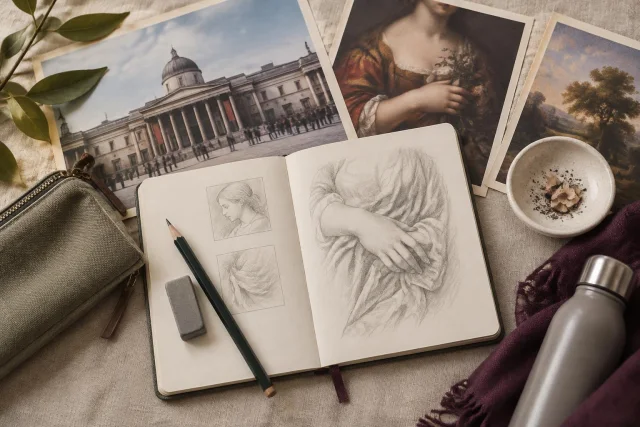
The size rule offers a practical guide for preparing your sketchbook: paper or a sketchbook up to A3. The National Gallery’s sketching page also lists permitted materials; check the current list before choosing pencils or other tools. [1]
A small sketchbook can be convenient for a quick study, provided the material and its size meet the stated conditions. Carrying fewer things also helps keep your attention on the work rather than on arranging a large working surface. There is no need to put together a special kit: the priority is for every item to be compatible with the museum’s current rules.
Before setting out, you can run through this simple checklist:
- Confirm that the paper or sketchbook does not exceed the stated maximum size.
- Check the current list of permitted materials and choose only tools included on it.
- Think of one specific visual question rather than bringing a long list of goals.
- Check current visitor and accessibility information, as well as the rules for drawing.
The checklist separates two preparations that are often confused: having suitable materials does not, by itself, confirm that the visit will unfold as expected. Access conditions, open galleries and the flow of visitors are separate matters worth checking individually.
Choose a detail without turning it into a challenge
When it is time to decide what to draw, it helps to narrow your focus. It could be a figure and its outline, the curve of a fold or the relationship between two shapes. The point is not to decide what is most worthwhile or prove that you can copy the image precisely; it is to find an element that invites calm observation.
A flexible sequence can help you get started:
- Look before drawing. Find your chosen detail and notice its overall shape.
- Reduce it to a few lines. Make a study that captures the silhouette, direction or relationship between shapes, without trying to complete the whole work.
- Look again. Compare your study with the detail and add only what helps clarify your observation.
The result can be incomplete. In fact, leaving it as a simple study helps keep the session compatible with the stated limit and the pace of the galleries. There is no need to correct every line or finish a composition: drawing here is a way of paying attention, not a test of skill.
If the first detail does not spark your interest, you can change the question: move from a silhouette to a fold, for example, or notice how several shapes are grouped. The idea is to keep the focus small enough to observe without staying in front of a single work for too long.
Keep the way clear
At the National Gallery, drawing is not permitted in entrances or passageways. Staff may also ask you to move when the gallery is busy, and the page consulted asks visitors not to spend more than ten minutes in front of a painting. [1]
That is why the plan needs to allow for stopping or moving on. If other people gather to look, you can put your sketchbook away, make room and continue with another work or from a different spot. If staff ask you to move, that instruction is part of the specific conditions for the activity, not an interruption to try to avoid.
The time limit does not need to become a timed challenge. It serves as a guide for keeping the stop brief; it does not mean you have to fill every minute or guarantee that drawing will be possible for the whole interval. A work may be surrounded by people or located in a gallery that is not available at that moment. In those cases, choosing something else is a practical way to continue with the idea without blocking the way.
This approach makes room both for those drawing and for those who simply want to look. The afternoon does not depend on completing a set number of sketches or staying in front of a particular work. Flexibility is part of the plan: observe, step aside when needed and continue somewhere else.
Check the visit before setting out
The drawing conditions are only one part of getting ready. Before leaving, it is sensible to check the visitor and accessibility information again, along with the current rules for drawing. This helps avoid treating guidance on a webpage as a guarantee that every detail will remain the same on the day of your visit.
It is also worth keeping expectations about the works and galleries open. The information available for this proposal does not confirm which painting will be on view, which spaces will be open or what access conditions will be like on a future date. For that reason, it is more useful to bring an adaptable visual question than to plan the whole afternoon around a single painting.
If you cannot use the materials you chose, the area is busy or you need to make way, you can continue the activity with another detail or another work that is available. And if you are not visiting London, you can apply the same visual question to an object at home; that at-home adaptation is a personal alternative, not an official National Gallery activity.
Take your observation to the Prado’s virtual visits
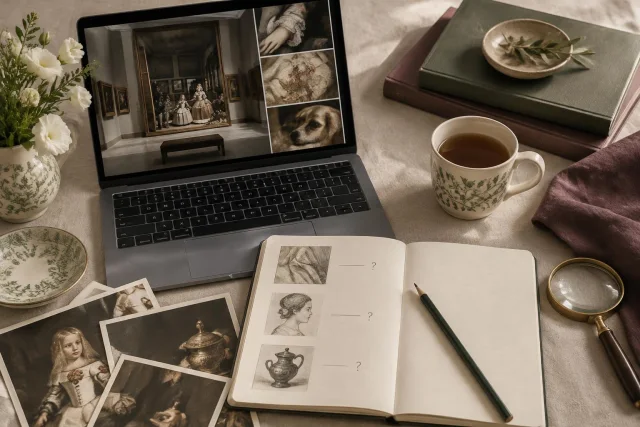
Anyone who would rather explore from home can use the Museo Nacional del Prado’s virtual visits, which include tours of the collection and a selection of exhibitions. Some tours include audio, and high resolution makes it possible to appreciate details in certain works. The physical location of works can change and may not necessarily match the collection’s digital tour. [2]
The digital version does not replace an in-person visit or work as a reservation to enter the galleries: it is another way to approach the works. What is available may change, so the virtual visits page is the right place to check which resources are currently available. There is no need to try to explore the whole collection in a single session; you can choose one work and follow a question as far as the available tools allow.
Three questions of your own can help you look without turning your answers into claims about art history:
- What kind of fabric does it appear to depict?
- How is a figure’s pose constructed?
- Which everyday object draws your attention?
You can note the title and artist shown in the work’s listing, along with the question that caught your interest. If an identification needs more support, the museum’s listing can help distinguish documented information from a personal impression. If the detail does not enlarge as expected, simply choose another work or keep reading its listing: not every piece offers the same digital exploration experience.
Choose the format that suits your afternoon
An in-person visit in London offers an opportunity to draw in the galleries under its specific rules: paper or a sketchbook no larger than A3, permitted materials, no drawing in entrances or passageways, moving if staff ask, and spending no more than ten minutes in front of a painting. The Prado’s virtual option, by contrast, allows you to explore digital tours and details in some works from home, with the caveat that their physical location does not necessarily match the online tour. [1] [2]
The choice depends on what you feel like doing: bringing a sketchbook and adapting your drawing to the flow of a gallery, or pausing in front of a work on screen and following a visual question. In either case, the goal can be modest: notice a shape, a pose or a fabric, and keep a brief note of what caught your attention. An afternoon of drawing does not need to end with a finished work; it may be enough to have looked in a different way.