



What to look for in the ingredient list
The practical question is simple: how can you recognize a paraben on the label, and what can you conclude from its presence? The names to look for are methylparaben, ethylparaben, propylparaben and butylparaben. These are examples of preservatives in the paraben family; they may appear together or alongside other preservatives. [1]
In an INCI list, look for those exact names, not just the generic word “parabens.” The specific name lets you identify which ingredient appears in the list, but it does not make every member of the family the same molecule, nor does it tell you how much is in the formula. That distinction matters: identifying a name is a first step in reading the label, not a complete assessment of the product.
A useful way to read it is to separate three questions:
- Which ingredient appears: the INCI name declared in the list.
- What function is attributed to it: in this context, a preservative function.
- What remains unanswered: the exact amount, the performance of the finished formula and individual tolerance.
The European CosIng database can be useful for checking INCI names, identifiers and functions, but its contents are informational and include both active and historical data. A term’s presence in the database does not amount to authorization for use or a safety approval. [3]
Cosmetics in which their use is documented
The available examples are set in the US context and include makeup, moisturizers, hair products and shaving products. [1] This helps explain why the name may appear across different categories, but it does not mean that it is present in every product of those types or that a particular formula contains it.
When shopping, the label on the product in front of you is more useful than a generalization about its category. If you want to know whether a cosmetic includes one of these ingredients, check its INCI list; do not infer its presence simply because it is, for example, a moisturizer or a hair product. If you find one, interpret the information precisely: it confirms that the name appears in the list, not how the whole product will perform in use.
Several parabens may also be combined with one another or with preservatives from other classes. So seeing one name does not necessarily describe the complete preservative system. The list gives a view of declared ingredients, but it does not always make it possible to reconstruct formulation decisions or each component’s contribution.
What the INCI does—and does not—explain
The ingredient list is an identification tool, not a complete formula sheet. It can help you recognize names and compare them across products. It does not reveal the precise amounts of each ingredient; by itself, it also does not provide an exhaustive description of every characteristic of a fragrance. [2]
For parabens, this particularly limits the conclusions you can draw from a quick read. Seeing methylparaben does not let you calculate its proportion, compare its concentration with that in another cosmetic or determine the effect of the complete formula. The label records ingredients, but it does not replace quantitative data or an assessment of the finished product.
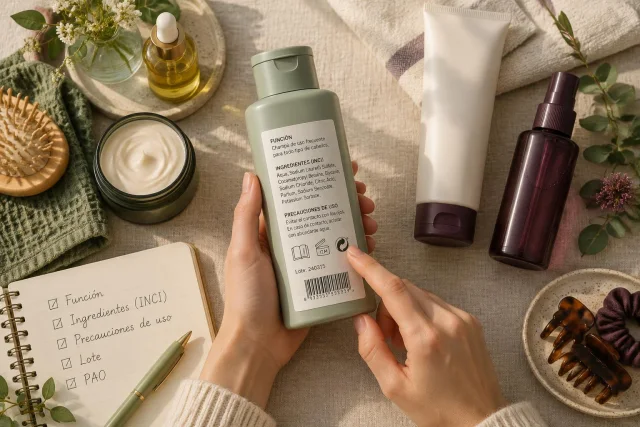
It is worth distinguishing INCI information from other details on the packaging. The batch number, nominal quantity and symbols for duration or use after opening address different questions. In particular, the open-jar symbol indicates a period of use counted from when the product is first used; it does not tell you how much paraben is included or, by itself, demonstrate a preservative’s efficacy. [2]
A reading rule: use the INCI to find and name ingredients; do not treat it as a quantified formula or proof of performance. This boundary lets you make use of visible information without asking the label to provide answers it does not contain.
Preservative function does not mean demonstrated efficacy
Saying that an ingredient has a preservative function describes its intended role in a formula. It does not prove that a particular product will preserve effectively in all circumstances, nor does it allow you to infer how well an individual will tolerate it. Preservation and cosmetic results are separate questions: one concerns the role of the preservative system; the other, the overall behavior of the product and the experience of the person using it.
Therefore, it is not correct to read the presence of a paraben as a guarantee of cosmetic efficacy, or to conclude that the product will necessarily be well tolerated. Nor is finding a name enough to make a general safety judgment about the entire family. The name identifies; it does not pass judgment. Assessing a particular product would require data that the list alone does not provide.
This approach also helps when comparing two labels. If one list includes one of the four names and another does not show it, the comparison lets you describe a visible difference in declared ingredients. It does not prove that the first formula is more effective, that the second lacks adequate preservation or that one will be better for a particular person. A name’s absence from the list does not, by itself, reveal what alternative system is used or how it works.
Regulation: do not transfer one jurisdiction to another
The examples of use cited here apply to the US market and should not be turned into a regulatory conclusion for Europe. Rules and assessments depend on the jurisdiction and the information applicable at a given time; an explanation of names and functions does not settle an ingredient’s regulatory status in every market.
It is also important not to confuse a reference database with an approval. CosIng brings together INCI names, identifiers and functions for informational purposes, and may contain both active and historical information. A name’s appearance there does not mean its use is authorized or that a safety approval follows from its presence. [3]
If the question is regulatory—for example, what conditions apply to an ingredient in a particular country—you need to consult regulatory information relevant to that jurisdiction and date. The label can help identify the term; it does not replace that check. For everyday reading, it is enough to keep three levels separate: the declared name, the preservative function and conclusions that require a regulatory or finished-product assessment.
A practical check before deciding
When reviewing a cosmetic, you can follow this order without overinterpreting the label:
- Find the term: look for methylparaben, ethylparaben, propylparaben or butylparaben in the INCI.
- Read the information within its precise scope: its presence indicates that the name appears among the declared ingredients; it does not indicate an exact amount.
- Consider the formula as a whole: parabens may be combined with one another or with other preservatives.
- Separate function from outcome: a preservative function does not, by itself, establish a cosmetic’s efficacy or the tolerance of a particular product.
- Place any legal conclusion in context: check the market and date; US examples do not constitute a conclusion for Europe.
The label offers a valuable, though limited, answer: it lets you recognize certain names and read them as part of an ingredient list. Its limits are just as useful. It is not a safety assessment, a concentration measurement, proof of preservation or a regulatory ruling. Understanding that difference makes it possible to make informed decisions based on what is actually written, without turning a name into a conclusion the label does not support.