



Read the label before deciding
When you’re thinking about changing your shampoo or conditioner, it’s easy to focus first on the brand name, the front-of-pack description or the claim that catches your attention. However, these elements aren’t enough to tell you what instructions apply to the specific product. An organised review starts with finding the information on the packaging and distinguishing what the label states from what we hope will happen.
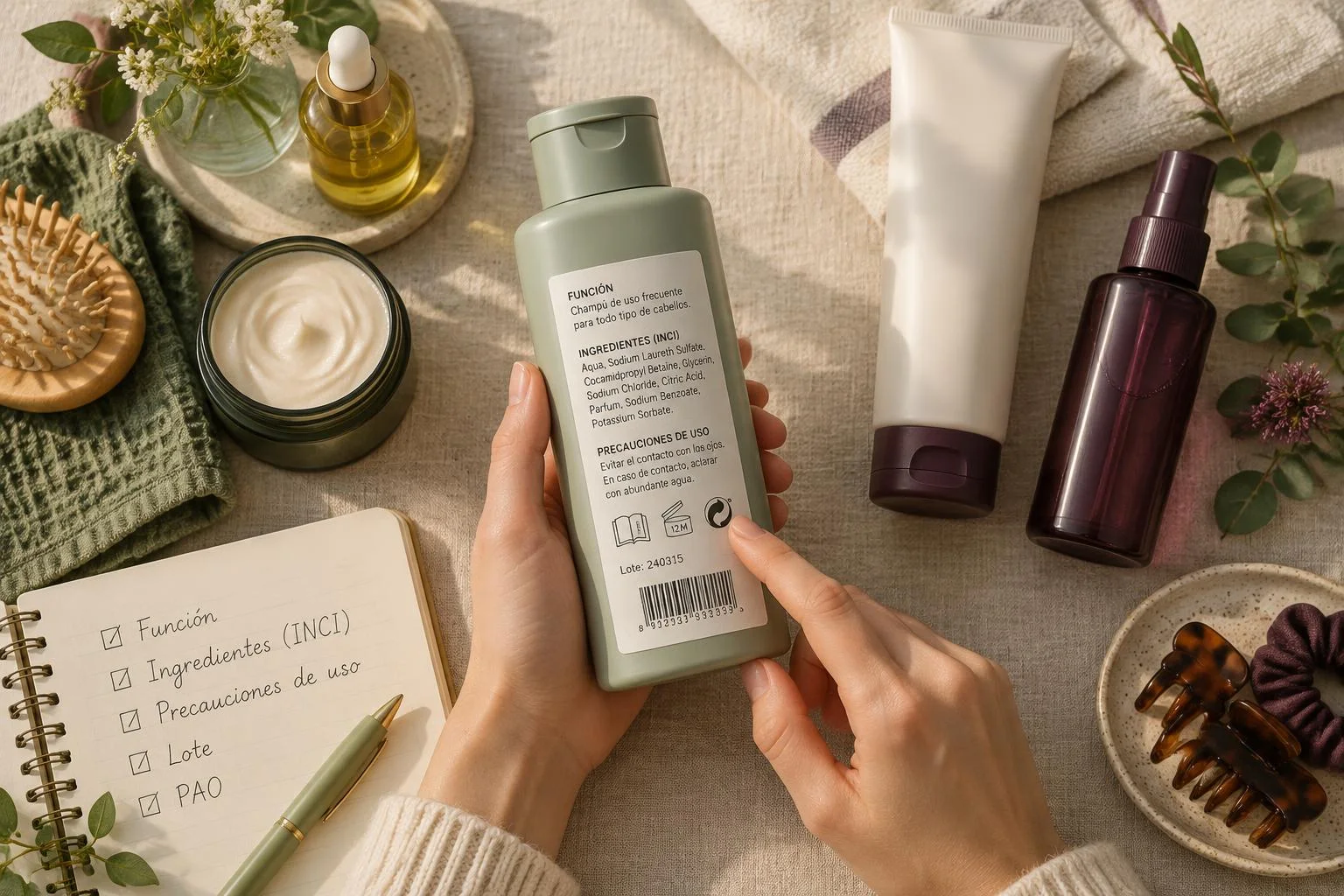
Cosmetic labelling includes information such as the product’s function, precautions for use, batch number, list of ingredients and, where applicable, shelf life. It also includes the information symbol and the open-jar symbol, which indicates the period of use after opening, known as the PAO. These details help identify and use the product according to its instructions; they do not, by themselves, assess its effectiveness.
The practical idea is simple: before adding something to your routine, read the exact product label, rather than relying on a general rule about a category. Two hair-care products can belong to the same category and still have different information and instructions.
Start with the stated function
Look for the function attributed to the product on its packaging. This can help you check whether you’re looking at a shampoo, conditioner or another hair-care cosmetic, and whether its stated purpose matches what you’re looking for. Treat it as a description of the product, not a guarantee of a personal result.
As an editorial example, imagine that you have two shampoos in front of you and one is presented for oily hair. Don’t assume that another shampoo from the same brand, or even another package in the same category, has the same function. Read each label separately. The brand and general type can guide your search, but they don’t replace the information specific to each product presentation.
It’s also worth separating the stated function from your expectations. If the packaging uses terms that seem to describe an effect, note them as part of the product’s presentation, but don’t turn them into a conclusion about how your hair will respond. This guide focuses on reading documented information, not predicting results.
Identify ingredients using INCI
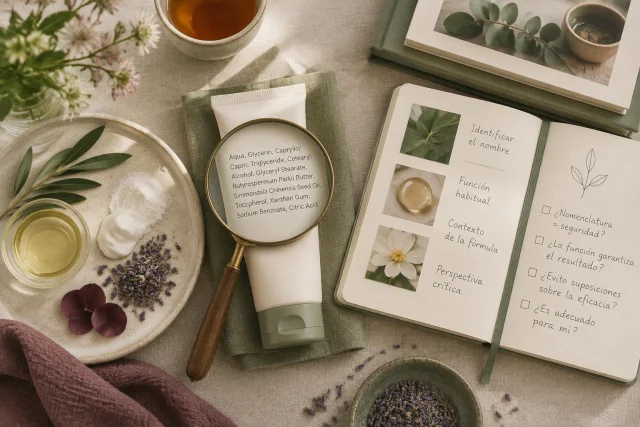
The ingredient list uses INCI names. This system makes it possible to identify components by their standardised names, rather than relying only on the brand name or the prominent description on the front of the package. For a practical review, find the full list and check that you’re consulting the one for the product you have in your hand.
If you already have a specific preference about an ingredient, you can compare the new product’s list with the information you’re considering. This step involves identifying and comparing names; on its own, it doesn’t establish which product will be more suitable or allow you to draw conclusions about effectiveness. The label is the source for finding out which ingredients the product declares, not an individual assessment of the formula.
As an editorial example, if you’re comparing a new shampoo with the one you currently use, you can save a readable photo of both INCI lists and check whether the component you wanted to find appears. Keep the comparison limited to that specific question. There’s no need to infer effects that the packaging doesn’t claim or treat a matching name as a recommendation for use.
Read the precautions for the specific product
Precautions for use are another essential part of cosmetic labelling. Rather than assuming that all hair-care products are applied in the same way, find the instructions on the package in front of you and read them before use. It’s especially useful to check them again when you change products: a familiar instruction on one shampoo doesn’t confirm that another product has the same conditions.
A practical approach is to separate three questions: what precaution is listed, which product it applies to and what specific action it indicates. If you save a photo, make sure the text is still legible and isn’t confused with the label of another item. That way, if you look at your notes again later, you’ll know which instructions you were recording.
As an editorial example, if you alternate between shampoo and conditioner, keep each note under the name or description shown on its packaging. Don’t automatically transfer the precautions from one to the other just because both are part of your routine. The exact label is the useful reference for that product’s instructions.
Keep track of the batch, shelf life and symbols
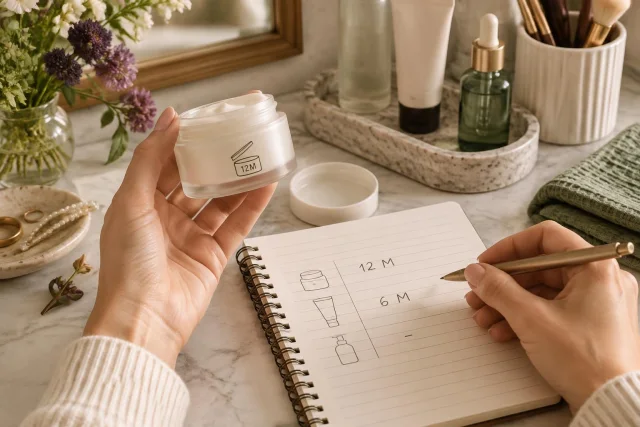
The batch number, shelf life where applicable and packaging symbols help identify or interpret specific information. The PAO—the open-jar symbol—indicates the period of use after opening the product. Don’t replace that indication with a universal duration for all shampoos or conditioners: check the specific packaging and follow the information shown there.
An information symbol points to where additional details can be found. If it appears, use it as a prompt to locate that information rather than overlooking the symbol. The batch number, in turn, can be recorded alongside the product name to avoid confusion between different items or packages.
As an editorial example, when you open a product, you can note its name as shown, the batch number and the opening date on a record, and check the PAO symbol on the package itself. The date you note is a personal record, not an invented period of use. To decide how to apply the shelf-life information, refer back to the details for that product.
| Packaging detail | What you can check | Practical approach |
|---|---|---|
| Function | What purpose the product states | Read it on the exact package; don’t infer it from the brand |
| INCI ingredients | Which names appear in the list | Look for the components you want to identify without attributing results |
| Precautions | Which instructions accompany the product | Check them before use and don’t transfer them to another item |
| Batch number | Which code identifies the batch | Record it alongside the product name if you need to distinguish packages |
| PAO or open jar | What period after opening the package indicates | Follow the printed information; don’t replace it with a general rule |
| Additional information | Whether the symbol points to further details | Find the information associated with the symbol |
A brief record for comparing without confusion
A useful note doesn’t need to become a review or an assessment of the product. Its purpose can simply be to gather details you can refer to later. You can create a record on your phone or save a clear photo of the packaging, as long as you identify which product it relates to.
As an editorial exercise, fill in a record with these fields: product name or description as shown on the packaging; stated function; INCI ingredients you want to locate; precautions; batch number; shelf-life or PAO information when shown; and opening date as a personal detail. Keep information copied from the package separate from your observations. For example, “the packaging states a specific function” is documented information; “I want to compare it with my current product” is a note about your purpose, not a claim about the product.
This method makes comparisons more precise because it avoids relying on memory or mixing up the instructions for two items. It also makes it easier to return to the original label if you have a question about a detail. If a photo cuts off a precaution or doesn’t make the INCI list readable, check the packaging again rather than filling in what’s missing by assumption.
Questions that help you choose thoughtfully
Before adding a product, ask questions that can be answered from the label. Have I identified its stated function? Am I looking at the INCI list for the correct package? Have I read its precautions, rather than assuming they’re the same as those for another product? Have I located the batch number and shelf-life information where applicable? Is there an information symbol, and do I know where to find the associated details?
You can add a personal question, as long as you distinguish it from documented information: what specific aspect do I want to compare with my current routine? Perhaps you want to identify the function, find an ingredient or keep the instructions. Setting a clear, limited goal helps prevent a label from becoming a promise it doesn’t contain. It also helps avoid confusing the act of reading ingredients with an assessment of the formula or a prediction about results.
Checklist before making a change
- Confirm that you have the package of the product you actually plan to use.
- Find the stated function and read it as a description, not a guarantee of a result.
- Check the INCI ingredient list for the exact product.
- Read its precautions and keep them associated with that package.
- Check the batch number and record it if useful.
- Look for the information symbol and find the associated details, if it appears.
- Check the PAO or shelf life where applicable, without applying universal time limits.
- Save a legible photo or note that distinguishes the information on the package from your own observations.
Conclusion: let the label guide your next step
Reading the exact product label turns a vague decision into a series of specific checks: function, ingredients, precautions, batch number and shelf-life or additional information where applicable. Public information provides a framework for recognising these elements in cosmetic labelling; the specific package provides the instructions you need to consult for that item.
The most useful approach is to keep what you need for comparison without inventing rules: an identified INCI list, the product’s precautions, the batch number and the PAO information shown. This lets you separate documented information from your expectations and avoid transferring instructions between different products. This is a guide to reading labels, not an assessment of effectiveness or an individual legal interpretation. For more documented information, see the [1].