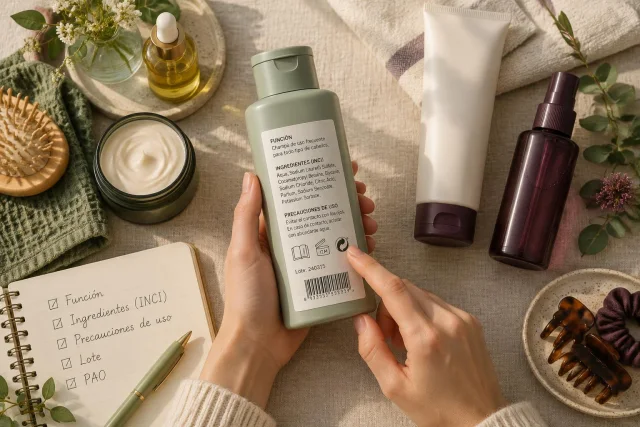




The useful question when reading a label
If an ingredient list includes Glycolic Acid or Lactic Acid, what can you conclude, and what remains unresolved? The straightforward answer is that these are two different ingredients, both classified as alpha hydroxy acids, or AHAs. The name lets you identify them and place them in a family; it is not enough to know the full formula, interpret its directions, or anticipate the experience of using it.
This distinction is especially useful when a package or product name includes a number. A percentage can look like a simple guideline, but appearing in a product name does not make it a universal instruction. For an accurate reading, it helps to separate three details: the ingredient name, the reference information provided by an inventory, and claims specific to a finished product.
The guide below focuses on this documentary reading. It does not compare formula results or offer use recommendations: it explains what the names identify and how far the conclusions supported by the available information go.
Two INCI names and one shared family
In this context, the common and INCI names are the same: Glycolic Acid identifies glycolic acid, and Lactic Acid identifies lactic acid. Both belong to the alpha hydroxy acid (AHA) family. [1] [2]
For a quick reading, look at the full name, not just a nearby word or an abbreviation that appears in a product name:
- Glycolic Acid corresponds to glycolic acid and is classified as an AHA.
- Lactic Acid corresponds to lactic acid and is also classified as an AHA.
- HA, in the product names cited alongside Lactic Acid, refers to hyaluronic acid; it is not another name for lactic acid.
The shared classification helps organize the vocabulary, but it does not make the ingredients interchangeable. Nor does it, by itself, allow a comparison of two finished cosmetics. Comparing products would require documented information about each formula and its conditions of use, not just an INCI name or membership in the same family.
What sharing the AHA category means
The family label supports a limited conclusion: both ingredients are grouped as alpha hydroxy acids. This relationship can help distinguish them, for example, from ingredients identified in other families, but it is not a complete profile of every product that contains them.
In particular, the AHA category alone does not determine an ingredient’s concentration in a formula, that formula’s directions for use, its results, or one person’s experience. Nor does it prove that two products containing members of the same family will offer identical effects. The family classifies; it does not predict the performance of a particular formula.
The commercial glossaries consulted present glycolic acid as an exfoliant and associate lactic acid with exfoliation and hydration. This language describes how these ingredients are presented in that commercial context; it is not an independent efficacy assessment and does not let us automatically attribute the same characteristics to every product that contains them. [1] [2]
Editorial example: if two labels list Glycolic Acid and Lactic Acid, respectively, you can note that both are AHAs and that they are different ingredients. You cannot complete the comparison with claims about which one will be more suitable or what results it will produce: those details do not follow from the names alone.
Why a percentage in a name is not a recipe
The documented product names include Glycolic Acid 7% Exfoliating Toner, Lactic Acid 5% + HA, and Lactic Acid 10% + HA. The figures are part of the names of specific products; they are not general guidance for choosing, preparing, or applying acids. [1] [2]
Reading a figure in context helps prevent turning an identifying detail into an instruction. A percentage on its own does not fully describe the formula or let you deduce how a product will feel. Nor does it show that a particular percentage is suitable for everyone or that a higher figure guarantees a particular result. A product’s directions should be interpreted in relation to that product; the names cited do not replace its specific instructions.
Editorial example: when recording Lactic Acid 5% + HA in a shopping note, it is reasonable to copy the name as it appears to identify the product. It would not be reasonable to turn that detail into a rule for preparing a mixture, deciding on a frequency, or automatically comparing another formula. The figure identifies the cited product name; it does not fill in the missing information about other products.
A simple practical question to ask is: “Does this figure appear as part of the name or as an explicit instruction for the product?” If it is part of the name, keep it as identifying information rather than treating it as a recipe or transferring it to different formulas.
Lactic Acid and HA are not synonyms
In Lactic Acid 5% + HA and Lactic Acid 10% + HA, the abbreviation HA refers to hyaluronic acid. Lactic Acid and hyaluronic acid are different names; their combination in a product name does not make them one substance or make one another way of writing the other. [2]
To identify the ingredient this guide covers, the relevant name is Lactic Acid. The mention of HA adds another element to the product name; it does not redefine lactic acid’s INCI name. Separating the two expressions helps avoid confusing an ingredient’s identity with additional information included in a product name.
Editorial example: if a personal note says “Lactic Acid + HA,” you can keep the full expression to recognize the product being mentioned. If the question is which of the two names identifies the AHA, the answer is Lactic Acid; HA should not be treated as a synonym for that entry.
What an ingredient inventory clarifies—and what it does not
CosIng, the European Commission database dedicated to information about cosmetic ingredients, provides INCI names, identifiers, and functions as reference data. It also contains information about active and historical records. It can therefore help verify how an ingredient is identified and what reference information is associated with its entry. [3]
That use should remain within its scope. An ingredient having an INCI name or appearing in an inventory does not mean the database certifies a product’s efficacy, approves its safety, or independently determines its conditions of use. A reference entry also does not assess a particular formula or predict an individual’s experience.
Regulatory information may depend on the jurisdiction and the question under review. Therefore, an ingredient’s presence in a database does not replace a specialist review of the applicable rules. The practical distinction is clear: an inventory can answer questions about nomenclature and provide information associated with a record; on its own, it cannot determine whether a particular formula is suitable for someone.
A useful comparison for organizing the information
The following table separates what can be identified from the available material from what is not established by the name or classification. It does not compare products or predict results.
| Reading criterion | Glycolic Acid | Lactic Acid |
|---|---|---|
| Common and INCI name considered here | Glycolic Acid; glycolic acid | Lactic Acid; lactic acid |
| Identified family | AHA | AHA |
| Documented commercial description | Presented as an exfoliant in the glossary consulted | Associated with exfoliation and hydration in the glossary consulted |
| Example of cited product name | Glycolic Acid 7% Exfoliating Toner | Lactic Acid 5% + HA and Lactic Acid 10% + HA |
| Conclusion not supported by the name alone | How a formula will feel or what result it will have | How a formula will feel or what result it will have |
The table highlights an important limit: the shared category does support classification, while the descriptions and commercial examples belong to distinct contexts. They are not enough to infer equivalence, superiority, or individual suitability.
A practical checklist for reading a label
When reviewing an INCI list or the name of a cosmetic, this sequence helps keep details and inferences separate:
- Copy the full name: Glycolic Acid and Lactic Acid identify different ingredients.
- Note the family without overinterpreting it: both are classified as AHAs, but the category does not prove identical results.
- Keep figures in context: the cited percentages appear in product names, not as universal instructions.
- Separate the abbreviations: HA in the cited names refers to hyaluronic acid; it is not a synonym for Lactic Acid.
- Use an inventory as a reference tool: it can help with nomenclature and information associated with a record, but it cannot assess the experience of using a formula.
- Look for product-specific information when you have questions about a product: an ingredient name does not replace that product’s own directions.
This checklist does not turn label reading into a complete assessment of a cosmetic. Its purpose is more modest and useful: to recognize what is written without adding conclusions that the information does not support.
The conclusion: identify before inferring
Glycolic acid and lactic acid are different ingredient names that share the AHA classification. That is the central comparison supported by the available information. The cited product names also show why a percentage should be read as part of a product’s identification, not as a recipe that applies to others.
An accurate reading separates name, family, and commercial claim. Inventories can clarify nomenclature and provide reference information, but they do not, on their own, establish a formula’s efficacy, appropriate use, or individual experience. With that distinction in place, the names no longer look like shorthand instructions; they are understood for what they support: two different ingredients within the same family, with clear limits on any further conclusions.