



The key question: which part of the cosmetic is “organic”?
When a package highlights the word “organic,” the useful first question is not whether the whole product deserves that label, but exactly what the claim refers to. It may relate to the origin or agricultural production of certain ingredients. On its own, it does not show that all components come from agriculture, that the finished cosmetic is certified, or that the product offers general health or environmental benefits. [1]
A label brings together several layers of information that are best kept distinct: the declared composition, the provenance of certain ingredients, and any certification supporting a claim. They are related, but one does not replace the others. An ingredient’s appearance on the list does not automatically tell you where it came from, and a claim about one component does not necessarily certify the finished product.
In the United States, the cosmetics reference distinguishes “organic” claims linked to the origin or agricultural production of ingredients and refers to the USDA’s NOP agricultural program. It also separates agricultural certification from the requirements that apply to cosmetics. This framework should not be applied automatically to other markets: it describes a U.S. context, not the regulatory status or certification of every product. [1]
To read the claim more precisely, break it down into specific questions:
- Ingredient: Which component is presented as organic?
- Provenance: Is its origin or agricultural production explained?
- Certification: Is a certification scheme identified, and what scope does it cover?
- Finished product: Does the claim refer to an ingredient or to the complete cosmetic?
If the package does not answer those questions, the conclusion should remain open as well. “Organic” is neither an INCI name nor a complete description of the formula; without additional information, it is also not enough to infer efficacy or overall environmental impact.
What the INCI list can help you check
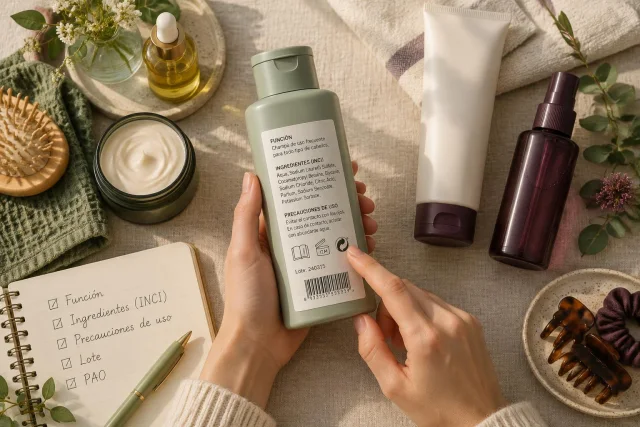
INCI names identify the ingredients declared in cosmetics. The list is useful for locating a component and comparing what appears on two packages, but it does not tell the whole story of the formula. It does not provide precise amounts and, for fragrances, does not necessarily reveal their full composition. [2]
The distinction becomes clearer when you frame the question before consulting the list. If you want to know whether a name appears, the INCI can help. If you want to know which crop it came from, what proportion is organic, or whether the finished product is certified, you need additional information: those answers do not follow from the name alone.
Comparing two lists also has limits. Seeing the same name on both does not prove that the formulas are identical or let you calculate the amount of that component. And if the front of the package highlights an ingredient, finding it in the INCI confirms its declared presence—not its agricultural origin, certification, or the effect attributed to it.
Editorial example: imagine two products whose packaging highlights the same ingredient. The list can help verify whether it appears in both, but not determine which contains more, which comes from organic agriculture, or whether either is certified. To go further, you would need to look for a specific statement about provenance and scope, rather than interpreting the name as though it included that information.
This approach avoids asking the INCI to provide an answer it is not designed to give. It is a tool for identifying declared names, not a certificate of origin or a summary of every production detail.
Packaging symbols answer different questions
Labels also bring together practical information that does not certify the organic status of ingredients. This includes the nominal quantity, batch number, minimum durability date, and period after opening. The open-jar symbol indicates the stated period of use once the product has been opened; it is not a composition certification. [2]
Each element is easiest to interpret in terms of its purpose:
- Nominal quantity: the amount declared on the package.
- Batch: a reference for identifying a product batch.
- Minimum durability: information about how long the unopened product keeps, where applicable.
- Open jar: the stated period from when you start using the product.
- Packaging-related symbols: these may provide information about materials or management systems, but do not guarantee that the packaging will actually be recycled in the municipality where it is used.
Editorial example: if someone sees the open-jar symbol alongside an “organic” claim, those are two different pieces of information. The first indicates a period counted from opening; the second is a claim whose scope needs to be clarified. Neither, on its own, confirms what the other means.
Likewise, information about packaging materials or management does not establish the agricultural origin of an ingredient. Information can be useful without answering the question on the reader’s mind. Separating these functions helps distinguish a practical instruction for use from a claim about composition or certification.
CosIng is an ingredient reference, not a seal
CosIng, the European Commission’s database, brings together INCI names, identifiers, and functions of cosmetic ingredients, with current and historical information. It can help you recognize a term or understand the function attributed to it in the database. The presence of an entry does not mean that a use is authorized or that the ingredient’s safety has been approved. [3]
A name database can seem conclusive when consulted without regard to its scope. In reality, finding an entry provides reference information: it does not prove that every product containing that ingredient is effective, suitable for everyone, or compliant with every condition of use.
Nor does it verify whether an ingredient is organic. A name, identifier, or function describes reference information; it does not establish agricultural provenance or the scope of a certification. The entry also does not reconstruct a formula’s concentration or, by itself, resolve restrictions that may apply to a substance. [3]
The most precise way to use CosIng is as a documentary glossary: search for the term, check what information the entry contains, and limit your conclusion to that information. If the question depends on conditions of use or a specific regulatory issue, the database is no substitute for a specialist review for the relevant market.
The United States and Europe: jurisdiction changes the scope
The available sources answer different questions. The U.S. reference addresses “organic” claims related to origin or agricultural production and refers to the USDA’s NOP program. CosIng, by contrast, is a European tool for looking up ingredients. A guide to reading labels helps identify elements on packaging, but does not certify an individual cosmetic. These are not interchangeable forms of evidence and cannot resolve every claim in every market. [1] [3] [2]
The difference is also one of scope: an entry in a European database provides information about an ingredient; a U.S. agricultural claim belongs to its own context; and label symbols serve other functions. A general explanation for one market should not be turned into a regulatory conclusion for another.
| If you want to know… | Check first… | What that check does not prove on its own |
|---|---|---|
| Whether an ingredient is declared | The INCI list | Its exact amount, provenance, or certification |
| What reference information exists for a name or function | The corresponding CosIng entry | Authorization of use, safety approval, or product efficacy |
| What an “organic” claim means | Its scope, provenance, and declared certification scheme | That the entire cosmetic is certified |
| The stated period after opening | The open-jar symbol | Ingredient origin or certification |
| What a packaging symbol indicates | The specific label and its context | That recycling actually takes place in every municipality |
If a purchase depends on a regulatory claim, first identify the country or market it refers to and which scheme or body supports the claim. If that information is unclear, do not fill in the gaps based on an INCI name, an isolated symbol, or an ingredient database.
A practical read, without jumping from a clue to a conclusion
You can review the package in this order to keep each piece of evidence in its place:
- Locate the highlighted word: determine whether it is attributed to one ingredient, several components, or the complete product.
- Check the INCI list: use it to recognize the declared names, without inferring precise amounts or agricultural provenance.
- Look for the certification’s scope: if a scheme is mentioned, check what it covers and which market it applies to.
- Read symbols separately: quantity, batch, minimum durability, and period after opening answer different questions.
- Consult CosIng with a specific question: an entry may help with a name or function; it does not turn the lookup into an approval of the product.
- Stop where the information ends: if the label does not specify provenance, scope, or certification, those details cannot be inferred from promotional language alone.
Editorial example: faced with a package that says “with an organic ingredient,” a careful reading would distinguish the ingredient claim, its appearance in the INCI, and any identified certification. If all you have is the name on the list, you can check that it appears among the declared ingredients, but you cannot establish where it came from or who certifies its origin.
The takeaway: separate ingredient, label, and certification
Reading a cosmetic advertised as “organic” does not mean decoding every symbol as if they all said the same thing. Start with the specific claim and distinguish three layers: which ingredient is declared, what information the package provides, and what certification supports that claim—if any.
The INCI helps identify ingredients; symbols can indicate quantity, batch, durability, or use; and CosIng serves as a reference for names and functions. None automatically replaces information about provenance or certification. The U.S. and European references also have different scopes and do not justify transferring a conclusion from one market to another.
The practical rule is simple: a clue only answers the question it provides information about. Keeping that distinction in view makes labels easier to read precisely and helps prevent a highlighted word from promising more than the documentation supports.