




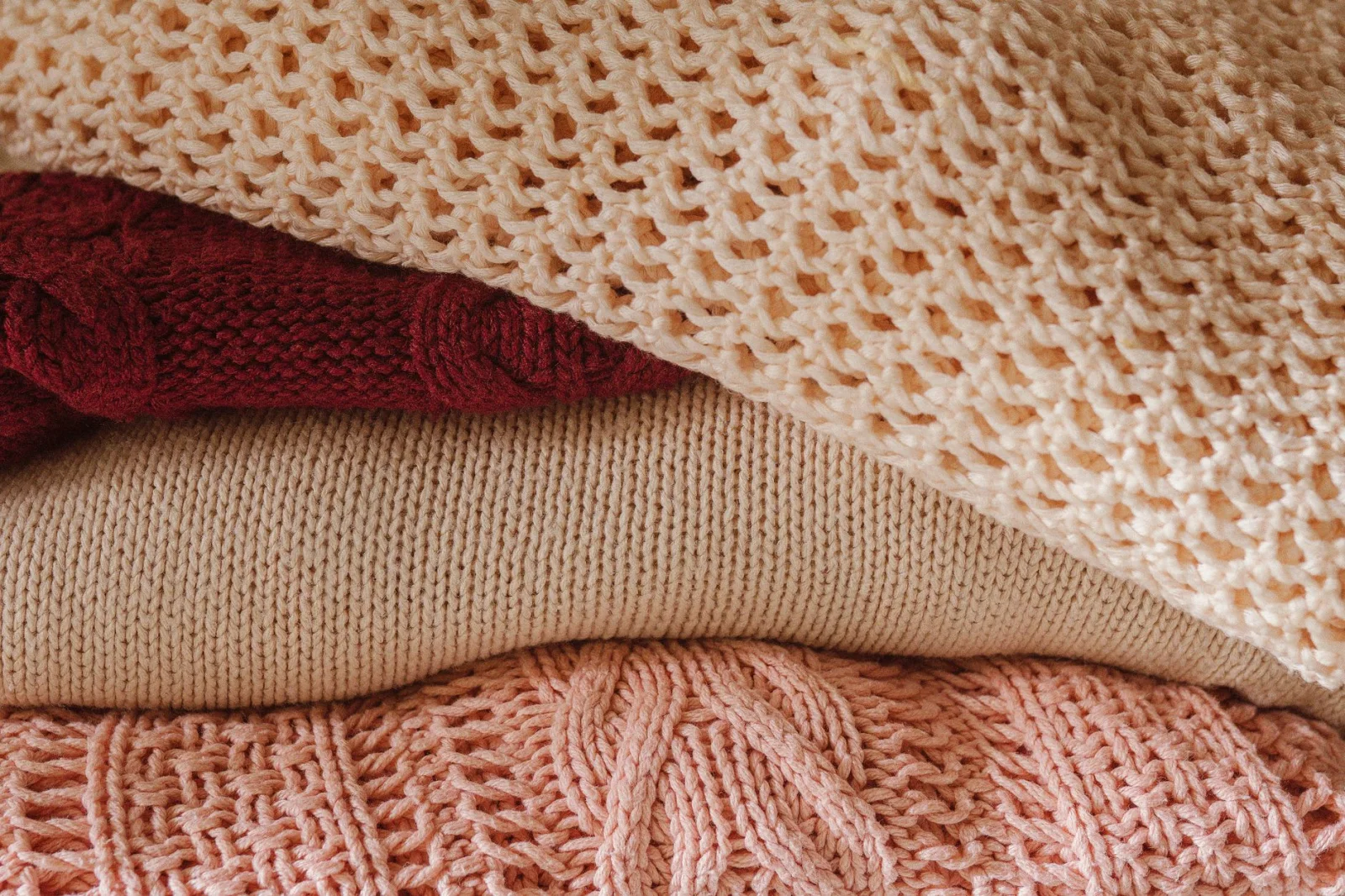
Why store wool clean?
A garment put away for the next season still needs everyday care: dust can build up, and dirt or residue left in the fabric makes it less advisable to store it as it is. The practical recommendation is simple: store wool clean and completely dry, in an organised place where it can be protected from dust, moths and mould. [1]
Before folding it, check the label and follow its cleaning instructions. There is no single programme you can infer from the word “wool” alone: the composition, construction and specific garment instructions all matter. If the right care method is unclear, it is best to work that out before putting the garment away rather than assume that a method suitable for another piece will work for this one.
A brief preparation routine can help you make a sensible choice:
- Check the label and keep any specific care instructions in mind.
- Make sure the garment is clean and dry before placing it in storage.
- Choose a container that does not compress it unnecessarily and limits its exposure to dust.
- Keep zips, fastenings and anything that could snag it away from the fabric’s surface.
Cleaning beforehand and choosing a container are separate decisions. A suitable bag does not replace cleaning, and putting away a clean garment does not, by itself, eliminate every risk associated with its surroundings. It helps to think of storage as a combination of preparation, protection and available space, not as a single solution.
What changes when you choose a vacuum bag
Vacuum bags can save space, which is appealing when garments are bulky or closet space is limited. That advantage does not automatically make them the best choice for every delicate piece, however. Moisture is an important consideration: trapped air can hold moisture, and these bags are not considered ideal for delicate garments. [1]
The decision therefore depends on the problem you are trying to solve. If the priority is reducing bulk, a vacuum bag offers that practical benefit, but it is worth weighing it against concerns about moisture and the nature of the garment. If it is a piece you would rather store with less compression and in a more breathable alternative, a fabric bag is worth considering.
There is no need to treat every vacuum bag as equivalent to an ideal storage container. Saving space is a specific benefit; possible moisture retention is a limitation worth considering. The information available does not establish a universal storage duration or precise humidity conditions for every bag or garment, so avoid turning a general comparison into a guarantee for a particular case.
These questions can help you decide:
- Is saving space a real need in this closet?
- Is the garment delicate, or does it have a construction you would rather not compress?
- Is it completely dry, and can you choose an option that raises fewer concerns about moisture?
- Do the label or the garment’s characteristics suggest extra care is warranted?
If several answers point towards less compressive protection, a breathable bag may be the more sensible choice. If space is the main consideration, weigh that compromise without assuming that removing the air eliminates environmental risks.
When a breathable fabric bag makes sense
Breathable fabric bags are a practical alternative for storing delicate garments without relying on vacuum compression. They are especially worth considering when you want to protect clothing from dust while avoiding a bag that may retain moisture. [1]
Their main appeal is not that they solve every preservation problem, but that they let you prioritise airflow over maximum space saving. For a garment you plan to put away for a season, that difference may matter more than compressing it to gain room. Choose according to the balance you need: more compression or a more breathable option.
Before putting it away, make sure the bag is clean and the garment has enough room to be placed inside without forcing it. A breathable bag does not replace suitable storage conditions: dust, moths and mould remain risks to consider. Choosing a container helps manage protection, but it cannot guarantee that a garment will be safe from every kind of damage.
A simple way to compare the options is to distinguish their main purpose:
| Option | Practical advantage | Consideration for delicate garments |
|---|---|---|
| Vacuum bag | Saves space by compressing the contents. | May retain moisture and is not ideal for delicate pieces. |
| Breathable fabric bag | Offers an alternative that allows for breathability. | Does not, on its own, remove the need to store the garment clean and protected. |
The table does not establish absolute superiority. If the closet has enough space, there may be no reason to prioritise compression; if space is scarce, the decision calls for weighing that benefit against concerns about moisture and the garment’s delicacy.
How to reduce snags while storing garments
Snags can occur when wool comes into contact with zips or other objects. Keeping those items separate is a simple way to reduce the risk of the fabric catching during handling or storage. [1]
Before closing the closet or container, check what is next to the garment. Another item’s zip, an accessory with protruding parts or an object pressing against the fabric can create unnecessary contact. There is no need to overcomplicate the organisation: simply store wool apart from anything that could snag it and avoid piling it up so it gets caught between other items.
The structure of the fabric also helps explain why garments do not always respond to handling in the same way. In single jersey, the face has columns of knit stitches and the reverse shows arcs; when cut, this structure can curl or unravel. Rib alternates knit and purl columns and stretches crosswise, while interlock joins two rib structures and resists curling. [2]
These differences describe knit structures, not an automatic classification of wool garments. They are a reminder that construction affects behaviour: a surface or edge may need more careful handling, but the specific construction cannot be identified from the fibre alone. Yarn, fibre, machinery and finishing also play a role, so a general description is no substitute for information about a specific garment.
Why storing a garment does not determine how to wash it
Storage recommendations do not tell you which wash cycle, temperature or method is right for a particular garment. The fact that it is best stored clean does not prove it can tolerate a particular programme, and the word “merino” alone does not reveal the right method. The label and the garment’s construction remain decisive. [1]
Nor should descriptions of knit structures documented for cotton garments be applied directly to a wool garment. Single jersey, rib and interlock have different structural characteristics, but that information cannot establish the composition of a garment without a label identifying it. Behaviour also varies according to yarn, fibre, machinery and finishing. [2]
A useful rule is to keep the two decisions separate:
- For washing, follow the label and the information specific to the garment.
- For storage, make sure it is clean and dry, choose between compression and breathability according to your priorities, and keep it away from anything that could snag it.
This avoids turning general storage advice into washing instructions that the evidence does not support. A good routine is not about applying the same method to every wool garment, but about combining the label’s guidance with a storage choice suited to the garment’s delicacy, the space available and the protection you want.