


The key question: what does the figure represent?
Can a garment that already feels comfortable help you choose a size in another one? Yes, as a point of comparison, provided you first confirm what was measured and how. A body measurement describes the body; a finished garment measurement describes a made-up piece. Even when both are expressed in centimetres or inches, they are not interchangeable.
A practical comparison does not begin by looking for an equivalent size. It begins by identifying the type of data, its method and the style it applies to. A chart may provide body measurements, garment dimensions or both. For example, the UNIQLO US guide distinguishes body measurements from finished garment measurements and notes that both are used when selecting a size in that market.[2] The relationship between a garment’s dimensions and the body also matters when interpreting ease, which is not a universal conversion.[1]
Two categories worth keeping separate
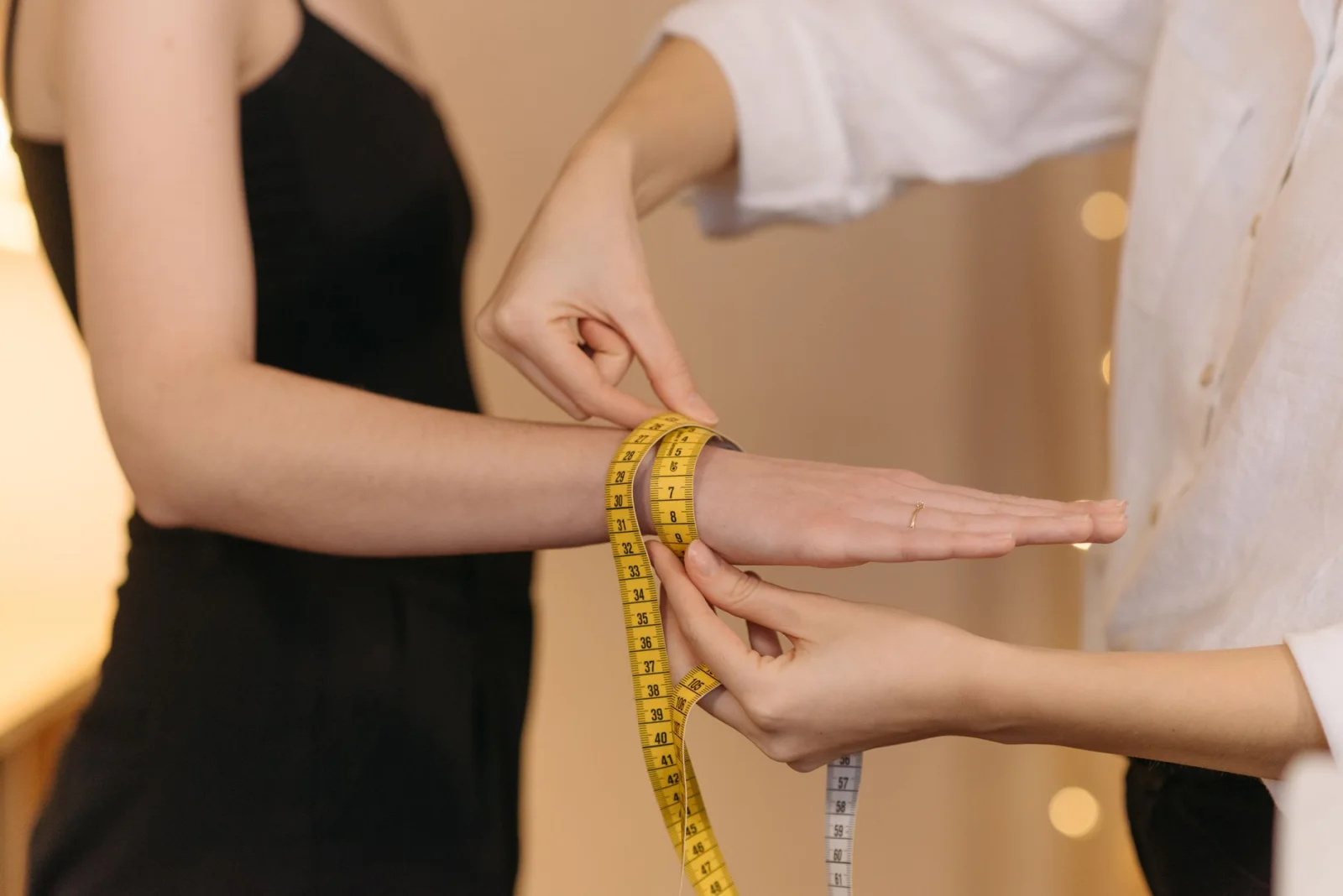
A body measurement is taken on a person by following the instructions for the relevant chart. It may describe the circumference of a part of the body. A finished garment measurement is taken on a made-up piece of clothing and may refer to a width, length or another dimension specified in the product information.
The distinction explains why a body measurement does not necessarily mean that the garment will have exactly the same dimension. There may be ease between the two: the allowance between the body and the garment, related to the intended fit. The amount and distribution of that ease depend on the piece and how it is designed; the available sources do not support turning it into a fixed rule for all garments.
When gathering data, note which category each figure belongs to:
- Body: a measurement taken on the person according to the relevant instructions.
- Finished garment: a dimension of a made-up piece, taken according to its product information or guide.
- Flat width: the width of the garment laid flat, if that is the specified method.
- Unit: centimetres or inches, as shown in the information consulted.
This classification prevents the mistake of comparing two figures simply because they use the same unit. If a product description does not say what is being measured or how, there may not be enough information to make a reliable comparison.
A flat width is not automatically a circumference
A width measured on a garment laid flat describes a distance on an object arranged in a particular way. Body circumference, by contrast, runs around the body. Having centimetres in common does not make these measurements equivalent.
For that reason, it is best not to multiply or double a width to infer a body circumference, unless the applicable instructions explicitly define that method and the relationship between the figures. Without that support, the calculation introduces an equivalence that the chart does not establish. The explanation of ease and garment measurements helps clarify why the two categories should be distinguished; it does not turn every flat width into a body measurement.[1]
Look for terms such as “width”, “circumference”, “body measurement” and “garment measurement”, as well as any diagrams or instructions accompanying the chart. If the product information says to lay the garment flat, use that method to interpret its figure; do not substitute a measurement taken on the body. The method is part of what the figure means.
Check the unit, method and style before comparing
A reasonable comparison requires the data to be compatible in several respects. Before using a familiar garment as a reference, check the following:
- Unit: compare values in a common unit. If one product description uses centimetres and another uses inches, do not read the raw figures as if they were directly comparable. Converting units is not converting sizes.
- Point and procedure: check which area is measured and whether the figure describes the body or the garment. A body circumference should not be compared directly with a width measured on a garment laid flat.
- Style and variant: confirm that the data applies to the specific garment you are considering. The general category—for example, a shirt or trousers—is not enough to assume that the instructions or measurement points match.
- Version of the information: identify the market and version of the chart available. A general guide can clarify concepts, but it does not replace the specific instructions for the style’s product information.
The practical priority is simple: first follow the instructions that apply to the garment and the version you are consulting. If two charts do not define their measurements compatibly, avoid forcing an equivalence and use the comparison only as limited guidance.
How to use a garment that already fits comfortably
Choose a piece whose fit you know and find a measurement that can be compared with the new purchase. Then confirm that both figures describe the same type of dimension and were obtained in a compatible way. If one chart gives body measurements and the other gives finished garment dimensions, do not put the figures side by side as if they described the same thing.
Editorial example: you have a shirt that feels comfortable, and its product information identifies the width of the garment laid flat. The product information for the shirt you are considering also provides this type of dimension and explains how to measure it. In that case, comparing the widths can guide you on that specific point. It does not let you claim that the shirts have the same drape, mobility or feel: those conclusions cannot be drawn from a single figure.
Another editorial example: you know only a body measurement, while the new garment’s product information gives a finished width without explaining how the two relate. There is not enough basis to infer the fit from these data. The useful conclusion is not to guess a size, but to recognise what information is missing.
A garment with a familiar fit can provide context when reading the available measurements.[1] Its value lies in helping interpret a compatible figure, not in automatically translating one size label into another. A personal reference offers guidance; it does not guarantee that another piece will feel the same.
What the UNIQLO US example does—and does not—show
The US guide distinguishes body measurements from finished garment measurements and advises consulting both when selecting a size.[2] It also documents a revision to the women’s body measurement chart beginning with the Autumn/Winter 2025 collection. A change to the measurements shown in that chart does not, by itself, mean that a garment’s finished dimensions have changed.[2]
This distinction separates two different claims: that a body measurement chart has changed, and that the dimensions of a made-up garment have changed. The cited case is limited to UNIQLO US’s women’s chart and the revision documented for that collection. It does not establish equivalence with other markets, brands, garments or seasons.
When consulting a chart, use the same order: identify whether it refers to the body or the garment, check the market and version, and follow the instructions relevant to the style. The example is useful for showing why the categories must be distinguished; it is not a general rule for converting sizes.
Organise your references without turning them into a universal chart
A brief personal note can help you recall what you compared and under what conditions. This is a practical suggestion from Gentle Chic, not an official chart or a promise of fit. You could record:
- The brand and style of the reference garment.
- The market and date when you consulted the information.
- The specific measurement and whether it refers to the body or the garment.
- The unit and method described in the product information.
- The new garment and the version of its chart or available information.
Editorial example: instead of saving only “chest measurement”, note whether the figure was a body circumference or a shirt dimension, which unit was shown and what instructions accompanied the product information. This makes it easier to distinguish a valid comparison from two figures that only appear comparable.
If you consult the information again later, the date helps you identify which version you used. It does not prove that the chart has changed or that one variant is equivalent to another; it simply preserves the context of your note.
Checklist before deciding
- Do I know whether each figure describes the body or the finished garment?
- Am I comparing the same type of measurement, rather than a circumference with a flat width?
- Do the unit, area and procedure match, or do I know how to account for the difference?
- Does the chart apply to the style, variant, market and version I am consulting?
- Am I using the familiar garment as guidance, without assuming it predicts drape or comfort on its own?
- Have I identified what information is missing if the data is not compatible?
If the answer to a key question is no, limit your conclusion: the reference garment may still help organise your search, but the figures available do not support a reliable equivalence.
The final decision depends on compatible data and preferences
A chart lets you read measurements with more context, but it cannot certify comfort, drape or mobility on its own. If you are between two sizes, the decision may also depend on your preferences and, where possible, trying the options. For a distance purchase, check the current information for the variant and the exchange terms before deciding; these can change, and no policy is established here for a specific product or market.
The short answer to the opening question is: a garment that already fits comfortably can be useful, provided the comparison is based on measurements of the same type, taken compatibly and linked to identifiable styles. Compare what the data means before comparing the figures. That way, a personal reference helps you read the available information without turning into a promise of equivalence between garments or brands.