



Looking at an artwork slowly does not require knowing how to draw or arriving with an interpretation prepared. The idea is to start with what is visible —a shape, a fold, a posture—and then note what question it brings to mind. That small shift helps keep observation from turning immediately into a conclusion.
The exercise can be done through a digital collection or during a visit to London’s National Gallery, with different rules for each setting. Online, simply choose an available artwork and explore the details offered by its virtual tour. In the gallery, check the museum’s current conditions and make room for other people. In both cases, the notebook is there to preserve a perspective of your own, not to produce a perfect copy.
Before interpreting, describe what is in front of you
The first step is to record details another person could also locate in the image. For example: “there is a dark fabric over the shoulder,” “the figure has one arm raised,” or “two round objects are visible near the edge.” These are simple descriptions, but they establish a concrete basis before moving on to ideas about meaning or intention.
A personal reading can be added afterward: “the fold makes the posture seem stiff,” or “I wonder whether that object matters to the scene.” It helps to mark the difference between the two layers. An observation points to what appears; an interpretation suggests what it might mean. If identifying an object, figure or textile requires certainty, the artwork’s catalogue entry is a better place to look for information than intuition alone.
An educational activity from the Getty suggests looking closely, asking questions and distinguishing visible details from interpretations; it also encourages attention to other people’s perspectives [1]. Although its context is a school activity, the method can be adapted for a personal visit without carrying over any of its access conditions or rules to the museum.
A notebook page can be divided into three lines:
- I see: a brief description, without explaining what it means yet.
- I wonder: a question prompted by a specific detail.
- I’ll check: a fact to look up in the catalogue entry, if needed.
For example: “I see a fabric with pronounced folds”; “I wonder whether the figure’s movement is connected to them”; “I’ll check how the garment is identified in the catalogue entry.” The last line can remain blank: not every observation needs to be resolved.
A question of your own for exploring a digital collection
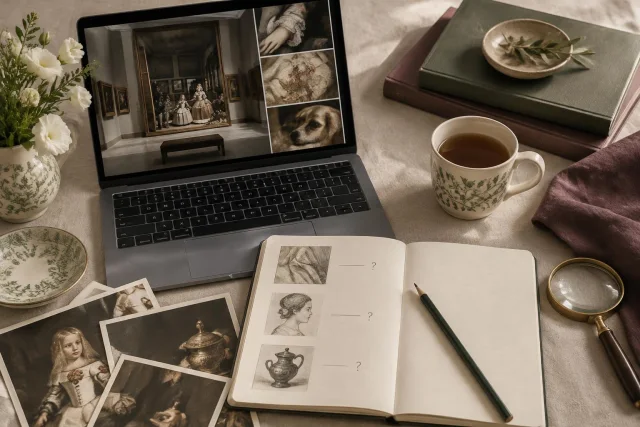
For a virtual visit, choosing just one artwork can leave more room for attention than trying to explore an entire collection at once. The Museo Nacional del Prado offers virtual tours of its collection and a selection of exhibitions; some works can be explored in high resolution, and certain tours include audio [3]. These options make it possible to look more closely at details available on screen, but the experience will depend on the specific resource and what is published when you visit.
A personal question helps guide your attention without imposing an answer. It can be as specific as “which textile seems lightest?”, “how is this posture held?”, or “which everyday object catches my eye?” These are questions for observing, not claims about the technique, subject or intention of the person who created the work.
A brief record can include the title and artist as they appear in the catalogue entry, along with the question that opened up the exploration. If the image can be enlarged, explore one detail at a time: a silhouette, the edge of a garment or the relationship between two shapes. If the level of detail you are looking for is not available, it is better to choose another work or read its catalogue entry than to fill in the gaps with assumptions.
The physical location of artworks can change and does not necessarily match the Prado’s digital tour. A virtual visit is therefore a way to explore online, not a reservation or confirmation that a work will be in a particular gallery [3]. The tour’s availability can also vary; the official link lets you check what is offered when you plan your visit.
A visit to the National Gallery with one detail in mind
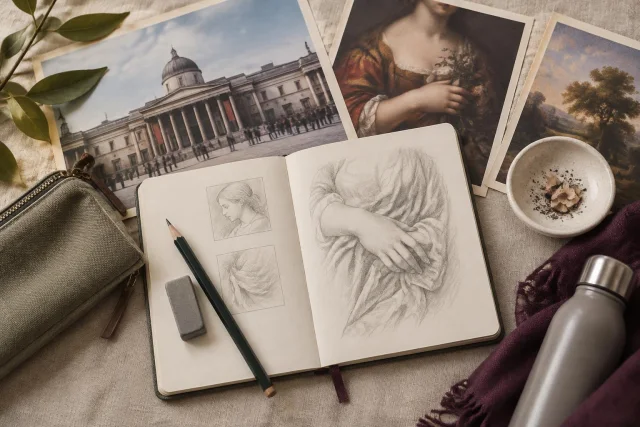
At London’s National Gallery, drawing in the galleries is subject to specific conditions. The page consulted sets a maximum size of A3 for paper or a notebook, limits time in front of a painting to ten minutes, and prohibits drawing in entrances and passageways. It also lists permitted materials and notes that staff may ask visitors to move when the gallery is busy [2].
These instructions apply to this museum, not to galleries in general. They are also the rules consulted on a particular date: before going, it is worth checking the drawing page and the visitor and accessibility information again. The official page is the reference for confirming both the conditions and permitted materials; do not assume that a rule encountered at another museum applies here.
To prepare for the exercise, choose one detail before entering: a silhouette, a fold or a combination of shapes. Bringing a small notebook and a pencil listed among the permitted materials helps keep the plan focused, but there is no need to set yourself the goal of completing a drawing. Look first; then, if the conditions allow, make a simple sketch. The purpose is to give one work your attention, not to measure your skill or finish a copy.
The visit also calls for flexibility. If the space becomes crowded or staff ask you to move, change position or choose another work. The stated limit is not a speed challenge: it helps keep the activity brief and respect the flow of people who are there to look. It does not presume that a particular gallery will be open, that a specific work will be on display or that conditions will remain the same at a future date.
What to note so the two settings stay distinct
A useful notebook page does not have to be long. It can keep four elements that will later help you recall what you observed and what remained a question:
- Artwork: title and artist, copied from the available catalogue entry.
- Visible detail: a shape, colour, posture or relationship between elements.
- Question: something the detail brings to mind, phrased without assuming the answer is certain.
- Context: digital tour or gallery visit, with a note about what information you consulted.
This record also clarifies what can be compared. Online, you can note which areas the tour allowed you to enlarge or whether audio was available. In a gallery, you can record the detail you observed without turning the visit into a promise of future access. There is no need to judge which format is better: each offers different conditions, and the exercise can be adapted to suit them.
If you share the activity with someone else, you can first write down your observations separately and then compare your questions. This preserves the distinction between describing and proposing an interpretation while making room for different perspectives; the exchange fits the Getty’s educational exercise’s approach to observation and conversation [1]. Shared ideas remain personal readings until supported by a catalogue entry or other documentation.
A nearby alternative, without attributing it to a museum
If you are not planning a visit to London or would rather not explore a collection on screen, the same structure can be applied to an object at home. A cup, a garment or a plant offers shapes and details that can be described before being interpreted: where the shadow falls, how a fabric folds or which part first draws your attention. This is a home-based adaptation of the idea, not an official National Gallery activity.
The simplest version fits in a note: “I see,” “I wonder,” and, if relevant, “I’ll look it up.” It can be done with words or a simple sketch. If you take the notebook to a museum, local rules on drawing and circulation remain decisive; if you work online, the catalogue entry and available features determine what can be checked.
A short checklist before you begin
- Choose one artwork or object and one specific detail; there is no need to cover an entire collection.
- Describe visible shapes, postures or relationships first, and keep your interpretations separate.
- Ask a question prompted by the detail without turning it into a confirmed fact.
- Consult the catalogue entry when you want to check an identification or contextual detail.
- For the National Gallery, check the drawing rules, permitted materials, and visitor and accessibility information before you go.
- If digital availability, image detail or gallery conditions do not suit your plan, choose another work or adapt the exercise.
A notebook of details can be no more than a line beside an artwork’s title. Its value lies in preserving the path between what is seen and what is thought: one concrete observation first, an open question afterward.