Who it is for and which areas it is intended for
CeraVe Hydrating Cleanser, marketed in Spain, is intended for normal to dry skin and presented for the face and body. This description helps place the product and understand its commercial audience; it is not an independent assessment of its suitability for any individual. The page consulted on October 22, 2026, also includes information about other products, so it is worth checking that each indication appears within this cleanser’s section. [2]
The distinction matters when deciding what to read first. The name and commercial description identify the product; the ingredient list provides a declared composition; and the instructions indicate the proposed use. These are different kinds of information, with different scopes. Reading them separately avoids turning promotional wording into a guaranteed result or attributing to this cleanser a benefit that appears on another product page.
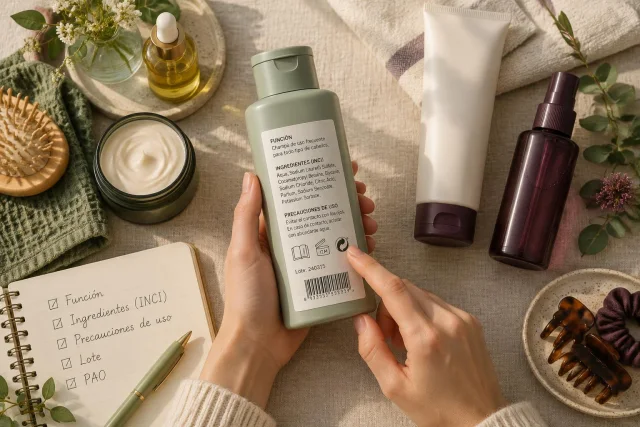
What the INCI list tells you
The declared list includes water, glycerin, fatty alcohols, ceramides NP, AP and EOP, sodium hyaluronate, and cholesterol, among other components. It is a practical way to locate specific names in the published composition, not a complete description of how the product will behave on any particular person’s skin. [2]
INCI nomenclature is used to identify ingredients by standardized names. A reference database can help identify those names, identifiers and recorded functions, but the presence of a substance there does not in itself constitute a safety approval or proof of efficacy. The database contains active and historical information and serves an informational purpose; it cannot, on its own, resolve how to interpret a specific formula. [3]
The order also does not provide a reliable percentage scale for reconstructing the recipe. The label can indicate which ingredients are declared, but it does not disclose their precise amounts. As a result, the position of glycerin or ceramides does not tell you how much is present, nor can you compare doses with those in another product based on the INCI alone. The industry guide to labels also notes that the list does not reveal a fragrance’s full formula. [1]
A useful reading can focus on verifiable questions: Is the name I’m looking for listed? Am I looking at the list for this version of the product? What information does the label not provide? Not filling in the gaps with assumptions is part of reading a list well, not a limitation to work around.
How its use is indicated
The published instructions for this cleanser are to massage it onto wet skin and rinse. They also say to avoid contact with the eyes and discontinue use if a reaction occurs. [2]
These instructions describe the stated method of use for the product. They are not a promise that everyone will get the same result. When referring to the physical packaging, it makes sense to check the instructions and list for the product in hand: the information available on a website may not, on its own, resolve questions about a particular presentation.
For an orderly reading, you can follow this short list:
- Area: the commercial description covers the face and body.
- Application: massage onto wet skin.
- Removal: rinse.
- Stated precaution: avoid the eyes and discontinue use if a reaction occurs.
The list summarizes the instructions; it does not add steps or clinical recommendations. If a reaction occurs, the documented instruction is to stop using the product; there is no need to reinterpret it as an assessment of the cause.
Declared composition and advertised benefits
The page attributes benefits related to hydration, the skin barrier and MVE technology to the cleanser. These are commercial claims about the product, not independently demonstrated results established by the presence of those names in the INCI. The list allows you to confirm that certain ingredients are declared; on its own, it cannot verify how much each contributes or what effect an individual will experience. [2]
It helps to distinguish three kinds of information here. First, the declared composition: the names that appear in the list. Second, the use description: how it is applied and what precautions are stated. Third, the advertised benefits: the language used to present the product. The first category does not automatically confirm the third. For example, the presence of ceramides in the list does not, by itself, demonstrate a specific result for the skin barrier; nor does a mention of hydration let you infer duration, intensity or an individual response.
The label guide helps explain why you should not infer more than the list provides: the nomenclature identifies ingredients but does not give their precise amounts. The CosIng database, in turn, offers guidance on names and informational functions without certifying the efficacy of a finished product. Together, these are tools for reading more precisely, not substitutes for evidence specific to results. [1] [3]
A practical way to assess a statement is to ask what kind of claim it is: Does it describe an ingredient visible in the list, a specific instruction or an advertised benefit? If the answer is the last one, it should be treated as such. A commercial claim does not become an independent conclusion just because it appears beside the INCI.
How to avoid mixing product sections
Product pages may bring together information blocks for different products. The page consulted includes modules that do not correspond to this cleanser; in particular, a statement about absorbing sebum should not be attributed to Hydrating Cleanser. [2]
To check which product a statement belongs to, first identify the product heading, then verify whether the text appears within its description, instructions or ingredient list. If a block does not maintain that clear connection, do not use it to describe the product. This care avoids both a mistaken attribution and a comparison between products built from mixed information.
A final reading, without over-inference
A brief check may be enough to assess the available information:
- The Spanish product page presents it for normal to dry skin and for the face and body.
- The list declares water, glycerin, fatty alcohols, ceramides NP/AP/EOP, sodium hyaluronate and cholesterol, among other ingredients.
- The stated method of use is to massage onto wet skin and rinse; it also says to avoid the eyes and discontinue use if a reaction occurs.
- Claims about hydration, the skin barrier and MVE should be read as commercial claims, not independent results.
- The INCI does not disclose precise amounts, and an ingredient-name database does not verify the efficacy of the finished formula.
- Statements from other sections of the page should not be attributed to this cleanser.
In this way, the product page answers specific questions—who it is commercially intended for, what composition it declares and how it indicates using it—without promising more than the information supports. The INCI list is useful for identifying names; it is not a quantified formula or an assessment of results. And a claim about benefits remains a commercial claim, even when it appears beside recognizable ingredients.