Before cleaning, identify the decision you need to make
If you’re wondering how to care for gemstone jewellery, the most useful answer does not begin with a cloth, liquid or technique: it begins with finding out what you have in front of you. The same guidance does not necessarily apply to every stone, because scratch resistance, impact resistance and sensitivity to environmental conditions are different considerations. The gem’s treatments and the type of setting also matter.
That is why a prudent approach is not to default to a “gentle” cleaning method, but to gather information before choosing one. If you do not know the gem, its treatment or the condition of the setting, limit your intervention to separating the piece from other jewellery and consult a qualified professional before wetting it, rubbing it or applying a product. Appearance alone does not resolve these uncertainties. [2]
Hardness and impact resistance are not the same
Hardness relates to resistance to scratching; it does not, by itself, describe how a gem will withstand a blow or pressure. A stone can be difficult to scratch and still be vulnerable to breaking or chipping if struck. In turn, certain environmental conditions can affect some gems even without an impact or visible friction. These are separate considerations, and knowing one does not settle the others. [2]
In practice, this changes the question. Rather than asking only whether a stone “is hard,” consider what could happen during the care you have in mind: might it rub against another piece? Would pressure or rubbing be involved? Could it be exposed to water, heat or other conditions? The answer will depend on the specific gem and how it is set; without those details, there is no basis for turning a general characteristic into a cleaning recommendation.
It is also worth considering the context in which the jewellery is used. Keeping several pieces together can make them rub against one another, a possibility worth bearing in mind even when the stones seem resilient. Separating them reduces contact between pieces, but does not replace identifying their materials or resolve the condition of their settings. [2]
Gem, treatment and setting: three details that change the decision
Before choosing a method, try to confirm three things: what the gem is, whether it has been treated and how it is set. Purchase information, a description of the piece or retained documentation can serve as a starting point. If they do not provide clear answers, do not fill in the gaps by intuition: a visually similar gem may call for different considerations, and a treatment can affect which kinds of care are appropriate. [2]
The setting is also part of the assessment. Cleaning affects more than the stone’s surface: a piece has fastenings and settings that are worth checking. If a prong appears displaced, a clasp no longer works as usual or the gem moves, the issue is no longer simply how to remove dirt. Avoid handling it until its condition has been assessed. Checking clasps and settings is a practical precaution noted for caring for gemstone jewellery. [2]
If you have a product description, read it as documentation about the piece, not as automatic permission to use any method. Note the exact terms for the gem, treatment and setting; then ask which specific care practices are compatible with those details. An incomplete label or a description that mentions only the stone’s appearance may not provide enough information to choose a cleaning method.
Cosmetics: reading the label does not identify a piece of jewellery’s tolerance
When cosmetics and jewellery come up together, it is easy to confuse two questions: what a product contains and how a particular piece might react to it. A cosmetic label can help identify the product’s function, ingredients and stated precautions. This information describes the cosmetic; on its own, it does not determine compatibility with a particular gem, treatment or setting. [1]
This offers a more precise way to act. If you want to identify a product that may have come into contact with a piece of jewellery, keep the packaging or note its name and consult the label information, including the precautions. Do not infer that a single ingredient proves that the product will damage the piece, or that a general warning by itself explains an observed change. Cosmetic documentation and assessment of the jewellery address different questions. [1]
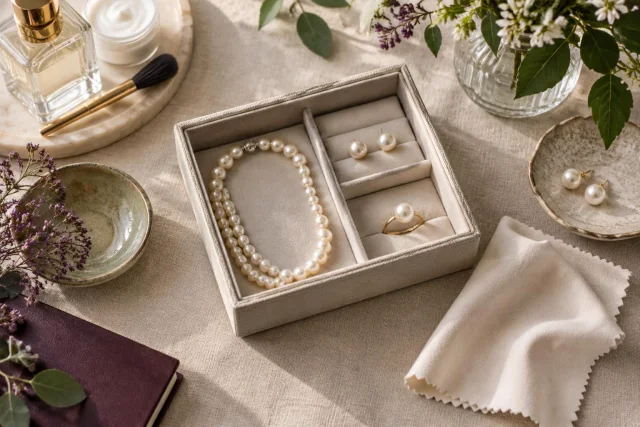
For pearls, the precaution is more specific: contact with cosmetics and heat are noted as factors to bear in mind. This justifies avoiding unnecessary exposure to those conditions, but it does not establish a universal cleaning method or mean that all products act alike. If you do not know what care the pearl can tolerate or the piece combines materials, seek advice before applying a product or technique. [2]
A practical check before intervening
Before cleaning or storing gemstone jewellery, gather the information available and decide whether it is enough to avoid friction or whether you need an assessment. This check does not prescribe a technique; it helps identify when there is not enough information to choose one.
- Identification: Do you know the gem, or only its colour and appearance?
- Treatments: Does the documentation say whether the stone has received any?
- Setting: Do the clasps and settings seem secure, with no perceptible movement of the gem?
- Exposure: Would the method you are considering involve rubbing, pressure, water, heat or contact with a product?
- Combination: Does the piece include pearls or other materials that may call for different considerations?
- Product information: If it came into contact with a cosmetic, can you check its label and precautions without turning them into a conclusion about the jewellery?
If key answers are unavailable, the most sensible choice is to postpone cleaning, rather than choose a generic recipe that seems unlikely to be harsh. Separating the piece from other jewellery avoids adding friction during storage while you gather documentation or seek guidance about that specific item. [2]
When to stop and seek an assessment
Stop if you do not know the gem or its treatment and the planned care requires direct contact; if the piece combines materials; if a pearl could be exposed to cosmetics or heat; or if a clasp or setting seems loose. In these cases, an assessment of the jewellery can clarify which materials are present and what kind of care is appropriate. General information about gems helps explain why identification matters, but cannot, by itself, establish a method for a piece that has not been examined. [2]
To request an assessment, bring the piece and share any details you have kept: the purchase description, information about treatments and, if there was relevant contact, the cosmetic’s name or packaging. The label lets you check what information is declared about the product, while the piece itself needs its own assessment. Keeping these two sources of information separate helps you ask a specific question without attributing a cause to the cosmetic that has not been established. [1]
Care begins with knowing what you do not know
A useful routine need not begin with a list of methods, but with a check: which gem the jewellery contains, whether it was treated, how it is set and what conditions it might encounter. Hardness does not answer all those questions by itself; nor does a cosmetic label determine the answer for a particular piece.
When information is incomplete, avoid friction between pieces of jewellery, check clasps and settings without forcing the piece, and leave cleaning until you have received appropriate guidance. That way, care is tailored to the jewellery you actually have, not a rule that assumes all gems and settings respond in the same way.