




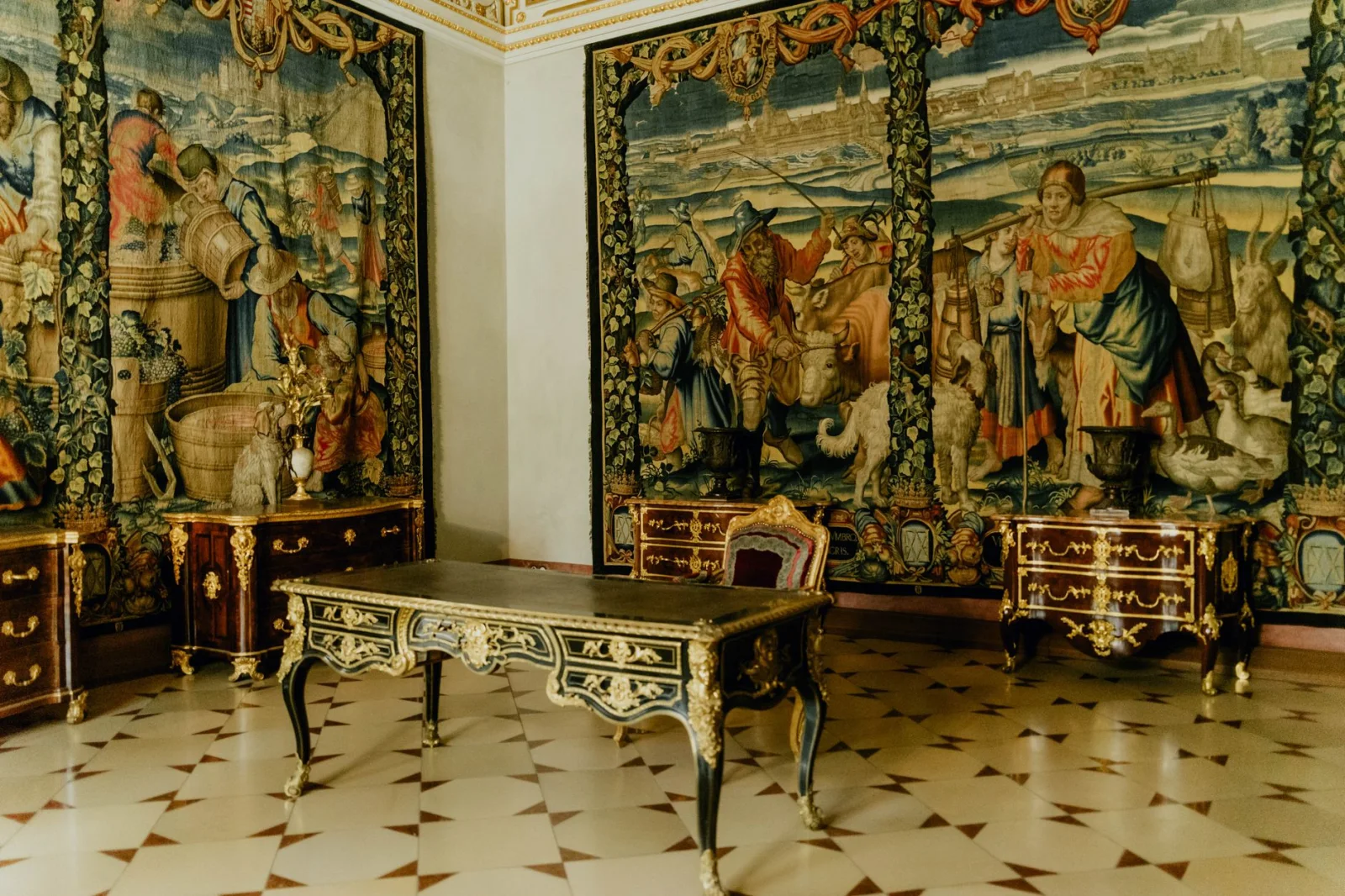
From commission to tapestry: who funded and who produced it
What can a museum record tell us about a Baroque tapestry, and what should we avoid inferring from it? The answer begins by separating two scales: the historical context of European commissions and the details attributed to a particular work. Between 1570 and 1720, courts and elites commissioned tapestries in various centres across Europe. These works brought together valuable materials, artistic designs and workshop labour, but that general description does not by itself identify the origin or composition of any particular example. [1]
The historical exhibition devoted to this period places production within networks of patronage and craft organisation. Commissions from courts and elites resulted in works where design and weaving could be associated with different people or institutions. It also shows how workshops and series formed part of organised production, rather than a uniform category simply called “Baroque tapestry.”
This framework helps us ask better questions of a record: who conceived the design? Where was the tapestry made? Which materials does the museum record? What date range does it propose? Not all the answers need to come from the same attribution, and they should not be confused with one another.
Workshops and patronage: a varied context
Paris and Brussels appear among the production centres described in the exhibition; it also notes the founding, in 1662, of the Manufacture Royale des Tapisseries de la Couronne for Louis XIV. These details show that workshops and court-linked initiatives were part of the European context, but they do not authorise assigning a particular work to one of these centres without specific supporting evidence. [1]
The distinction is practical: a general history can explain which institutions existed and what forms of patronage encouraged commissions; an object record documents the attributions recorded for a work. The fact that a manufactory was important during the period does not demonstrate that it wove every Baroque tapestry, even if a piece’s appearance or date seems compatible.
It is best to read the historical overview as a map of possibilities, not an automatic label. The context explains the system; the record defines what is attributed to the individual work. This distinction prevents a history of workshops from becoming an undocumented provenance.
The Elephant: two attributions that are not interchangeable
The record for The Elephant, from The Berain Grotesques Series gives a differentiated attribution: the tapestry was made at the Manufacture Royale de Beauvais, France, after a design by Jean Baptiste Monnoyer; its style and border are associated with Jean I Berain. These are not three ways of naming a single author. The record distinguishes the place of production, the design, and the contributions to style and border. [2]
This distinction matters because a work’s design and its weaving describe different tasks. Saying that a tapestry was made at a manufactory is not the same as claiming that its design originated there; attributing a design to an artist does not erase the involvement of the workshop that executed the weaving. In this case, the available information allows each relationship to be expressed without turning them into a single authorship or making a broader claim than the record supports.
When reading a different object, look for equally specific wording. “Designed by,” “made at” and “style and border by” convey different kinds of information. If a record does not identify one of these aspects, there is no need to fill the gap with details from a general history of the period.
Materials, technique and the scale of the work
For The Elephant, the recorded materials are wool and silk. The technique is described as tapestry weave with slit and double interlocking joins. The record also gives dimensions of 461.1 × 306.4 cm. These are details of this object, with reference number 1956.101 and credit line Robert Allerton Endowment; they should not be transferred to other tapestries or presented as properties of an entire category. [2]
The combination of details helps us read the record in layers. Materials indicate which fibres are listed; technical terms record how the textile’s construction is described; dimensions express the scale of the work. None of these categories replaces the others. Knowing, for example, that a piece includes silk does not by itself provide a complete description of its technique, condition or conservation history.
One useful way to organise the information is to note each detail alongside its function:
- Place of production: the manufactory the record associates with the weaving.
- Design: the attribution to Jean Baptiste Monnoyer.
- Style and border: the association with Jean I Berain.
- Materials: wool and silk, according to the work’s record.
- Technique: tapestry weave with slit and double interlocking joins.
- Scale: 461.1 × 306.4 cm.
The list does not turn a record into an exhaustive materials report. It helps keep the categories separate and identify which information is actually recorded.
Read a date as a range
The date attributed to The Elephant is “about 1688–1732.” The range itself matters: it should not be reduced to an exact year or replaced with a single date chosen for convenience. It extends beyond the 1570–1720 framework used for the historical exhibition. The exhibition’s context can therefore help situate Baroque production, but it does not replace the record’s specific dating. [2] [1]
In practice, retain wording such as “about” and the full range when summarising a record. This preserves the precision of the attribution without suggesting that the museum gives an exact date. It also avoids fitting the work’s date to a general period simply because the two frameworks partly overlap.
General chronology and the dating of an individual object answer different questions. An exhibition can define the period it addresses; a record can propose a particular range for a work. There is no automatic contradiction when those frameworks do not match exactly: what matters is not replacing one with the other.
What a record can—and cannot—establish
The record allows us to describe The Elephant as a tapestry attributed to the Manufacture Royale de Beauvais, based on a design by Monnoyer, with style and border associated with Berain, made about 1688–1732, in wool and silk and using the recorded technique. It also allows us to identify its dimensions and reference number. This is a concrete basis for explaining how information about a work is organised.
It does not allow us to attribute the same materials, dimensions, technique, designers or manufactory to other tapestries. Nor does it establish that all works in a series share exactly the same details. The historical context provides information about patronage, workshops and European production, but does not by itself establish conservation condition, current sale or the presence of this example in an exhibition. The cited record should not be read as an exhibition schedule.
For a careful reading, a simple checklist is enough:
- Distinguish historical context from an object’s attribution.
- Separate design, place of production, style and border.
- Retain the recorded materials and technical terms as written.
- Keep the dating range and its qualifiers, such as “about.”
- Do not extrapolate dimensions, fibres or workshop to other examples.
- Treat the record as documentation of a work, not confirmation of its current display or availability.
This lets one particular work help us understand how to read an attribution without making it a universal model. The context explains why tapestries depended on commissions, artists and workshops; the record shows how those elements can be distinguished in an object record. That is the most useful approach: broad in context and precise in what it claims about each tapestry.