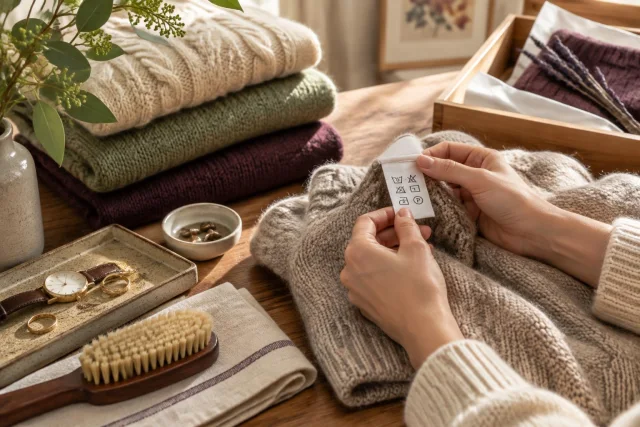




If you want to repair a luxury item, what should you know before taking it in or sending it? The answer starts with distinguishing the possibility of requesting an assessment from confirmation that the work will be carried out. Hermès’ service in the United States covers several item categories, but each piece must be assessed; the available information does not establish a universal price or turnaround time. For a cosmetic in Spain, the preparation is different: keeping the labeling, batch number and duration information helps identify the product, but does not by itself substantiate its effectiveness.
This guide separates those two processes so you can make a useful enquiry without assuming an outcome, cost or applicable conditions. The repair categories relate to the US service; the cosmetic information relates to the Spanish context. The conditions for one process should not be applied to the other.
What types of items can you ask about?
Information about the US service covers work on leather goods, including bag zippers and stitching, as well as shoes and boots. It also includes watch maintenance, jewellery, garment examinations, furniture and accessories such as scarves, ties and gloves. Assessments are handled through customer service or stores.[1]
The list can help you decide whether it is worth asking about an item category, but it does not confirm that every type of damage can be addressed. An item’s fitting into a category does not mean a particular repair will be accepted, nor does it let you anticipate the scope of the work.
Editorial example: if a bag has an open seam, you can explain that you are asking about a stitching repair. That makes the request clearer, but does not establish that the item can be repaired or what work might be proposed. If the lining is also worn, mentioning each issue separately lets you ask about both without assuming they will be part of the same job.
How to describe the problem without jumping to a diagnosis
An initial enquiry is more precise when you distinguish what you observe from what you want to know. Describe the everyday symptom—for example, a zipper that will not move, an undone seam or a mark on a garment—and say whether you are seeking a repair, maintenance or an assessment. There is no need to assign a technical cause that has not yet been confirmed.
This way of framing the request helps keep the conversation focused on the item and your specific need. It also avoids confusing a description of the damage with a promise about the method or outcome. Describe what is visible; leave the assessment of the work to the evaluation.
Editorial example: instead of asking only, “Can you fix it?”, you could say that the bag’s zipper is sticking and ask which channel to use to have the item examined. This identifies the problem while leaving the question of feasibility open.
What to confirm before handing over or sending the item
Before arranging transport, it is worth confirming which channel is appropriate for the item category and what steps are needed for it to be examined. Information about the service directs customers to customer service and stores for an assessment, but does not set a universal procedure for every item or situation.[1]
You can prepare these questions to find out which conditions apply to your case:
- Channel: Should you contact customer service or visit a store for this type of item?
- Identification: What details about the item are needed to guide the enquiry?
- Drop-off and return: What steps should you follow before leaving or sending the item?
- Cost and timing: When and how could an estimate be provided, if the repair is feasible?
- Scope: What work is being proposed, and which parts of the item would it cover?
These are practical questions, not conditions that have already been confirmed. The available information does not publish repair prices or set a general timeframe, and it does not indicate that every request will result in a repair. Avoid planning your budget or schedule around assumed figures, dates or procedures. Wait for a response about the specific item before deciding how to proceed.
If there are several areas of damage, list them separately. That way, you can ask what has been assessed and what any proposal would include. A clearly defined request keeps the conversation organised; it does not replace a decision about the item.
Repair and authenticity are separate questions
When buying second-hand, you may have questions about condition, authenticity and whether a repair is possible. These are different matters, however. The fact that a service covers a category or assesses an item does not in itself authenticate that piece or document its history or condition before assessment.[1]
If authenticity is your main concern, state that clearly and confirm what information the chosen channel can provide. Do not interpret a maintenance assessment or repair as certification: the available information does not promise that outcome.
Editorial example: for a pre-owned item with a damaged clasp, you can split the enquiry into two parts: ask whether the clasp can be assessed, and separately ask what information is available to address your question about authenticity. The first question concerns a repair; the second requires a different answer. Details you have kept about the purchase may help explain the context, but should not be presented as conclusive proof unless they have been established as such.
What to keep from cosmetic labeling in Spain
For cosmetics, keeping information is useful for documentation. Information available about cosmetics in Spain includes labeling details such as the product’s function, ingredient identification, precautions, batch number and duration. Keeping the packaging or saving these details legibly can help you identify the product and refer to them later.[2]
When checking a package, it is worth keeping:
- Name and declared function, to recognise the product you are asking about.
- Ingredient list, as identified on the labeling.
- Relevant precautions and instructions shown on the package.
- Batch number, to identify the specific unit.
- Duration information, when provided.
If you do not keep the package, a legible transcription of the details can help you have them to hand; make sure each detail remains associated with the correct product. This is a practical suggestion for organising information, not a claim about an additional requirement.
The label lets you consult what is declared about the product; it does not, on its own, demonstrate that a formula achieves a particular effect. The presence of an ingredient does not guarantee a result either. It is worth distinguishing documentary identification of the cosmetic from any conclusion about its effectiveness, which cannot be drawn solely by reading the ingredient list.[2]
Why the two processes should not be conflated
A repair enquiry and a question about a cosmetic may share a practical need: having relevant information before asking a question. But the item, purpose and geographic scope differ. The maintenance and repair service referenced here applies to the United States; the cosmetic labeling information relates to Spain. Confirm each process through the appropriate channel and in its relevant context, rather than assuming that conditions for one apply to the other.
Editorial example: if you live in Spain and want to ask about a repair covered by the information for the US service, do not assume that its procedure automatically applies where you live. Confirm the channel and conditions for your case. Separately, an enquiry about a cosmetic label in Spain does not determine how a fashion repair is handled.
Nor are a cosmetic’s batch number and proof of authenticity for a luxury item equivalent. A batch number helps identify a cosmetic product unit; it does not establish the origin of a bag, watch or piece of jewellery. Keeping these uses separate prevents a detail from being assigned a function that has not been documented.
Checklist before making an enquiry
Before getting in touch, define your question and gather only the relevant information:
- For a luxury item: identify the item, describe the damage or maintenance you want to ask about, and enquire about the assessment channel, possible cost, timing and scope.
- If the item is pre-owned: separate the repair question from any question about authenticity; do not treat an assessment as certification.
- For a cosmetic in Spain: keep the package or make a legible record of the function, ingredients, precautions, batch number and duration shown.
- For any process: confirm the specific conditions before arranging shipping, setting a budget or counting on a date.
A useful enquiry starts by separating what you know
Preparing does not mean anticipating the answer. For a luxury item, it means identifying the category, describing the problem and finding out how it will be assessed, without turning the availability of a service into a guarantee of repair. For a cosmetic, it means keeping the information that helps identify it and reading its declarations without confusing them with proof of effectiveness.
The most useful distinction is simple: ask about an assessment when you need to know what can be done with an item; keep the labeling when you need to identify or ask about a cosmetic. Keeping the item, purpose and geographic scope separate makes it easier to get a relevant answer and avoid planning around conditions that have not yet been confirmed.