




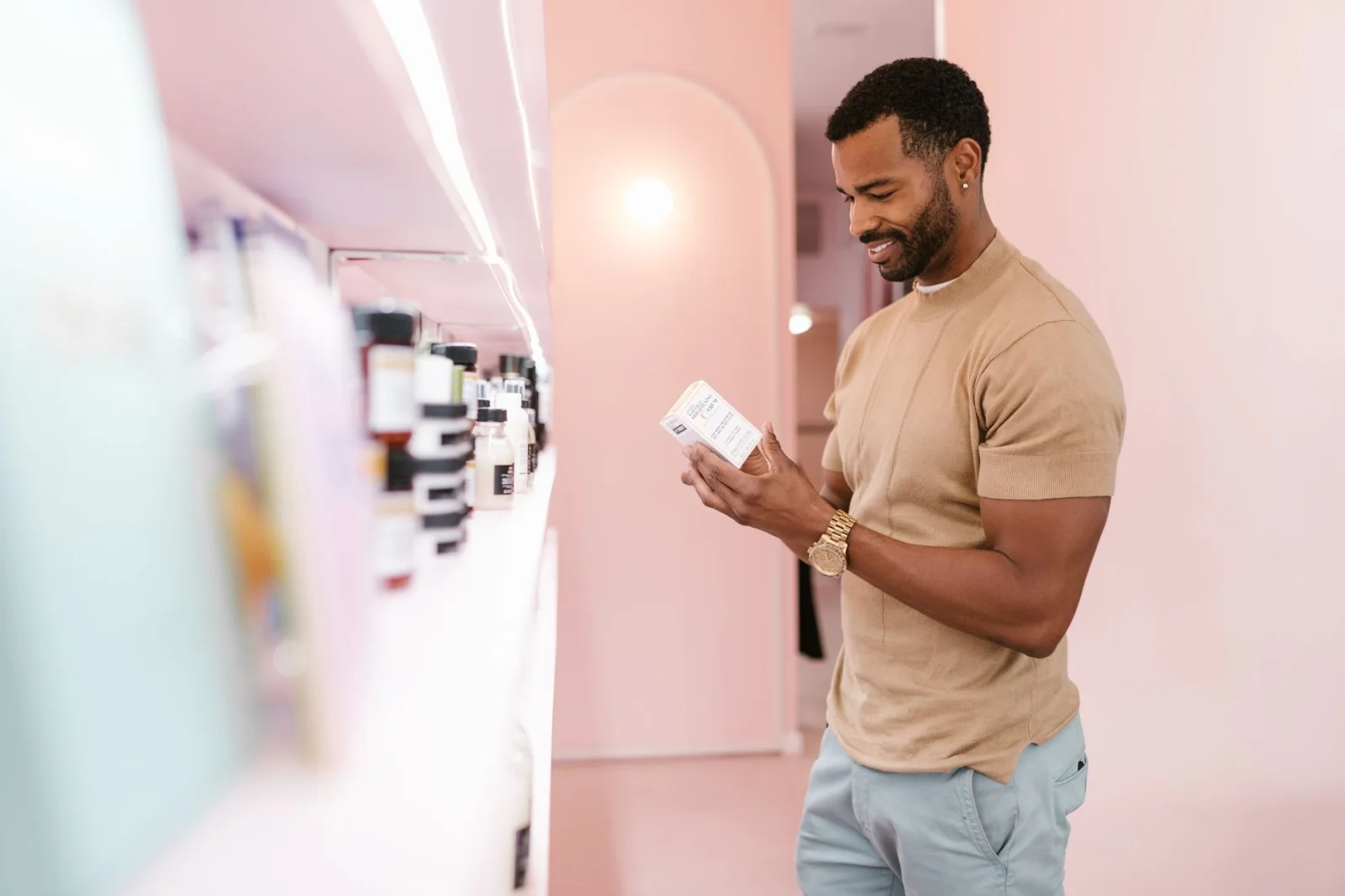
Two labels, two different questions
What should you look for on a cosmetic product, and how should you read a garment’s care symbols? The answer depends on what each label is designed to communicate. In Spain, cosmetic labelling helps identify the product, its function, its ingredients and certain directions for use. For textiles, the GINETEX system organises garment care instructions into five symbol families: washing, bleaching, drying, ironing and professional care. [1] [2]
These are not two versions of the same scale. Cosmetic information helps you recognise the product in front of you and the instructions that accompany it; a textile label guides you through care operations for that garment. The specific label is the starting point, not a general rule inferred from an ingredient, fibre or habit.
What to look for on a cosmetic label
For a first reading, look for the product’s function and the details that let you identify it and check its directions for use. The Spanish framework consulted includes information such as the ingredient list, precautions, batch number and duration. Each detail answers a different question: what the product is, what it declares as containing, what warnings it includes and how to identify the unit or period indicated. [1]
A practical way to read the label is to follow this order:
- Identify the declared function. Start with the product type and the intended use indicated, rather than inferring it from a striking ingredient.
- Find the ingredient list. It lets you check the declared components; on its own, it does not explain their concentration, the precise role of each component in that formula or the result it will have for a particular person.
- Read the precautions and directions for use. They relate to the specific product and should not be replaced by general guidance taken from another cosmetic.
- Keep the identification and duration details. The batch number and time-related information help identify the product and find the labelling that applies to it.
This process does not turn the label into an independent assessment of the product. It is a way to distinguish descriptive information—such as function or declared ingredients—from the evidence needed to assess a specific claim. Reading the details carefully helps you ask more precise questions, but it does not add proof that the label does not provide.
How textile symbols are organised
The GINETEX system groups care instructions into five families. Each indicates a type of operation, and the marks accompanying the symbol specify the relevant limits. The visual sequence should not be read as a universal recommendation for all garments: it is consulted as part of the instructions on the specific label. [2]
| Family | Operation covered | What to check |
|---|---|---|
| Washing | The indicated washing treatment | The symbol and limits shown on that label |
| Bleaching | Whether a bleaching treatment is covered and under what instruction | The specific instruction, without applying it to other garments |
| Drying | The drying method or treatment indicated | The details and limits associated with the symbol |
| Ironing | The instruction relating to ironing | The specific garment’s instruction, not one for a similar piece |
| Professional care | Information for professional care | The corresponding symbol and its limits |
The table summarises the categories; it does not replace reading each symbol or let you assign an instruction to a garment without seeing it. The shape and marks have meaning within the system; if a detail on the label is unclear, it is better to check it than to guess from the fabric’s appearance alone.
Read the limits; do not fill in what is missing
A textile instruction is not an invitation to choose the treatment that seems gentlest or most familiar. The symbol family indicates which aspect of care is being addressed; the accompanying details set the limits for interpreting that operation in the case of the garment. There is no single formula to apply across garments just because they appear to share a fibre, colour or category of use. [2]
For example, if two garments look similar, that resemblance does not prove they should receive the same treatment. The useful approach is to check the washing, bleaching, drying, ironing and professional care instructions shown on each one separately. If an instruction in a particular family cannot be interpreted with confidence, do not invent an answer based on another garment’s label.
The same principle helps prevent confusing a category with a broader guarantee. A symbol provides information within its scope; on its own, it does not describe every aspect of the fabric or predict the result of every method applied to it. Focusing on what the label actually communicates makes it easier to follow without attributing information it does not contain.
The presence of an ingredient does not equal efficacy
In cosmetics, an ingredient list and an efficacy claim are different kinds of information. The declared presence of a component does not by itself show that the product achieves a particular result. Nor is it enough to conclude what effect it has in a specific formula or for a specific person. The information consulted distinguishes ingredient identification from the product’s documentation and claims; it does not establish the efficacy of a particular formula. [1]
This matters when someone compares labels while looking for a familiar active ingredient. Finding it may answer the question “Is this ingredient declared?”, but not necessarily “What result can I expect from this product?” The second question would require evidence supporting the specific claim, and simply reading the list does not provide that evidence. It is therefore best not to turn the presence of a name into a promise about performance.
It also helps to distinguish the declared function from a personal interpretation of the ingredients. A label can provide information for identifying a cosmetic and checking its precautions, but it does not automatically turn each component into a complete explanation of the formula. This caution makes it easier to read without overstating what the available information demonstrates.
A brief reading routine for each case
Before using a cosmetic, identify its function, check the ingredients, and review the precautions and identification or duration details shown on the label. If a claim about results matters to your decision, do not consider it proven merely because an ingredient associated with it appears on the list.
Before caring for a garment, read its own label and check the washing, bleaching, drying, ironing and professional care families. Interpret the limits that accompany the symbols together, and avoid transferring instructions from another piece, even if it seems equivalent.
The essential difference is simple: for cosmetics, identify and contextualise the product information; for textiles, follow the operations indicated for that garment. In both cases, careful reading works best when it respects the scope of each detail, without turning a declaration into proof of efficacy or a symbol into a universal rule.