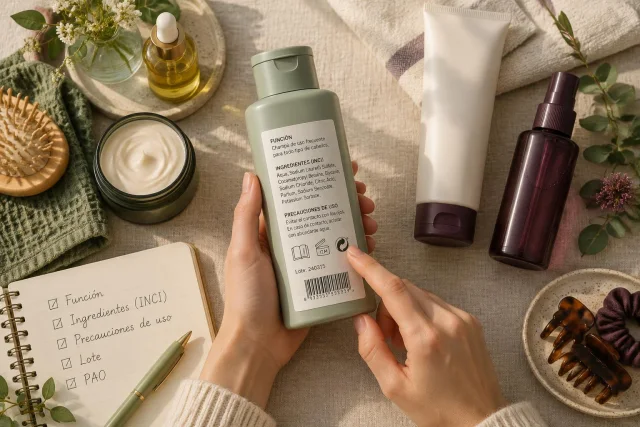
The key question: what does it prove when an ingredient appears in a database?
If a name appears in CosIng, does that mean the ingredient is approved for any cosmetic? No. CosIng lets you look up INCI names, identifiers, and functions; its presence in the database does not constitute authorization for use or a safety approval. The U.S. reference on organic cosmetics addresses a different question: the origin or agricultural production of certain ingredients and the relevant certification. Identifying, evaluating, and certifying are different questions. [2] [1]
To read both references without confusing their scope, it helps to start with what each one can establish. An ingredient database helps identify names and functions; a statement about organic production points to agricultural criteria and, in the U.S. context, a certification system. Neither one, on its own, answers every question about a finished product.
What you can look up in CosIng
CosIng provides lookup information on INCI names, identifiers, and cosmetic ingredient functions. The database includes current and historical data, so an entry can help identify a name or understand the function attributed to it in that context. [2]
This can be useful when a label includes an unfamiliar name or when you want to distinguish an ingredient’s name from a commercial claim. The identifier and function help organize the information, but they do not automatically describe a product’s concentration, full formulation, or performance.
A search can help answer specific questions:
- What INCI name corresponds to the entry you looked up?
- What identifier is associated with it?
- What function does the database list?
- Is the information you consulted current or historical?
The answer ends there unless you consult other relevant documentation. Finding an entry is identification, not a verdict on a product. It is also not enough to infer that a substance is suitable for any use, has a particular efficacy, or meets all the requirements that apply in a given market.
Why an entry is not the same as approval
The main distinction is between the role of an informational database and that of a regulatory assessment or authorization. A name’s presence in CosIng does not imply that its use is authorized or that the safety of a product containing it has been approved. [2]
There is also a difference between considering an ingredient on its own and considering the finished cosmetic. The entry you consult is not enough to establish how a product was formulated, the conditions under which it is used, or which restrictions might be relevant. That is why it is unwise to turn a listed function into a conclusion about efficacy, safety, or legality.
A lookup record helps with identification; it does not replace a review of applicable rules or an assessment of the product. If the question is whether a specific cosmetic can be marketed or whether an ingredient is permitted under certain conditions, a standalone lookup does not settle the matter. The market and jurisdiction matter, and regulatory or health questions call for a specialist review.
What “organic” means in the U.S. reference
The U.S. information distinguishes the cosmetic as a product from the organic claim applied to the origin or agricultural production of its ingredients. It also refers to the USDA’s NOP program and distinguishes agricultural certifications from the obligations that apply to cosmetics. [1]
This distinction matters because “organic” is neither an INCI name nor a cosmetic function. On its own, it does not identify a substance or explain what it does in a formula. It describes a different matter, connected to origin or agricultural production and, where applicable, certification within the relevant framework.
A label may therefore raise at least three separate questions:
- Composition: What ingredients appear on the list?
- Origin: What is claimed about the origin or agricultural production of an ingredient?
- Certification: What certification is claimed, and which product or ingredient does it apply to?
The U.S. reference helps keep these categories distinct. It does not establish that a specific cosmetic is certified; documentation about that product and the relevant certification would be needed to determine that. Nor does the word “organic” alone support a conclusion that the cosmetic offers overall health or environmental benefits. [1]
Declared origin and certification are not interchangeable
A statement about origin answers a question about provenance; certification requires a framework and evidence supporting that status. These are not equivalent claims. Without further documentation, a brand’s description of an ingredient as coming from organic agricultural production is not enough to demonstrate that the finished product is certified.
This distinction also helps avoid attributing certification to the whole product when the available information refers to an ingredient, or to an ingredient when the claim concerns only the product. Check exactly what each claim refers to: the raw material, one or more components, or the cosmetic as a whole. The U.S. reference expressly distinguishes agricultural certification from cosmetic obligations; it does not turn one category into the other. [1]
In practice, when reading a label or product description, it helps to record exactly what is claimed without broadening its scope. “Ingredient of organic origin,” “organic product,” and “certified product” should not be treated as synonyms unless the documentation supports them in the same way.
Two references, two scopes
CosIng and the U.S. information can help organize a search, but they do not form a shared scale of approval. The first provides names, identifiers, and cosmetic ingredient functions; the second explains the scope of organic claims in the United States and their relationship to agricultural production and certification. [2] [1]
| If the question is… | The lookup can help… | It does not establish on its own… |
|---|---|---|
| What name or function appears in CosIng? | Identify an entry, an INCI name, an identifier, or a listed function. | Authorization for use, safety, or efficacy of a specific product. |
| What does an organic claim mean in the U.S. context? | Distinguish the cosmetic from claims about origin or agricultural production and recognize the reference to agricultural certification. | That a specific product is certified or offers overall health or environmental benefits. |
| What can be concluded about a product in a particular market? | Clarify what information is already available and what question remains unanswered. | That the requirements of one jurisdiction automatically apply in another. |
The comparison is therefore about scope, not regulatory equivalence. One source focuses on looking up ingredients; the other on understanding certain claims and certifications in the United States. That explanation should not be applied automatically to Europe, nor should a CosIng entry be used to settle a question about agricultural certification.
A practical way to read both references
When a label raises questions, it is clearer to work through them one by one and keep the exact scope of each answer:
- Identify the term. If you are looking up an ingredient, check its name and the information available in CosIng; note whether the entry is presented as current or historical.
- Separate function from origin. A cosmetic function does not, on its own, indicate how the ingredient was produced. A statement about origin does not explain what function the ingredient serves in the formula.
- Check what the claim refers to. Distinguish a claim about an ingredient from one presented as applying to the entire cosmetic.
- Ask for evidence of a specific certification. A statement about origin does not, without documentation, prove that the product is certified.
- Keep the market in context. U.S. information about organic production does not replace a review of the rules that apply in Europe or another jurisdiction.
This order helps avoid common leaps: going from an entry to approval, from a function to a performance promise, or from a statement about provenance to product certification. If you need a regulatory or health conclusion about a specific cosmetic, these references offer context, but they do not complete the assessment on their own.
The useful takeaway: look things up without overinterpreting
CosIng helps you navigate INCI names, identifiers, and functions; it does not certify products or turn the presence of an entry into approval. The U.S. information helps distinguish cosmetics, ingredients of agricultural origin, and certification, but a statement about origin alone does not prove that a product is certified. [2] [1]
The most precise reading keeps identity, function, origin, certification, and compliance separate. Each term answers a different question; moving from a general reference to a conclusion about a product requires information and a review tailored to that product and its market.