




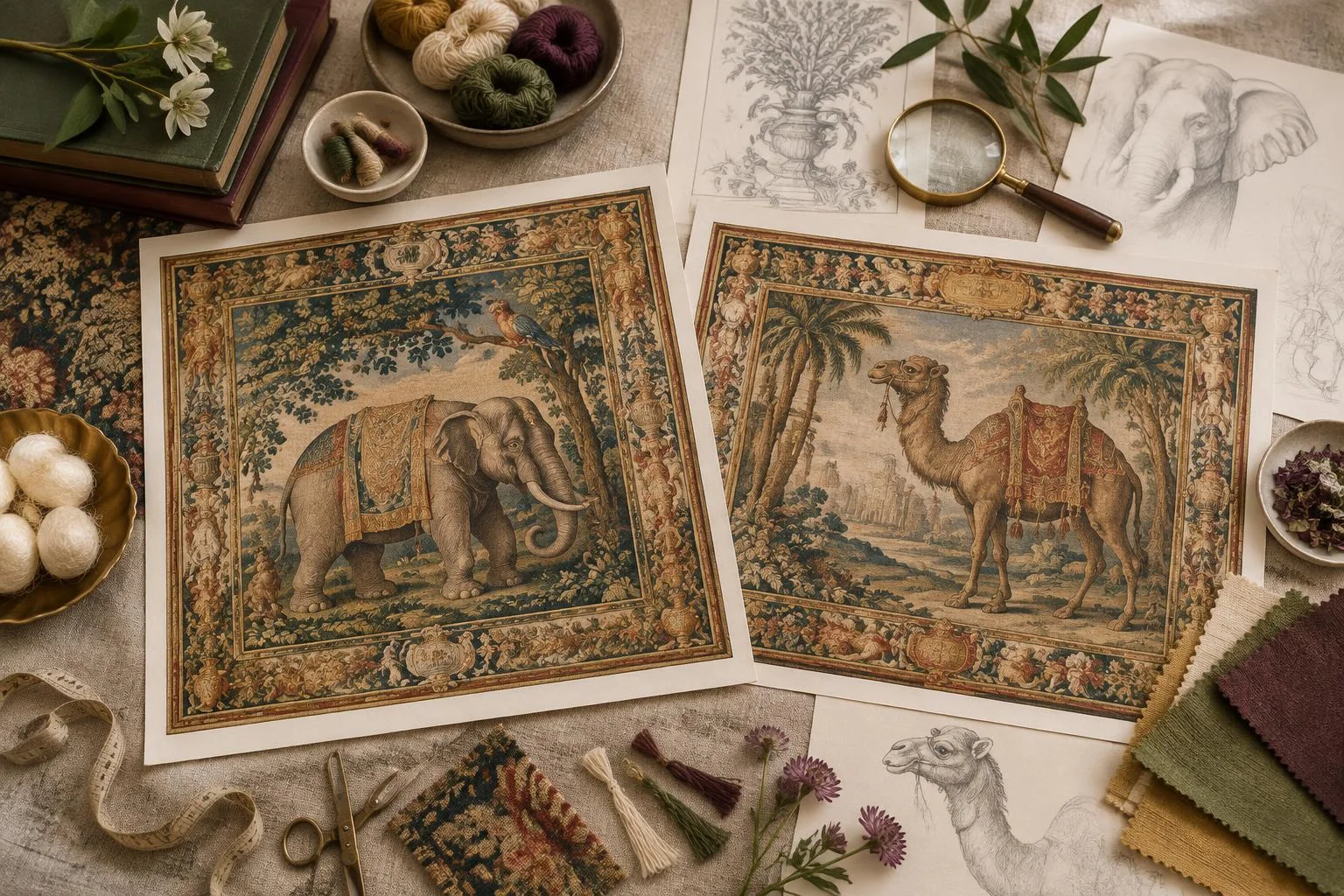
Two works, not two versions of the same record
What can we learn by comparing two Beauvais tapestries when their records do not use exactly the same fields or offer the same kind of date? Here, the records for The Elephant, held at the Art Institute of Chicago, and The Camel from a set of five Grotesques, at the Metropolitan Museum, allow us to compare catalogued chronologies, dimensions, materials, attributions and composition. The practical answer is to read each detail within the record for its own work: sharing Beauvais or a designer does not make the two tapestries a single piece, nor does it justify transferring information from one to the other.
The records describe distinct works, with different measurements and chronologies. They also separate roles that can be confused when reading an attribution: who designed a composition, who is associated with its style, who designed a border, and where it was woven. The comparison helps sort these categories; it does not replace a physical examination or, by itself, establish each object’s complete material history.
Dates and dimensions: each measurement belongs to its work
The Chicago record lists The Elephant with a catalogue date of circa 1688/1732 and dimensions of 461.1 × 306.4 cm. Its medium is listed as wool and silk, with slit and double interlocking weaves. The Met record, by contrast, lists The Camel as designed circa 1688 and woven circa 1690–1711 in Beauvais; its dimensions are 299.7 × 529.6 cm, and its materials are wool and silk. [1] [2]
The difference in shape is easy to miss if you compare only the figures. In the Chicago record, the first value is greater than the second; in the Met record, the second is greater. The measurements describe the catalogued dimensions of each piece, not a shared scale that would let us infer how they were displayed, what space they occupied or how they are perceived today. For a careful comparison, keep the exact order in which each record gives height and width, without rearranging the numbers or assigning them an unstated interpretation.
It also matters to keep each date with its object. The weaving interval associated with The Camel is not a date of manufacture for The Elephant. Likewise, the catalogue dating for The Elephant should not replace the explicit distinction between design and weaving in the Met record. A chronology cannot be transferred on the basis of similar subject matter, manufacture or authorship.
Design, style, border and manufacture are distinct categories
The two records distinguish several layers of attribution. In the Chicago record, Jean Baptiste Monnoyer is associated with the design of The Elephant; Jean I Berain with the style and border design. The manufacturing field places the weaving at the Manufacture Royale de Beauvais, France. The catalogued name is Jean I Berain: this form, including the “I”, should be preserved and not confused with another version of the name.
The Met record associates the design of The Camel with Jean-Baptiste Monnoyer and its style with Jean Berain; it attributes the border design to Guy Louis Vernansal the Elder. It also places the weaving in Beauvais. The comparison shows one point in common—Monnoyer is listed as a designer in both records—and one difference in the border attribution. It does not mean the pieces share all design elements, or that one attribution can be completed using the other. [1] [2]
A useful way to read these records is to keep the categories separate:
- Design: the conception identified for the work in the record.
- Style: the stylistic association noted in the record; it is not automatically synonymous with manufacture.
- Border: the design attributed to the ornamental frame, which may have its own attribution.
- Weaving or manufacture: the workshop and place that the record links to the textile’s execution.
This approach avoids turning a list of names into a single, simple authorship. It also helps distinguish what the works have in common from what is specific to each piece, without filling gaps with assumptions.
Workshop direction is not the same as an individual weaving date
In the Chicago record, the workshop is linked to three possible periods of direction: the Behagle family from 1684 to 1711, the Filleul brothers from 1711 to 1722, or Noël-Antoine Mérou from 1722 to 1733. The record presents these periods as alternatives, while the tapestry’s catalogue date is listed separately as circa 1688/1732. The periods of direction describe the documented administrative context; they do not, by themselves, establish when this specific piece was woven. [1]
The distinction matters because an interval can cover years associated with different directors without automatically identifying an individual production date. Nor does it allow us to select one alternative as certain without further evidence. The most faithful approach is to preserve the catalogued wording and not turn it into an exact year or a weaving sequence that the record does not establish.
The Met record gives the chronology of The Camel differently: designed circa 1688 and woven circa 1690–1711. Those dates belong to that work and do not, on their own, settle the individual chronology of The Elephant. Although both records refer to Beauvais and their dates partially overlap, that overlap does not prove the pieces were woven at the same time or under the same director. [2]
The composition described for The Camel
The Met record describes The Camel within a fantastical setting populated by musicians, acrobats and animals. This is a description of the catalogued composition, not a new observation or a license to attribute the same figures or arrangement to The Elephant. The title connects the work to a set of five Grotesques, and the record mentions numerous versions of the series. That identifies the catalogue context, but does not prove that every historical version comprised five pieces. [2]
This distinction helps us read the title without making a broader claim than the record supports. “From a set of five” identifies the work within its registered title; it is not enough to reconstruct how many pieces were produced across all versions, or how many survive. The composition, in turn, is a valid point of comparison only for the Camel described in that record.
What the records do not say about the tapestries
The available information allows us to compare identification, catalogued dates, dimensions, materials, attributions and aspects of the composition described for The Camel. This material does not document an assessment of feel, quality, current condition, treatments or restoration. None of these characteristics can therefore be inferred from the presence of wool and silk, the listed technique or the dimensions.
The Chicago record includes a credit to the Robert Allerton Endowment, but the provenance field is blank. That credit does not, by itself, establish a chain of ownership or an acquisition date. This is a useful distinction between a recorded credit and documented provenance: they are different in scope, and one does not automatically fill the other’s gap. [1]
A short checklist for comparing without mixing up details
When reading records for textile objects, it can help to check these questions before summarising them:
- Which work and collection does each detail belong to?
- Does the date refer to the design, the weaving or another form of cataloguing?
- Do the attributions distinguish design, style, border and manufacture?
- Is the original order of the dimensions and their units preserved?
- Does the record state a characteristic, or simply leave information unrecorded?
Applied here, the checklist yields a clear conclusion: both records document Beauvais tapestries in wool and silk and associate Monnoyer with the design, but they differ in the dates given, dimensions and border attribution. The Met also provides a description of the Camel’s composition; Chicago records alternative periods of workshop direction for the Elephant, which are not proven individual weaving dates. The comparison is more precise when it preserves these differences rather than resolving them by analogy.