




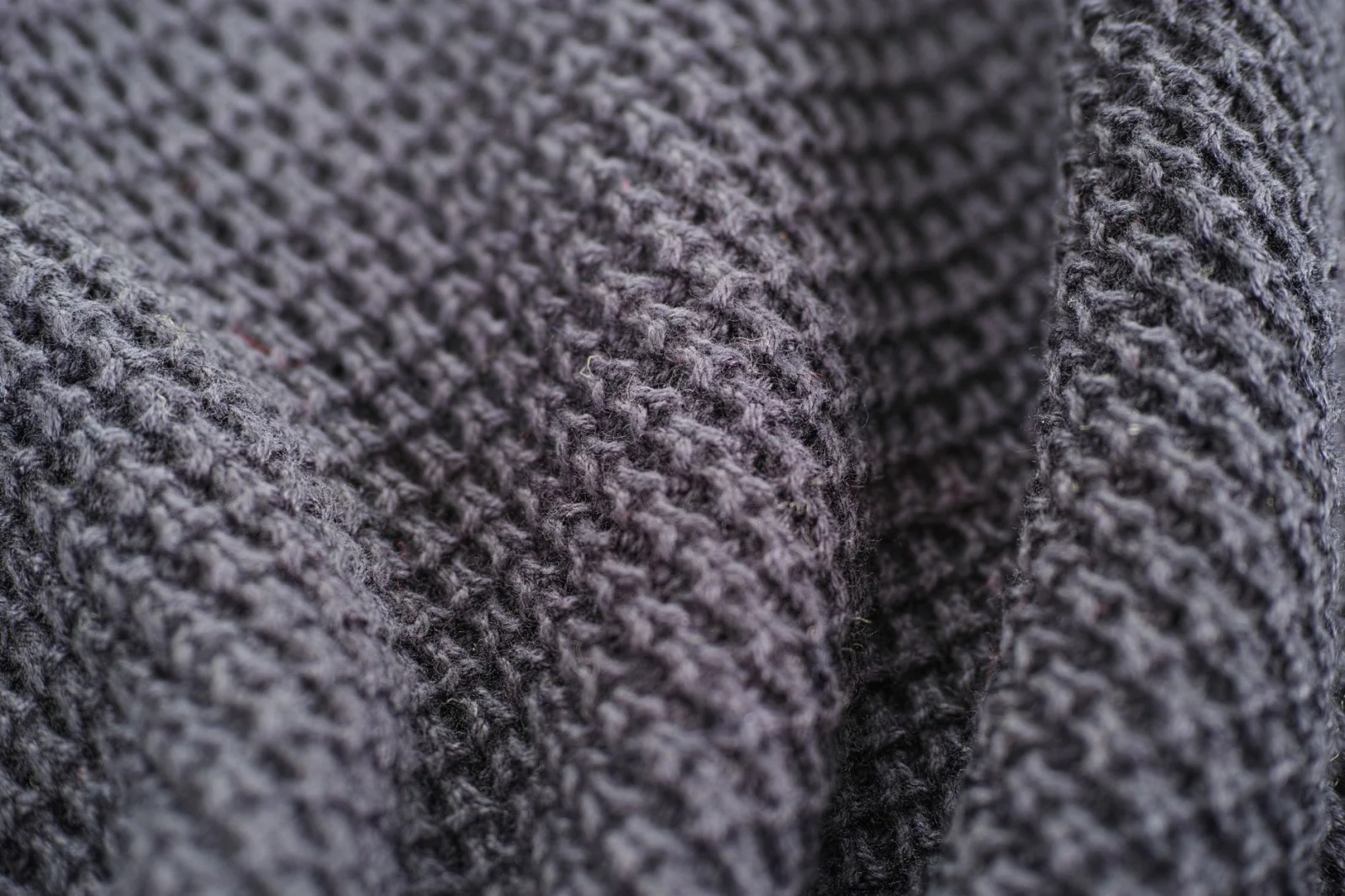
How to distinguish structures without confusing them with composition
How can you tell whether a garment is made in single jersey, rib or interlock? Start by comparing the right and wrong sides: the arrangement of the loops offers the most useful visual clue. Then look at the edges and how the fabric sits. This lets you describe structural differences and some tendencies without turning a visual impression into a claim about the fibre, weight or care.
In knitwear, the yarn forms interlocking loops. The way they are arranged defines visible surface features and can influence how the fabric behaves. Single jersey, rib and interlock are different constructions; they are not fibre names. A recognisable surface does not confirm whether a garment contains cotton, wool or another material. [2]
Examine both sides in good light and look for vertical columns of loops. If an edge is visible, also note whether it curls or stays stable. You do not need to cut the garment: simply examine a seam, the inside or an area where the finish reveals the fabric. These observations are useful guides, but the yarn, fibre, machinery and finish also affect the result.
Single jersey: columns on the right side, arcs on the wrong side
Single jersey usually shows vertical columns of loops on the right side and arcs on the wrong side. The difference between the two sides is its characteristic visual sign. It may be harder to see in a finished garment if there are prints, added texture or a finish that alters the surface. In that case, look for a less-treated area on the inside.
This construction may tend to curl when cut and may also ladder from the edge. This is a structural tendency, not an identical result in every garment. A hem or seam can control the edge, and the yarn and finish influence how an individual piece behaves. [2]
Single jersey appears, among other uses, in T-shirts and underwear. This association helps place the structure, but it cannot identify every garment by category: a T-shirt is not necessarily made of single jersey. Nor does it reveal the fibre. Appearance describes the visible construction, not the declared composition.
Editorial example: when looking at a T-shirt, compare an area of the body with the inside of the neck. If you find columns on one side and arcs on the other, you can describe the body as having the typical appearance of single jersey. If the neck has a different structure, that does not contradict the observation: a garment can combine constructions.
Rib: alternating relief and crosswise stretch
Rib alternates knit and purl columns. As a result, both sides show a sequence of ridges, rather than the more distinct contrast between columns on one side and arcs on the other in single jersey. The width and definition of these columns can vary; there is no single measurement to look for when identifying rib.
Rib can stretch crosswise. This helps explain why it is used in garments and in finishes such as necklines, cuffs and waistbands: the structure can accommodate the stretch in these areas. But looking at it cannot establish how much a piece will give, or how accurately it will recover its shape. Those results also depend on the yarn, fibre, machinery and finish. [2]
Editorial example: if a cuff has alternating columns and the garment body shows columns on one side and arcs on the other, describe each area separately. The cuff may be rib even if the body is single jersey. A finish does not necessarily represent the whole garment.
Interlock: similar-looking faces, different construction
Interlock links two rib structures. It can look similar on both sides, so the contrast between right and wrong sides is less apparent than in single jersey. The technical description also notes stability against curling; this expresses a tendency of the construction, not a guarantee that every garment will stay flat in all circumstances. [2]
Dresses, children’s clothing and close-fitting garments are among its stated uses. These are possible applications, not rules for identifying a construction by garment type. A dress does not have to be interlock, and similar-looking faces are not enough to confirm it without further information: other manufacturing factors can influence the surface.
Editorial example: when a piece has faces that look similar, note that observation first instead of stating with certainty that it is interlock. If a technical specification confirms the construction, you can use the name with greater confidence. Observation alone does not determine the yarn type, fibre or exact manufacturing method.
Practical comparison: what to look for in each case
| Structure | What to observe on the faces | Described tendency | Uses mentioned |
|---|---|---|---|
| Single jersey | Columns of loops on the right side and arcs on the wrong side | May curl when cut and ladder | T-shirts and underwear |
| Rib | Alternating knit and purl columns on both sides | Can stretch crosswise | Garments and neckline, cuff and waistband finishes |
| Interlock | Similar appearance on both sides | Stability against curling | Dresses, children’s clothing and close-fitting garments |
The table brings together general features, not guaranteed results for an individual piece. The yarn, fibre, machinery and finish can alter the weight and behaviour. So avoid treating a single feature—such as a flat edge or similar texture on both sides—as definitive proof. [2]
What the surface reveals and what requires a specification
The structure can help you describe how the loops are arranged, why an area has alternating columns or why a cut edge may tend to curl. It also gives you more precise vocabulary than simply saying “smooth fabric” or “stretch fabric”. When comparing garments, it helps separate differences in construction from differences that only seem to depend on thickness or texture.
By contrast, appearance does not establish the composition or the proportion of fibres. Nor does it determine weight, finish, durability or suitable care on its own. To find out the materials and instructions for a particular piece, check its label; if you need further details about its construction, look for a specific technical specification.
A clear way to describe what you see is to separate observation from conclusion: “I can see pronounced columns on both sides” is different from “this garment is interlock”. If there is no technical information to confirm the name, maintain that distinction. This is particularly useful when there are prints, surface treatments, seams covering the edges or several structures in the same piece.
Knit construction does not determine wool care
Identifying a structure does not determine how to care for a wool garment. These are different facts: knowing that a piece looks like interlock does not confirm that it contains wool, and knowing that it contains wool does not by itself establish a washing method. For the instructions for a particular garment, the care label is the practical reference.
Storage is another matter. An industry guide recommends storing wool clothing clean and protecting it from moths, mould and dust. Vacuum bags can save space, but they can also retain moisture and are not ideal for delicate pieces; breathable fabric bags are suggested as an alternative. It is also advisable to prevent zips and other items from snagging garments in storage. These recommendations concern storage and are not a universal washing method for every wool or merino garment. [1]
Editorial example: if a garment looks like rib and the label declares wool, use the label for specific care instructions and treat the structure as a separate observation. You can follow the storage recommendations described when putting it away, keeping in mind that they do not replace the garment’s washing instructions.
A short checklist for examining a garment
- Compare the right and wrong sides. Look for columns on one side and arcs on the other to recognise the typical appearance of single jersey; look for alternating columns when considering rib; observe whether both sides look similar when assessing whether it might be interlock.
- Look at the edges without altering them. Curling can be a clue to single jersey, but seams and finishes can control it. There is no need to cut the garment.
- Examine more than one area. A body and a cuff may have different structures. Describe each part before classifying the whole piece.
- Distinguish what is visible from what is confirmed. If there is no technical specification, describe what you observe and retain uncertainty about the exact construction.
- Check the label for composition and care. Do not infer fibres, proportions or instructions from the appearance of the knit.
A more precise reading of knitwear
Single jersey, rib and interlock name different ways of arranging knitwear. Comparing the faces helps you recognise their characteristic signs; looking at the edges adds context about tendencies such as curling or crosswise stretch. None of these clues turns an observation into a complete specification of the garment.
The most useful reading combines visual curiosity with precision: describe the surface first and confirm technical details separately. This helps you better understand why a cuff behaves differently from the body of a T-shirt, without confusing structure with composition or care. The label and garment-specific information remain the references for those details.