



What can you learn from a cosmetic label, and what do you need to know about a piece of gemstone jewellery before deciding how to care for it? The answer begins by separating two kinds of information: cosmetic labelling describes details about the cosmetic product; assessing a piece of jewellery depends on the gem, its treatments and how the piece is constructed. A cosmetic label is not a jewellery-cleaning guide, but keeping it can help you document which product was involved if a question arises.
Knowing that a stone seems hard or that you wear the piece every day is not enough. Scratch resistance, the possibility of chipping or fracturing, sensitivity to environmental conditions, treatments and the setting are distinct considerations. If these are unknown, a general recipe cannot resolve the uncertainty. The most useful approach is to gather the information available, identify what is missing and seek advice when a recommendation does not refer to the specific piece.
Three distinct aspects of durability
When assessing a gem, it helps to distinguish its resistance to scratches from its resistance to breakage and its sensitivity to environmental conditions. A surface that resists scratches well is not necessarily immune to impact; nor, on its own, does it tell you how the gem will respond to other conditions. Gemmological guidance treats these vulnerabilities separately and notes that care depends on the stone and the piece in which it is mounted [2].
This distinction helps you think through everyday situations without turning an impression into an instruction. A piece of jewellery may seem sturdy and still need care when stored alongside other pieces. Keeping them from rubbing against each other helps reduce contact, but it does not determine which cleaning method is appropriate. These are separate decisions: one concerns how jewellery is stored; the other requires knowing the materials and construction.
When gathering information, ask separately:
- Has the gem been identified, and what is known about its scratch resistance?
- Is there information about its vulnerability to impact or breakage?
- Are any sensitivities related to the environment or wear known?
You may not have answers to everything. Distinguishing a known fact from an assumption is more useful than inferring care from appearance, a commercial name or the impression that a piece is durable.
The gem does not tell the whole story of the jewellery
A finished piece of jewellery brings together more than the visible stone. A gem’s treatment, the setting and the mounting can all affect which precautions are worth considering. That is why guidance for a loose stone does not automatically apply to a mounted piece: cleaning may involve different components, and general advice may not account for all its materials.
Available gemmological information describes varied vulnerabilities in gems, treatments and jewellery components, and recommends paying attention to clasps and settings. It does not, however, identify the treatment of a particular piece or establish appropriate care without information about that piece [2]. The useful question is not only “What stone is it?” but “What do we know about this complete piece of jewellery?”
Before following a recommendation, gather what you know about the gem’s identification, treatments, setting, mounting and previous maintenance. If the documentation is incomplete, note what is missing rather than filling the gap with a guess. An inherited piece, for example, may have a recognisable gem even if its treatment or the exact way it is secured is unknown. Knowing what is missing lets you ask a more specific question, though it does not by itself determine how to clean the piece.
What cosmetic labelling tells you
In Spain, cosmetic labelling may include the product’s function, ingredient list, precautions, batch and durability information. These details help identify the cosmetic and preserve useful information for a query about that product [1].
That scope matters: the label describes the cosmetic, not a piece of jewellery’s gem, treatment, metal or setting. Reading the ingredient list does not provide an assessment of compatibility with a specific piece or a cleaning recipe. Nor does the presence of an ingredient, on its own, demonstrate the particular efficacy of a formula. Each label answers different questions, and neither replaces missing information about the other item.
If you need to keep product information, save the packaging or a clear image of its label. Check that any listed details are legible: name and function, ingredients, precautions, batch and durability information. This may help explain which cosmetic was used; it does not turn the label into a certificate of gemstone safety or let you predict how a piece of jewellery will respond to contact.
A comparison to keep the decisions separate
The table summarises which questions each set of details can help you ask. It is not a compatibility matrix: the available information does not let you match an ingredient list to a gem and conclude on a care method.
| Information you have | Question it can help you ask | What it cannot establish on its own |
|---|---|---|
| Cosmetic labelling | What is the product, and which ingredients, precautions, batch or durability details are listed? | Whether a formula is compatible with a gem, treatment or setting. |
| Gem identification | Which stone has been identified, and what documented care guidance can you consult for it? | How the complete piece will respond if its treatments or construction are unknown. |
| Treatment details | Is there a treatment on record that should be mentioned when asking for advice? | That a general guideline is appropriate for every piece of jewellery with that gem. |
| Setting and mounting information | Which components, clasps or fastenings should be included in the query? | That a method intended for the stone is appropriate for the complete piece. |
| Incomplete information | Which detail should you find out before acting? | A safe method inferred from what is unknown. |
The practical value of this comparison is that it prevents a leap in reasoning: having more information about the cosmetic does not make up for missing details about the jewellery, and identifying a gem does not automatically answer questions about its treatment or setting.
Cosmetics and jewellery in an everyday situation
Editorial example: imagine that you wear a piece of jewellery with an identified gem, but do not know whether it has been treated. You also still have the packaging for a cream used near the piece. The label can help you identify the cream and record its warnings, but it does not clarify how the gem was treated or whether the setting can tolerate a particular cleaning method. With these details, it would not be appropriate to declare the product compatible or incompatible; information about the jewellery is missing.
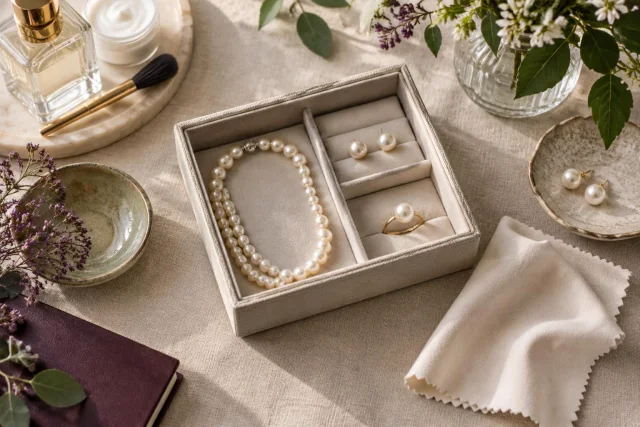
Pearls merit special consideration: gemmological guidance mentions contact with cosmetics and heat among the factors relevant to their care [2]. This does not assess a specific formula or determine what to do with every piece of jewellery containing pearls. It does, however, remind us that not all gems should be treated as though they share the same conditions.
Editorial example: if a piece combines materials or has a fastening you do not recognise, keeping the cosmetic’s name and precautions may help you describe the context when seeking advice. Do not use them as a substitute for identifying the piece or as a basis for trying a cleaner. The available information helps you ask better questions; it does not justify inventing an answer that the labels do not provide.
When it makes sense to seek advice before cleaning
Consult a gem or jewellery specialist if you do not know the gem, its treatment or how it is secured; if the piece combines several materials; or if a recommendation does not explicitly account for its characteristics. It is also reasonable to seek advice when a clasp or setting seems to need inspection. Paying attention to these parts is part of jewellery care, not a conclusion that can be drawn from an ingredient list [2].
To make your question clear, keep information about the piece separate from information about the cosmetic. You can bring the available identification, any documentation about treatments, details of the setting and mounting, and a clear photo of the label if the product was involved. Explain what you do not know, too. A consultation does not need to become a list of assumptions: the clearer you are about what is documented and what is not, the more precise your question will be.
A short checklist before deciding how to care for the piece
- About the jewellery: note the identified gem, any recorded treatments, the setting, the mounting and any documented maintenance details.
- About the cosmetic: keep its identification, function, ingredients, precautions, batch and durability details available on the label.
- About the recommendation: check whether it refers to the complete piece of jewellery or only to a gem in general terms.
- About what is missing: distinguish missing information from known facts; do not fill gaps based on appearance or intuition.
- Before cleaning: seek advice if the guidance does not account for the piece’s treatment, setting or construction.
The central idea is simple: a cosmetic label documents a product, while caring for a piece of jewellery requires information about its gems and how it is assembled. Keep both records if they may be relevant, but do not confuse them or use one in place of the other. When details about the piece are incomplete, finding out more before acting is a practical decision, not a cleaning recipe.