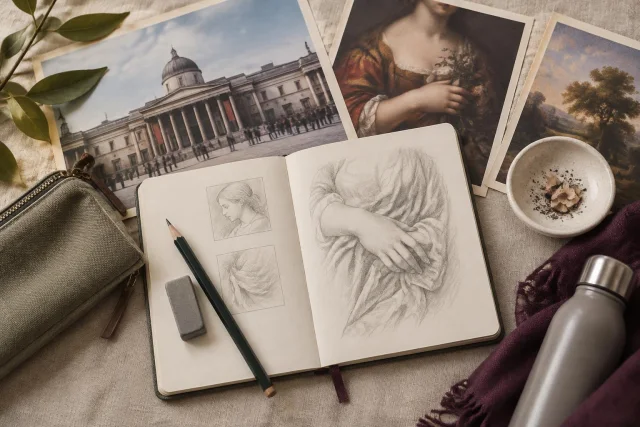
Two different ways to get closer to a museum
Can a virtual visit introduce you to a museum as if you were walking through its galleries? The Museo del Prado’s digital visit offers a navigable route across three floors, 360-degree panoramas, and a selection of artworks with high-resolution enlargements. V&A South Kensington’s information, by contrast, helps you plan an in-person visit with opening hours, general admission, and some exceptions. These are useful resources for different purposes: one organizes an on-screen exploration; the other sets out practical conditions for visiting the museum.
The distinction matters when choosing. If your aim is to observe details of selected works on a device, the Prado route offers specific tools for doing so. If you want to visit V&A galleries, the decisive reference is its in-person visitor information, which includes partial closures and exceptions to opening hours. A digital visit is not the same as the physical availability of an artwork or the experience of seeing it in a gallery.
The conditions described here correspond to the pages consulted on October 22, 2026. Opening hours, admission, and digital content can change; check them again before organizing a visit or relying on a particular feature.
What the Prado virtual route includes
The virtual visit moves through the ground, first, and second floors using 360-degree panoramas. Rather than being limited to a gallery of isolated images, it lets you move through interior views and explore a selection of 89 artworks. Some can be enlarged in gigapixel format, and five sculptures have 3D-Photo viewing. [2]
These features let you switch between two scales: the spatial orientation of a panorama and closer observation of a selected artwork. For anyone who wants to look at images from the collection without being physically in Madrid, that combination has its own value. It should not be mistaken for a complete reproduction of the galleries: it is a digital route with specific tools, not a promise to replicate every aspect of an in-person visit.
The selection also shapes what you can explore. The 89 artworks listed do not automatically represent every work on display, and the option to enlarge an image does not extend equally to the entire collection. The format is most useful when understood as a curated route through views and digitized artworks, not as an exhaustive inventory of the museum.
Enlargement and digitization differ from one artwork to another
The option to enlarge some images in gigapixel format invites you to notice details that may be difficult to perceive in a conventional-size reproduction. Sculptures available in 3D-Photo add another kind of visual exploration. But these features apply to a selection: the level of digitization varies between artworks. [2]
In practice, it helps to distinguish between three things: an artwork being part of the route, having an image that can be enlarged, and having a three-dimensional view. These are not interchangeable features. If you are looking for a specific piece, the presence of panoramas or other digitized artworks does not, by itself, confirm that the piece has a gigapixel enlargement, a 3D resource, or a physical location accessible during a visit.
The route’s own notice limits access to two different devices. This is a condition of use worth keeping in mind if you plan to switch devices during your exploration or share access. The information consulted does not confirm offline access, universal compatibility, or that every version is free; those details should not be assumed. Check the resource itself to confirm whether a particular digital feature is available.
What information V&A provides for an in-person visit
V&A South Kensington lists its address as Cromwell Road, London SW7 2RL, and states that general admission is free. Some exhibitions or events are ticketed, so free general admission should not be taken to mean that every activity or part of the museum is free to enter. [1]
The published hours are 10:00 to 17:45, with opening until 22:00 on Fridays. However, some galleries close earlier than the general closing time. Visitors also begin to be cleared from the building 30 minutes before closing. As a result, the building’s closing time does not always coincide with the last opportunity to enter or remain in a particular gallery.
The museum closes from December 24 to 26, according to the information consulted. Friday’s extended hours also do not guarantee that every room remains open into the evening, and they do not replace the Photography Centre’s specific programme. For a visit with a particular goal, the general hours are a starting point, not confirmation of access to every space.
Choose the format based on what you want to do
The Prado’s digital route can help you orient yourself among views of the museum and examine artworks included in the selection. V&A’s in-person information helps you assess whether a visit fits the published hours and general conditions. Rather than treating these resources as equivalent versions of the same experience, it is clearer to choose according to the practical question you have.
- To explore visual details: the Prado route offers gigapixel enlargements for part of the selection and 3D-Photo viewing for five sculptures. The specific feature depends on the artwork.
- To explore spaces on screen: 360-degree panoramas cover the ground, first, and second floors, although they do not make the route an exhaustive reproduction of every gallery.
- To plan a visit to V&A: check the general hours, galleries that close early, and when visitors begin to be cleared from the building, especially if you plan to visit in the afternoon or on a Friday.
- For a particular exhibition, event, or centre: check the conditions for that activity; free general admission and overall opening hours are not enough to confirm access or scheduling.
Choosing does not have to mean setting screens against museums. A virtual visit can be useful for visual exploration from a distance; an in-person visit depends on the space being open and its conditions on the chosen date. Each resource meets a different need.
What to check when looking for an artwork, gallery, or activity
If you are interested in an artwork at the Prado, check whether it appears in the virtual selection and what kind of resource is available: panorama, enlargement, or three-dimensional view. Do not infer that an artwork that has not been digitized is absent from the museum, or that an artwork included in the virtual visit will necessarily be on display on a particular date. The digital information described does not, by itself, confirm the physical availability of each piece.
If you are looking for a gallery or activity at V&A, review the specific information as well as the general hours. A gallery may close earlier; an event may require a paid ticket; and Friday evening hours do not guarantee access to every room. Check the Photography Centre’s programme separately rather than inferring it from the building’s hours.
Before making plans, it is useful to check:
- whether the artwork appears in the Prado virtual visit and which digital tools it offers;
- whether the route works on the device you plan to use, bearing in mind the stated limit of two different devices;
- whether a V&A gallery follows the general hours or closes earlier;
- whether the exhibition or activity you have chosen requires a paid ticket;
- whether your planned date coincides with a closure or a particular programme.
The available information makes it possible to compare a digital exploration resource with the conditions for an in-person visit, but not to claim that one replaces the other. Checking the details of the specific resource or space is the most direct way to avoid misplaced expectations, especially when your plans depend on a single artwork, gallery, or activity.