




What question does a wardrobe review through use answer?
A useful review is not about deciding whether every garment deserves to stay forever. It is about clarifying what purpose it serves now, what it needs before it can be worn again, and whether there is a specific reason to keep it even if it is not part of your weekly routine. The goal is to make clearer decisions, not to achieve a perfect wardrobe.
You can start with a manageable category: clothes worn frequently, a shelf, garments for one season, or pieces awaiting repair. This approach borrows a structured way to begin from KonMari’s category-based selection, while adding editorial questions about use, fit, and care. It is a Gentle Chic adaptation, not a complete description of the method or a promise of transformation.
Define a category you can actually review
Gathering a specific category makes it possible to compare garments that serve similar purposes without turning the task into an endless review. If the everyday problem is finding work clothes, for example, you can start with those garments. If several pieces have been set aside because of a loose button, the category might be the small pile of pending repairs.
You can also set a physical limit: a shelf, a drawer, or part of the wardrobe. There is no need to empty the whole room or buy organizers before you know what you want to keep and how much space you have. A brief, contained review often offers a more practical answer than an ambitious sorting project that never gets finished.
Before you begin, it helps to decide what “finished” means for that session. It could mean returning everyday clothes to an accessible place, setting aside the pieces that need repair, or noting decisions that cannot be resolved in the moment. A small, concrete result counts too: it can make the things you use easier to find without requiring every item to have a permanent destination.
Separate the decisions: keep, check, repair or leave pending
A garment can fit into more than one practical category. You might want to keep it, but it needs a button; it may suit a particular occasion, even if it is not comfortable for many hours. Separating the decision to keep something from the task needed to wear it again avoids treating every doubt as a binary choice between keeping it and removing it from the wardrobe.
| Decision | Useful question | Possible next step |
|---|---|---|
| Keep | What purpose does it serve in my life now or for a specific occasion? | Return it to a suitable, accessible place for that purpose. |
| Check the fit | Is it comfortable as it is, or does it need altering? | Try it on under usual conditions and consider whether the change is realistic. |
| Repair or maintain | Is there a specific flaw preventing me from wearing it? | Identify the repair needed and decide when to take care of it. |
| Leave pending | What information or circumstance do I need before deciding? | Note the reason and choose when to review it again. |
| Find another destination | Have I decided I no longer need it, and what options will the recipient actually accept? | Check the available requirements before passing it on. |
These categories are a working tool, not a universal classification. Formalwear may be worn rarely and still meet a specific need. Another garment may be worn often even though its fit is uncomfortable. Frequency provides context, but it does not by itself decide whether something should stay.
Three questions for observing current use
For each garment, Gentle Chic suggests a brief worksheet with three questions. They are not part of KonMari’s official protocol: they are an editorial resource for broadening reflection on what to keep and turning it into practical decisions.
- When would I wear it? Thinking of a recognizable situation—a workday, a formal occasion, or a particular climate—helps distinguish a real purpose from a vague possibility. You do not need to wear it every week for that purpose to make sense.
- What is it comfortable with? This may refer to an outfit, an activity, or how long you wear it. A specific answer offers more information than judging the garment only by how it looks on a hanger.
- What does it need before I wear it again? It might need cleaning, a button, a seam repair, or a fit check. Identifying the need turns “I’ll fix it someday” into a task you can take on, deliberately postpone, or rule out.
The answers do not have to produce an immediate verdict. If a piece is part of a uniform, suits a particular climate, or has keepsake value, that reason can also clarify why it is still there. Nor do you need to photograph your body, choose a target size, or force yourself to feel enthusiastic about a necessary garment. Practicality and personal enjoyment can coexist, but they are not the same criterion.
What category-based selection from KonMari offers—and what this adaptation does not
The description of the KonMari method places clothing at the beginning of a category-based process and proposes keeping what sparks personal enjoyment [2]. Using that structure as a starting point can make a review more manageable: consider one group of garments at a time instead of trying to resolve the entire wardrobe in one session.
The Gentle Chic adaptation retains that structure, but adds questions about purpose, comfort, maintenance, and repair. It is not presented as an official version of the method and does not require following its different stages. Nor does it make personal enjoyment the only valid measure: a practical garment, one linked to a need or kept for a meaningful reason, may call for a different assessment.
The distinction matters because it helps avoid two shortcuts. The first is attributing a worksheet created here to the original method; the second is interpreting infrequent use as automatic proof that a garment is surplus. The category makes the review easier; the wearer’s circumstances give the decision meaning.
Fit, maintenance and repair: pinpoint the obstacle
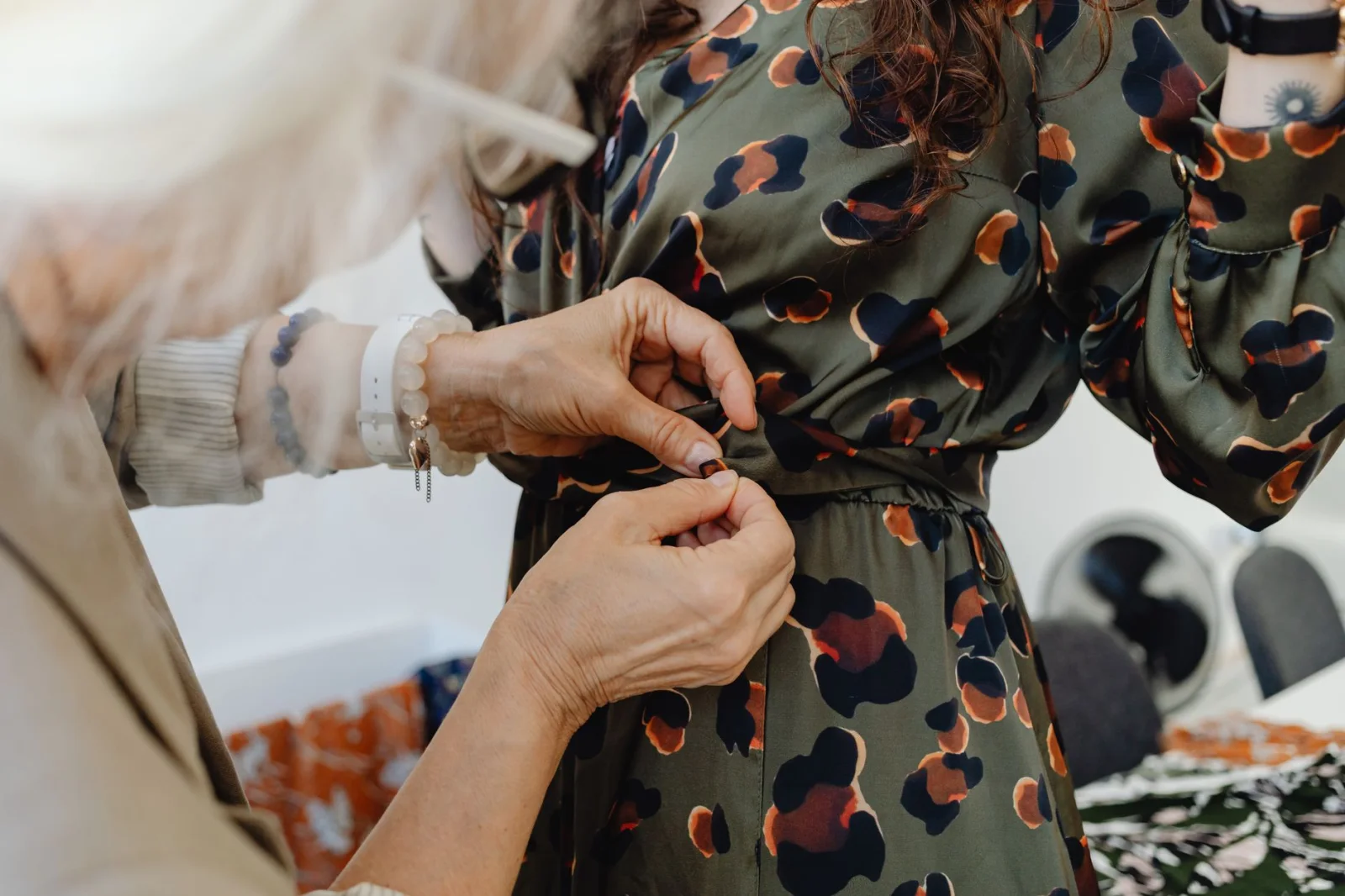
If you want to keep the garment, the next step is to name what is preventing you from wearing it. “I don’t wear it” does not tell you whether the obstacle is a fit that is no longer comfortable, an open seam, care instructions you do not understand, or simply the lack of a planned occasion. Distinguishing these possibilities helps avoid confusing a one-off repair with a lack of usefulness.
Guidelines for designing clothes to last longer consider aspects such as duration of use, clear instructions, fit adjustment, maintenance, and repair [1]. This framework directs the review toward conditions that may help extend use; it does not establish that every repair is possible, worthwhile, or suitable for every garment.
A practical decision might begin like this:
- If there is visible damage, note what repair is needed and whether it can be done with the resources available.
- If fit is the main concern, first assess comfort in actual use, then consider whether an alteration would be reasonable.
- If care information is missing, check the garment label and available instructions before taking action.
- If the garment still has no clear purpose, note the uncertainty instead of assigning it a repair by default.
You do not need to resolve every task during the review. Separating “I want to keep it” from “I have to repair this today” makes it possible to create a realistic list, especially when time or budget is limited. It also helps prevent a pile of pending repairs from becoming an obligation that is postponed indefinitely.
If a decision is pending, note a reason and a time to review it
Some decisions depend on information that is not available in the moment: whether a piece still serves a purpose, whether it can be repaired, or whether a suitable drop-off option exists. In those cases, a short list can record the garment, the specific reason for uncertainty, and when you will reconsider it. The review date or occasion should make sense for the person organizing the wardrobe; there is no universal timeframe that guarantees a correct decision.
For example, “light coat: check when changing seasonal clothes whether it still meets a need” is more useful than “decide about the coat.” The first note names what remains to be found out and when it might be done. The second merely postpones the task. If the garment serves a seasonal or special purpose, leaving it pending does not mean you have made the wrong decision.
The purpose of the list is to make the next action visible, not to keep garments in permanent limbo. When the chosen time comes, you can revisit the questions about use, comfort, and care needs with clearer information.
For a garment you are letting go, check the actual options
If you decide a garment no longer belongs in your wardrobe, its destination calls for a separate decision. Donating, selling, or recycling are not interchangeable or guaranteed options: they depend on the actual requirements of whoever receives, buys, or handles the material. Before passing a garment on, check what the recipient accepts and in what condition.
The available references on designing clothes to last longer do not establish a universal destination for discarded items or allow the environmental impact of an individual decision to be calculated [1]. For this reason, an option should not automatically be called sustainable just because of its name. A practical decision begins with a specific check of the available options and their requirements.
A useful review can end with just one improvement
A clearly defined category, a few straightforward questions, and a short list of pending tasks are enough to make some wardrobe decisions easier to see. The result might be separating everyday clothes from seasonal pieces, identifying a specific repair, or recognizing a garment that still serves a purpose even if it is worn rarely.
Progress means that the next choice feels clearer, not that every doubt disappears. Reviewing your wardrobe through use lets you keep things without having to justify every garment with enthusiasm, address fit and repairs with purpose, and consider the destination of what leaves based on the options that actually exist.