Begin with what you can actually see
How can you approach an artwork without turning every gesture, garment or object into a certain story? One useful answer is to separate, at least at first, what the image shows from what it makes us think. That distinction does not limit the imagination: it lets you enjoy an interpretation while recognizing it as a possibility, not a confirmed fact.
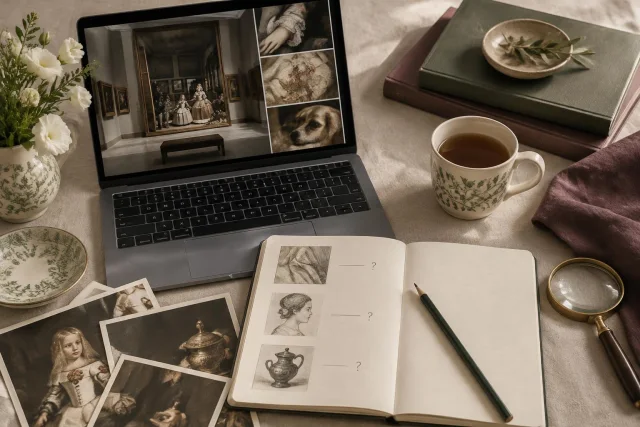
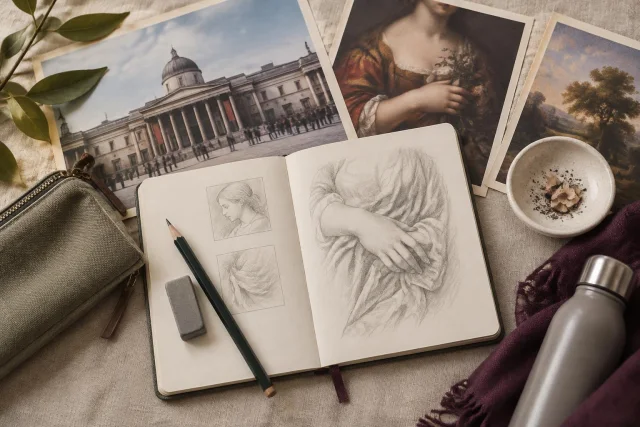
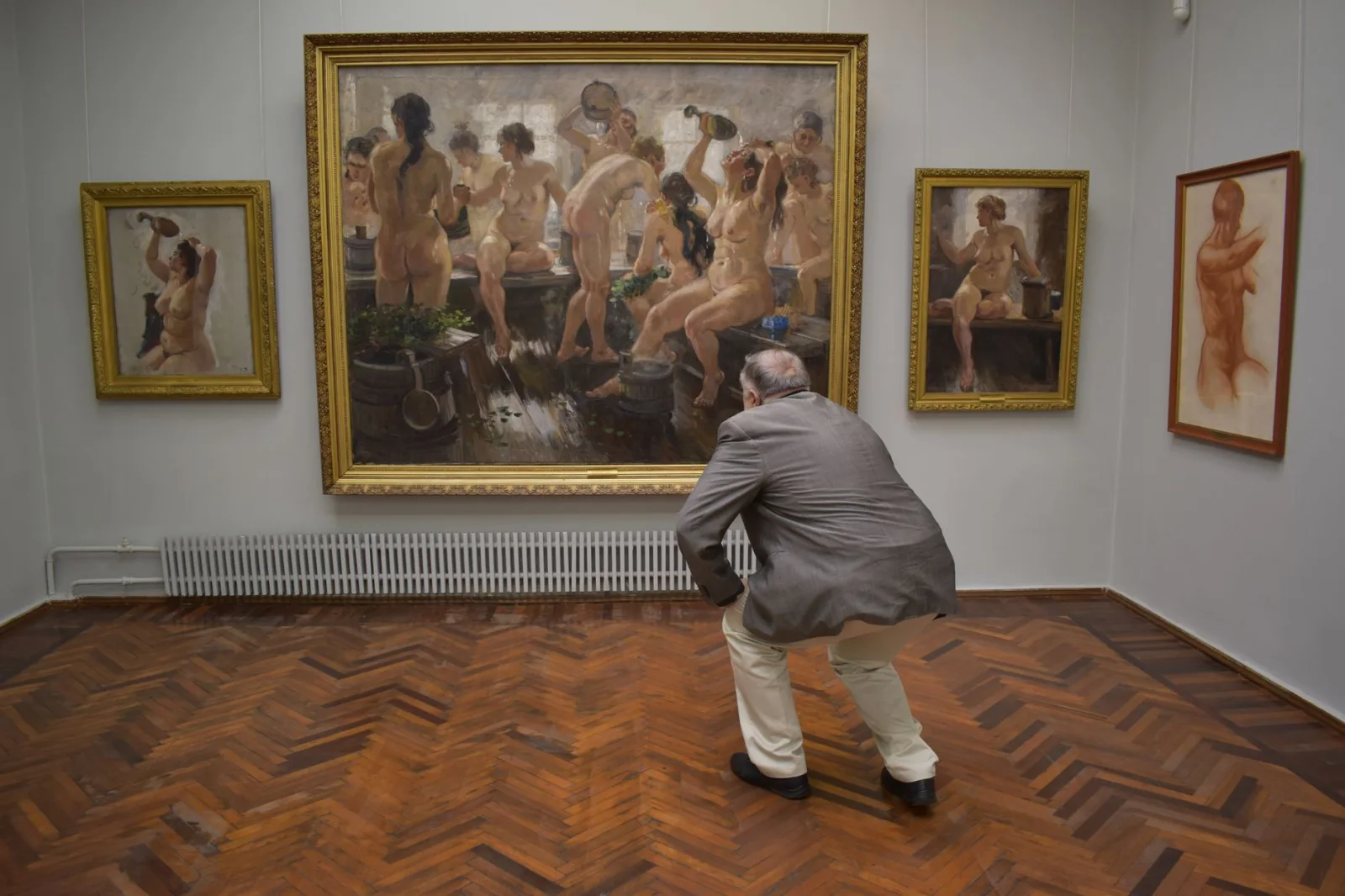
You can do this exercise in front of an artwork in a gallery, with a reproduction or during a virtual visit. First, note a few visible elements; then ask questions about them; finally, consult the record if you need to verify an identification. This is an adaptable editorial proposal, not an official activity of the museums mentioned.
For example, “there is a dark cloth over the shoulder” describes an element. “The person is in mourning” assigns it a meaning that may not be confirmed by looking. The second idea can still be interesting if framed as a hypothesis: “I wonder whether that cloth might suggest mourning.” The difference lies in the degree of certainty, not in the value of the question.
A first round: name before you explain
Start with what you could point to in the image without having to justify its meaning. Notice shapes, colors, positions and relationships between elements. You do not need to make a complete inventory: a few specific notes are enough to create your own starting point.
Try a few simple questions:
- What figures, objects or shapes appear?
- Which colors stand out, and where are they concentrated?
- What occupies the center, and what lies near the edges?
- Which elements seem to touch, separate or overlap?
- What part first draws your attention?
A note such as “a figure is looking to the left” is more descriptive than “the figure is waiting for someone.” If the direction of the gaze is hard to make out, you can write “seems to be looking toward the left side.” Recognizing what you cannot see clearly is also a way of observing precisely.
This first round helps distinguish the image from the story we build around it. If you note “a small object is on a table,” you can then ask what role it seems to play. But the description alone does not confirm what it was used for or what it meant in the context of the artwork.
Three questions for looking more closely
Once you have made your initial description, choose an area that intrigues you. Pick one or more of these questions: what fabric seems to be shown, how a posture is formed, and which everyday object catches your eye. These are ways to look, not requirements every artwork must meet.
What fabric seems to be shown?
Look for folds, edges, transparencies, smooth surfaces or changes in texture. You might note “the fabric forms broad folds” or “the edge looks shiny.” If it brings a material to mind, express your uncertainty: “it looks like wool” or “I can’t make out what fabric it is.”
The way something is depicted does not always allow for a certain identification. It is therefore helpful to keep two notes separate: the visual effect you perceive and the material that may be listed in the record. If that information does not appear in the record, the question can remain open without invalidating your observation.
How is a posture formed?
Notice the tilt of the torso, the position of the hands and the relationship between the body and the space around it. “One arm is resting on a surface” describes a position; “the posture seems relaxed” expresses how you perceive it. Both notes can be useful as long as you recognize that they are not the same kind of statement.
As an editorial example, imagine a figure with their head tilted and one hand near their face. You can first record those two details. Then ask yourself whether the gesture seems thoughtful, tired or difficult to interpret. The image presents the visible gesture; reading it as a particular mood remains a personal possibility unless documentary information supports it.
Which everyday object catches your eye?
Choose an object and notice its relative size, location and relationship to the figures. Instead of immediately stating what it represents, ask: “Why is it placed here?” or “Can I make it out clearly?” Its position may guide an interpretation, but its presence alone does not prove a particular story.
If none of these subjects appears, let it go. The exercise works best as a flexible selection rather than a checklist: you do not need to find a recognizable fabric, decipher every gesture or assign meaning to every object.
From description to hypothesis
Once you have a few notes about what is visible, explore what they suggest to you. A practical way to organize your thoughts is to write them in two parts:
- What I observe: “The figure keeps one hand near their face.”
- What I wonder: “Could the gesture express worry, tiredness or concentration?”
The question opens up interpretations; it does not prove which one is correct. Someone else may suggest a different reading of the same detail. An educational resource from the Getty proposes a practice of slow looking that invites viewers to ask questions, distinguish details from interpretations and listen to other perspectives. That approach can inspire personal observation without turning it into an official activity of another institution.[1]
If you share the exercise, compare your descriptions first. Someone may have noticed a line, object or posture the other person overlooked. Then you can compare your questions without treating the conversation as a test with a required answer. A different reading can broaden your perspective, even though it does not by itself verify a historical fact.
As an editorial example, two people may agree that a figure is holding an object yet disagree about whether the gesture seems careful or tense. Their shared description helps clarify what they are looking at; their difference in impression remains part of the conversation, not an error that must be resolved at all costs.
Adapting observation to a screen
The Museo Nacional del Prado’s virtual visits let you explore its collection and a selection of exhibitions from home. For some artworks, high resolution makes it easier to appreciate details, and some tours include audio. Availability depends on the resource you view, so you can work with the view provided without expecting every image to offer zoom or a feature it may not have.[2]
Choose an available artwork and focus on one detail rather than trying to explore the entire collection at once. If the image can be enlarged, zoom in on a specific area; if not, observe the available view or continue with the record. An image’s limitations do not require you to fill in what is missing with a guess.
A brief note can help you return to the experience later. Write down the title shown on the page, the artist if listed, one observation and a question of your own. For example: “I see pronounced folds in the clothing” and “I wonder what effect this posture creates.” This keeps the distinction visible between what you recorded and what you would like to find out.
A digital visit is a tour through online resources, not a reservation to enter the galleries. The physical location of artworks may also change and does not necessarily match the digital tour. This distinction matters if you are looking for an artwork in person; when viewing it from home, it is enough to remember that the virtual tour does not confirm where it is currently located.[2]
When to consult the artwork record
The record is especially useful when an impression turns into an identification question. If you want to confirm the title, the listed artist, a recorded material or another detail documented on the page, consult the information associated with the artwork. Then keep your statement within the bounds of what you find there: a personal note does not replace documentary identification.
Return to the record if your interpretation depends on a detail that is hard to make out. A garment may look as though it is made of a particular material, or an object may suggest a certain use, but appearance does not guarantee that conclusion. If the record does not answer the question, you can leave it open rather than complete the answer with an assumption.
A practical way to organize your notes is to use two columns:
| What I note | How to treat it |
|---|---|
| Visible color, shape, position or relationship | Description; add a qualification if the detail is hard to make out |
| An impression of the gesture, atmosphere or effect | Personal reading; frame it as a perception or question |
| Title, artist or material listed in the record | Information documented on that page; do not extend it to aspects it does not record |
| An identification the image cannot confirm | Open question; consult the record or preserve the uncertainty |
Before you begin, check which resources are available: not every artwork offers the same level of zoom or audio, and the digital selection does not necessarily reflect the galleries’ current layout.[2]
A short checklist for returning to the artwork
Before closing the page or moving to another image, review your notes:
- What did I note that is directly visible?
- What did I write as an impression, possibility or interpretation?
- Which detail would I like to look at again?
- Is there an identification I should check in the record?
- What question do I want to keep, even if I do not yet have an answer?
Not every observation needs to lead to a definitive explanation. It can remain a description, a considered hypothesis or an open question. Looking slowly means making room for all three ways of approaching an artwork and knowing which one you are using: seeing a detail does not oblige you to turn it into a story, but it can be the beginning of a more attentive reading.