


The useful question: how is the pattern controlled?
When looking at patterned fabric, it is easy to start with its appearance: whether the design is small or large, subtle or striking, matte or shiny. But those impressions are not enough to identify how it was made. The more useful technical question is a different one: how are the yarns controlled during weaving? In general terms, dobby uses a limited number of harness frames, while jacquard allows individual yarns to be controlled. This difference makes different kinds of designs possible, but it does not establish a hierarchy of quality.[1]
The visible motif can guide observation: dobby is often associated with small geometric shapes, while jacquard can produce large, complex designs. However, size alone does not confirm the technique. Nor does it reveal a fabric’s fiber, weight, durability or place of production. These are separate questions and require separate information.
This distinction is especially useful when shopping for clothes or comparing samples. A description such as “geometric texture” speaks to appearance; “dobby” names a construction. If the product information does not specify the technique, it is more accurate to describe what you see than to turn an impression into a confident identification.
Dobby: small motifs formed in the structure
Dobby uses a limited number of harness frames to raise groups of yarns and create weave combinations. It is therefore commonly associated with small, repeated motifs, often geometric ones.[1] The pattern does not have to be a printed layer on the surface: it can arise from the arrangement of yarns in the fabric itself.
The scale can make the effect look different from different distances. From afar, a repeated motif may read as a uniform texture; up close, its shapes become clearer. This helps when describing a sample, but it is not proof of dobby: other surface characteristics can also create a textured or geometric impression.
Editorial example: when comparing two shirts, one with small diamonds and another that looks plain at first glance, you can note that the first has a repeated geometric motif. If the label does not identify the construction, there is no need to call it dobby. The observation remains useful without attributing a process that the available information does not confirm.
It is helpful to keep these conclusions separate:
- A small motif is a visual observation.
- Identifying it as dobby is a claim about construction.
- Fiber content, fabric weight and origin are independent facts.
One answer does not replace the others. In particular, a design’s texture or regularity cannot tell you whether the piece is made of cotton or another fiber, or how much it weighs or how long it will last.
Color and light: a motif does not need two tones
A woven pattern can be visible even when the yarns are a single color. In general dobby examples described in the documentation, different areas reflect light differently, making the motif perceptible. Different colors can also be used in the warp and weft, adding color contrast to the structure.[1]
This helps explain why a fabric can look more or less patterned depending on how you view it. If the motif depends on reflection rather than a strong separation between colors, the lighting or viewing angle can change how visible it is. A straight-on photograph, therefore, may not show the same texture that appears when the sample is moved. That difference in appearance does not prove a change in composition or identify the technique.
Editorial example: to describe a single-color sample, look at it from more than one direction and note whether the pattern stands out through tone or reflection. You can record “motif visible depending on the angle of light” as a visual description; only the product information or other specific documentation can confirm that it is dobby.
When comparing fabrics, it helps to separate three questions:
- Color: are there different tones in the warp and weft, or does the motif appear mainly through variations in light?
- Surface: does the pattern seem to be part of the fabric or applied on top? The impression is a guide, but does not identify the process on its own.
- Product information: is a specific technique named, or is the appearance described only with terms such as “textured” or “geometric”?
The value of this approach is that it prevents a visual description from accidentally becoming a technical claim. “A textured surface is visible” and “it is woven in dobby” do not mean the same thing.
Jacquard: individual control for more complex designs
The central difference with jacquard in this comparison is individual control of the yarns. Compared with the limited number of frames associated with dobby, this control makes large, complex designs possible.[1] The name describes a way the pattern can be constructed, not every property of the fabric.
So a garment with a large pattern may be consistent with a jacquard design, but size does not confirm the technique. And even if the product information does state “jacquard,” the word does not automatically reveal the fibers, fabric weight, durability or origin. Likewise, “dobby” does not mean lower quality: both terms describe how the pattern is arranged, not how fabrics rank from best to worst.
Editorial example: if a curtain has a large ornamental motif, you can describe its scale and look for an explicit jacquard designation in the product information. If it is not there, leave the technique unconfirmed. Look for the declared composition in another part of the same product information; do not use the motif as a substitute for that detail.
A practical comparison looks like this:
| Question | Dobby | Jacquard |
|---|---|---|
| What aspect of control is described? | A limited number of harness frames | Individual control of the yarns |
| What kind of design is commonly associated with it? | Small motifs, often geometric | Large or complex designs |
| What cannot be concluded from the name alone? | Fiber, fabric weight, durability or origin | Fiber, fabric weight, durability or origin |
| What can confirm it for a specific piece? | Specific information about its construction | Specific information about its construction |
The table summarizes general characteristics, not a rule for classifying every fabric by sight. A pattern can suggest a question; identifying a specific piece depends on documentation linked to that piece.
Baroque tapestries: design and workshop practice
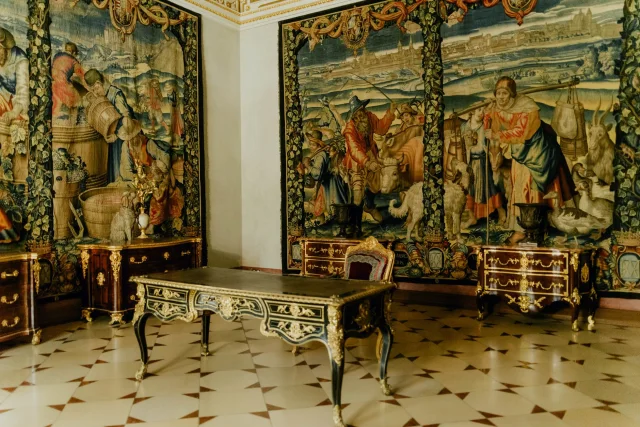
Baroque tapestries offer a different context for thinking about the relationship between image and textile. An exhibition on European tapestries from 1570 to 1720 explored works connected with commissions from courts and elites and with collaboration between artists and workshops in different centers. It also placed the founding, in 1662, of the Manufacture Royale des Tapisseries de la Couronne for Louis XIV in that context.[2]
This history helps distinguish tasks that are sometimes conflated: conceiving a design, producing the piece and carrying out the weaving are not necessarily the same attribution. But this historical context should not be transferred uncritically to a contemporary fabric. Tapestries are not examples of dobby simply because they have woven motifs; their value here is to show that behind a textile image there can be a documented relationship between design, commission and workshop.
A specific object shows how much a well-identified record can tell us. The Elephant, from The Berain Grotesques Series is listed as a tapestry made around 1688–1732 at the Manufacture Royale de Beauvais, France. The design is attributed to Jean Baptiste Monnoyer, while the style and border are attributed to Jean I Berain. The record lists wool and silk, and a tapestry technique using slit and double interlocking links.[3]
The date is given as a range, not an exact year. And the names associated with the design and style do not erase the distinction between those contributions and the production of the piece. The practical lesson is documentary: a record can distinguish authorship, materials, technique and place of production; ornamental appearance alone does not provide all those answers.
What information to look for in a fabric’s product details
To identify a specific piece, it helps to treat each field as an answer to a different question. Not every product listing provides every detail, and a blank field cannot be filled in by looking at the motif.
- Construction: look for an explicit indication of dobby, jacquard or another technique. “Geometric” describes the design, not necessarily the method.
- Composition: check the fibers declared for that piece. Touch and appearance cannot establish them with confidence.
- Weight or fabric weight: rely only on the stated detail, if available. It cannot be inferred from the motif’s size or from the fabric looking thick or textured.
- Origin: look for a specific indication of the place of production. The name of a technique does not certify origin.
- Identification: check that the product information applies to the item you are looking at, not a similar sample or a historical object used for comparison.
Editorial example: in a product listing that says “woven with a geometric motif” and declares the composition, but does not name dobby or jacquard, you can record the appearance and composition as available details. The technique remains unspecified. This is a more complete reading than forcing an answer based on the shape of the design.
A checklist for looking closely
Before describing a piece or comparing two fabrics, you can follow this short checklist:
- Describe the visible motif: scale, repetition, texture and contrast.
- Notice whether color or reflected light seems to make the pattern stand out.
- Separate what you observe from technical identification; do not turn “looks like” into “is.”
- Look for the construction in product information linked to the exact piece.
- Read composition, weight and origin separately, if documented.
- Leave any detail unresolved if the product information does not provide it.
The order matters because it prevents one striking feature from dominating your reading. A complex motif can draw the eye, but it does not answer questions about material or origin on its own. A subtle appearance does not indicate lower quality either.
A more precise way to read woven patterns
To understand a motif, start with what you can actually observe: its scale, contrast and the way light makes it visible. Then identify which claims require documentation. In general terms, dobby is associated with small motifs, often geometric, formed using a limited number of frames; jacquard allows individual control of the yarns and more complex designs.[1]
Baroque tapestries add another perspective: textile design can be connected to artists, workshops and commissions, and the record for a specific piece can distinguish those details from its materials and technique. But a historical comparison does not identify a modern garment. The most reliable answer combines careful observation with information specific to the object: the pattern opens the question; documentation helps make the answer precise.