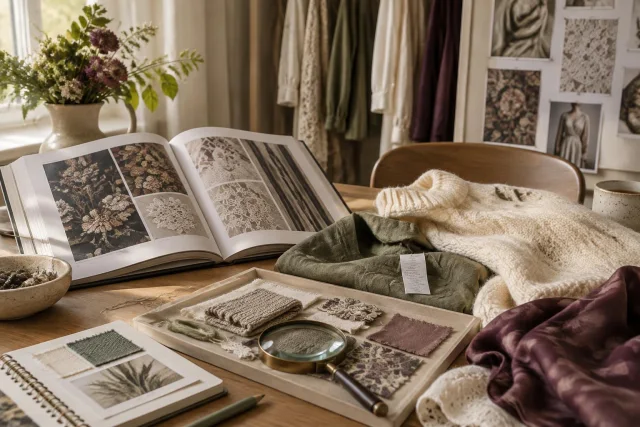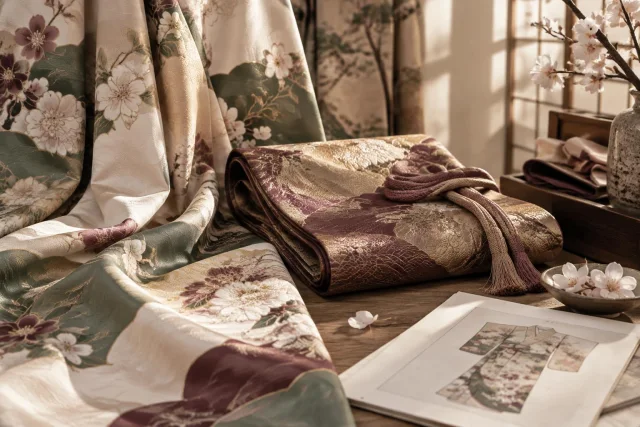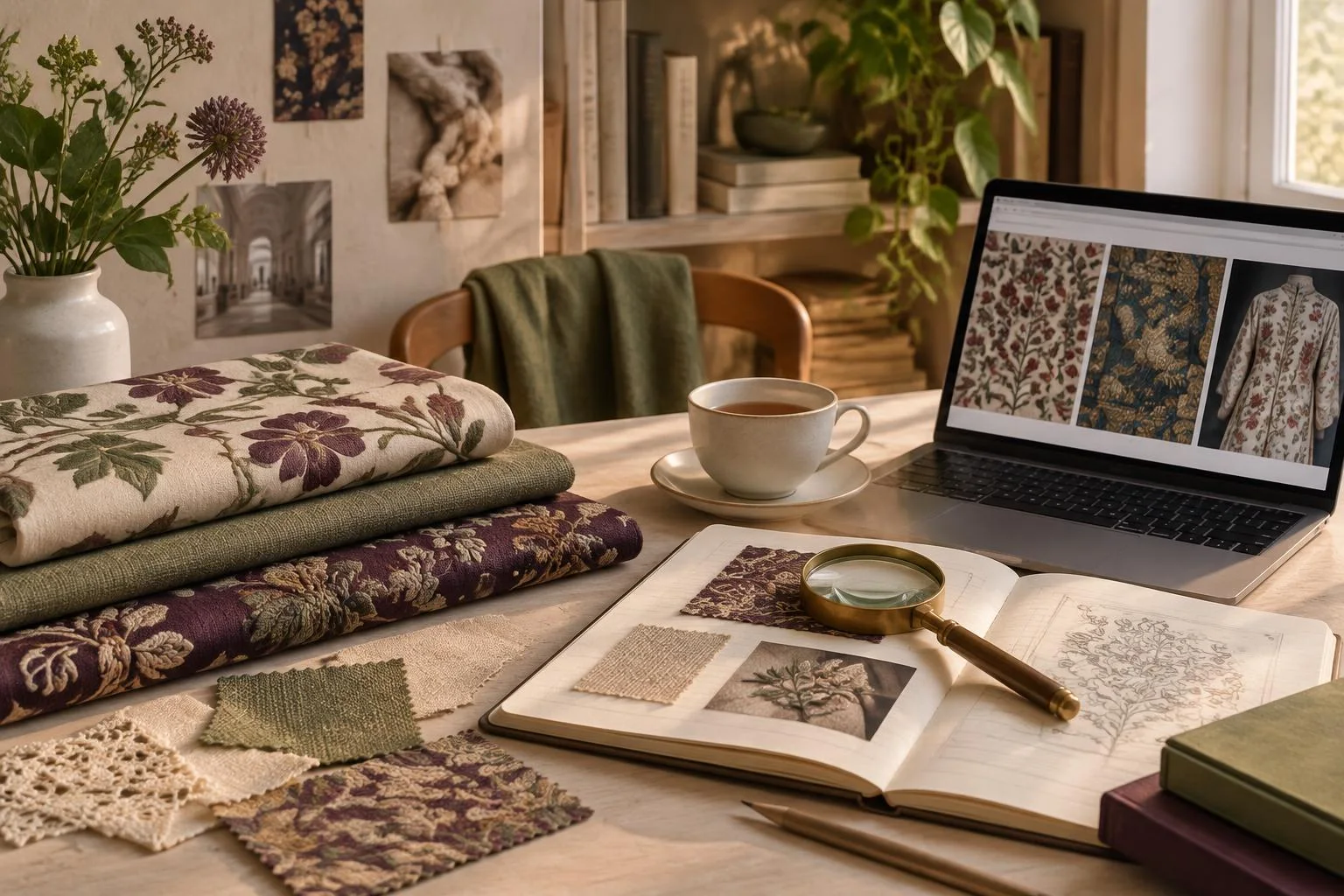
A surface brings together different clues
When looking at a decorated fabric, we often describe it with a general impression: it has texture, it shines, it looks soft or it features a very defined motif. But each observation answers a different question. Decorative technique, fabric structure and material are not synonyms: one explains how a design is incorporated or formed; another refers to how the fabric is constructed; the third identifies what it is made of.
Separating these aspects helps you describe things more precisely and avoid attributing properties to a garment that its product description does not state. It also helps you make better use of digital catalogues: what an institution writes is documentary information; what a photograph suggests is a visual observation; anything that is not specified remains a question.
The Victoria and Albert Museum (V&A) offers a textiles and fashion collection that includes fabrics, prints, embroidery, lace, tapestries and carpets. The collection documentation presents objects and techniques from different periods and places, though you should not expect every record to describe every aspect of each piece ([1]). The Metropolitan Museum of Art essays put textile techniques in context through documented objects: one discusses European embroidery between 1600 and 1800, and another, textiles from India and their production processes ([2]; [3]). These are complementary references, not a licence to identify any contemporary garment by analogy.
What it means to distinguish technique, structure and material
A record that identifies an object as embroidered provides information about a decorative technique. It does not automatically identify the fibre of the base fabric, nor does it necessarily describe the fabric’s entire structure. An essay on European embroidery explains the practice in relation to needle, thread and base fabric; this context helps explain why embroidered decoration and fabric construction are related but distinct questions. Its scope is historical and European, and it does not determine the technique of an object without documentation of its own ([2]).
Similarly, a record may indicate a material without explaining how the surface was formed or how the fabric was constructed. And an image showing a clear motif does not, by itself, confirm whether it was made through embroidery, printing or another process. It is best to retain the vocabulary used in the documentation without replacing it with a more specific term that adds information.
Editorial example: a record names an embroidered floral motif but does not indicate the fabric composition. You can record “embroidered floral motif” as documented information and “material not specified” as missing information. Filling that gap by assuming a fibre based on the photograph’s colour or sheen would mix observation and inference.
What museums contribute—and what they do not resolve on their own
The V&A collections and the Met essays are useful for consulting documented objects and seeing how techniques and materials are described. An essay on textiles from India, for example, discusses materials, techniques and exchange, and distinguishes fabrics, embroidery, printing and dyeing processes through contextualised objects. This diversity invites us to avoid overly simple categories; it does not let us infer the composition or provenance of a contemporary garment from its photograph alone ([3]).
Records do not have to offer the same level of detail. One may mention technique and material; another may provide a more general description. So when consulting an object, look for what it expressly states and also note which aspects are not mentioned. The absence of information does not confirm an answer: if a record does not indicate the composition, it does not prove that the fabric is made from one fibre or another.
An image is another source of clues, although a more limited one. It can help you describe the distribution of a motif, the contrast between the background and the design, or the appearance of a surface. You can write “the design seems concentrated along the edge” as an observation of the image. That is not the same as claiming that the piece was made using a particular technique, and the image alone does not reveal how it feels to the touch or how it drapes.
A table for separating information, observation and questions
The following table is an editorial tool for organising your research; it is not a museum classification or a quality assessment.
| Aspect | What you can record | What to leave as a question if it is not documented |
|---|---|---|
| Decorative technique | The term used in the record, or that it is not specified | The exact process, if you only have an image |
| Structure | The structural description provided in the record | How the fabric is constructed when this is not stated |
| Material | The materials expressly named | The composition inferred from colour, sheen or appearance |
| Design | Placement, repetition and contrasts visible in the image | Whether a visual effect confirms a particular technique |
| Physical experience | Nothing about touch or behaviour if you are only consulting it digitally | Feel, weight, drape or response during wear |
| Missing information | The specific information that is not provided | Why it is missing, unless a source explains this |
This distinction is useful even when you are not seeking a specialist identification. It lets you describe precisely what you know and prevents an inference from becoming an assumed fact through repetition.
Comparing without turning techniques into a hierarchy
Print and embroidery are useful terms for talking about how a motif appears, but they are not, on their own, a way to rank pieces from best to worst. A technique label does not automatically determine quality, price, durability or comfort. To support a comparison of that kind, you would need specific information that is not contained solely in the name of the technique.
Instead, you can compare specific aspects of the records: which techniques they name, which materials they state, how they describe the object and what remains unspecified. Separately, you can describe the images: where the motif appears, how it contrasts with the background or what the surface looks like. Keeping these records separate makes the comparison more useful and transparent.
Editorial example: imagine two records: one states embroidery and the other describes a print. A faithful comparison would first note these documented terms; then summarise the visible features of each image and, finally, point out the missing information. It would not conclude that the first garment will last longer or that the second will be more comfortable, because these properties do not follow from the decorative technique alone.
The scope of the museum examples also matters. The embroidery essay concerns a historical European context; the essay on textiles from India addresses a different group of objects and processes. Read together, they provide context on different textile practices, but they do not turn a contemporary appearance into proof of origin, material or technique ([2]; [3]).
Applying this reading to a contemporary garment
A collection record can help you formulate questions, but it does not replace information about the garment you are considering. Do not assume that it shares material, construction or behaviour with a museum object because they have similar-looking motifs. Visual comparison can help you identify what interests you; the answer should come from information specific to that garment.
Start by reading its description and noting the exact words used about material or technique. Then separate those details from what the photograph seems to show. If something important to your decision is missing, ask the person offering the garment a specific question without presuming the answer.
Editorial example: a jacket in an image shows a motif that looks embroidered. You can ask whether the sales description confirms that technique and what material it lists. The photograph helps explain what you want to clarify, but it does not prove what the answer will be or whether the shop has additional information.
If the garment is available to you, looking at a label or reading a description is not the same as testing its durability. Limit your inspection to what you can do without pulling, scraping or handling it in a way that could damage it. If the information you need is still not available, you can leave the question open or look for more specific information about that piece. There is no need to turn a documentary omission into a conclusion.
An editorial proposal for observing methodically
This exercise is a practical proposal of our own, not a method attributed to museums. You can adapt it to a digital record or a garment available for careful observation:
- Copy what is stated: record the words used in the description for technique, material and structure, without adding synonyms that imply more information.
- Mark what is not specified: write down which information is missing instead of filling the gap with an assumption.
- Describe the image separately: note the motif, its placement and visible contrasts as visual impressions.
- Clarify what you need it for: distinguish whether you are comparing descriptions, trying to understand a design or deciding what to ask.
- Ask a specific question: seek clarification about the missing information that affects your decision, without anticipating the answer.
The method helps make three records visible: what a source states, what you observe and what you still want to find out. It is not a test of quality or durability, and it does not replace a description specific to the object. Its value lies in helping you consult and compare without attributing more to an image than it can show.
Checklist before finalising a comparison
- Have I kept decorative technique, structure and material separate?
- Have I attributed to the record only the information it expressly states?
- Have I described the image as an observation without treating it as technical confirmation?
- Have I identified what is missing without filling the gap with an assumption?
- Am I comparing specific descriptions rather than attributing quality, price or durability to a technique?
- If this is a contemporary garment, have I consulted information about that specific piece and asked a clear question about the information I need?
Looking precisely also means knowing when to stop
Consulting textile collections and publications can expand our vocabulary for describing textiles and help us understand how different objects are documented. But each record has its own scope, and the historical context of an essay does not replace a description of a contemporary garment. Images let us observe the design; they do not replace technical information or physical experience.
The clearest way to read a surface is to keep three records: what the documentation states, what you can observe and what you still need to find out. That way, print and embroidery no longer seem like labels that explain everything. They become starting points for careful description, comparison of what is actually documented and useful questions—without turning gaps into certainties.