




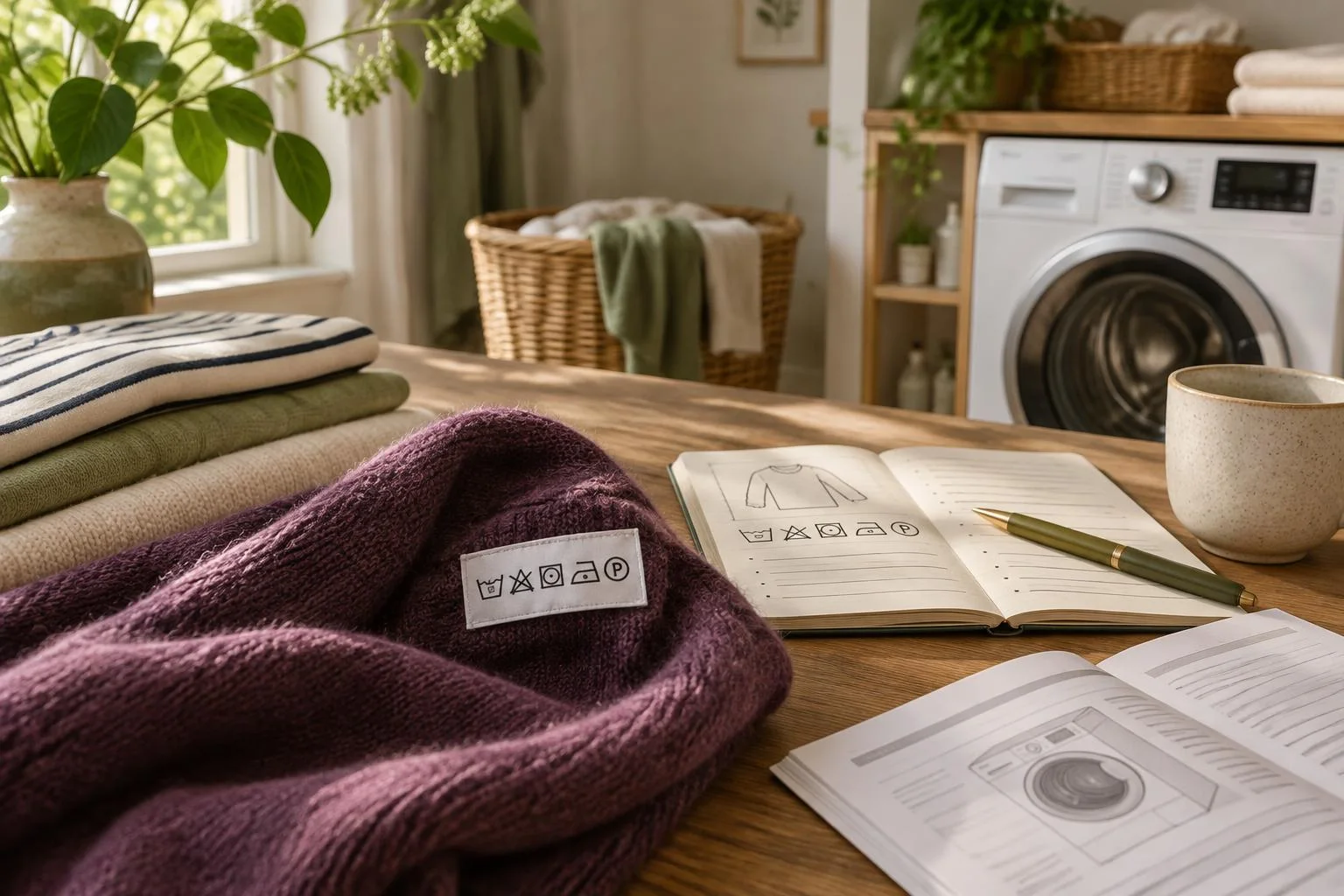
The label as a starting point, not a recipe
Choosing a wash cycle seems simple until a garment has several instructions, an unclear label, and an appliance with options we don’t know well. The most useful way to start is to read the entire label before selecting a cycle. It isn’t enough to identify a temperature or recognize the fiber: the instructions apply to the specific garment and may limit different aspects of its care.
GINETEX organizes the symbols linked to ISO 3758:2023 into five categories: washing, bleaching, drying, ironing, and professional care. Each covers a different stage. Considering them together helps avoid a partial reading—for example, attending to washing while overlooking a drying restriction or a professional-care instruction.
The five categories and their symbols are explained here: [1]. In this guide, we describe the concepts in words without reproducing or redrawing sets of symbols. If you need to identify one precisely, consult the official explanation.
Editorial example: imagine a shirt with information about washing, ironing, and professional care. Before opening the washing machine, note all three instructions and check whether the appliance offers a compatible option. That review does not, on its own, determine the entire process, but it prevents a decision based on a single symbol from ignoring the other instructions.
What each care category adds
The five categories are best understood as parts of the same information label, not as interchangeable options. The washing instruction provides information about that stage; the bleaching instruction concerns a different type of treatment; drying and ironing have their own instructions; and professional care refers to a category distinct from domestic washing. You don’t need to memorize every variation to adopt the main habit: check the entire label and clarify any instruction you don’t understand.
A personal note can make that information easier to use. Write the garment’s name or a brief description, put in your own words what the label allows or restricts, and flag any questions. There’s no need to create a technical guide or translate a symbol from memory. The goal is to keep the available instructions and know what’s missing before acting.
Editorial example: instead of writing only “wash with care,” a note might say “blue jacket: check washing and drying instructions; ask what the instruction I don’t recognize means.” This is a way to organize information, not a new interpretation of the label. If the note is going to stay with the garment, keep it linked to that specific piece so you don’t confuse its instructions with another garment’s.
Read the washing number as a maximum limit
The number inside the washtub expresses a maximum temperature. It doesn’t mean that temperature is necessary for every wash or that you should automatically choose it. The distinction matters because a maximum sets the limit indicated by the label; on its own, it doesn’t prescribe a complete cycle.
The bars under the washtub modify the indicated mechanical action. Therefore, read the number and bars together, not as decorative details or substitutes for the other categories. A prudent choice starts with the complete instruction and is then compared with the appliance’s actual options.
Avoid turning information about one garment into a general rule for all similar garments. Two items made from the same fiber may differ in finish, embellishments, or construction. The label applies to the specific item, and the textile composition alone does not confirm that all these elements can be treated in the same way.
Editorial example: if a garment’s label sets a maximum and the washing machine manual lists several cycles, don’t choose a cycle just because its name seems to match. First check what both documents say and whether the label’s instructions can be followed using the available options. If you can’t establish that correspondence, the useful decision may be to ask rather than guess.
Why the fiber alone doesn’t decide
Knowing the composition helps describe a garment, but it doesn’t replace its care instructions. The finish, embellishments, and construction may also affect the restrictions given. So don’t infer the complete treatment from the name of a fiber or apply to one garment the recommendation you remember for another.
When ironing, follow the label rather than deciding solely on the basis of fiber type. The same whole-label approach applies to other steps: look for the relevant instruction for each stage, and don’t infer permission that the label doesn’t give.
Editorial example: a skirt may have an embellishment that isn’t mentioned in its composition description. Even if you know the main fiber, that information isn’t enough to decide how to treat the whole garment. The skirt’s label and, if needed, a question about that specific item are more relevant references than a general rule about the material.
Compare the instructions with the appliance manual
A label and a manual answer different questions. The label communicates instructions for the garment; the manual explains the appliance’s options and how to use it. Before choosing, check both and look for an option that respects the relevant restrictions for the garment. If you can’t find a clear match, don’t treat the cycle that seems closest as a safe equivalent: ask the manufacturer or a textile-care professional for guidance.
This comparison can also reveal practical limits. The machine may offer cycle names that don’t match the label’s wording, or it may not be obvious which option meets an instruction. In that case, keep track of the specific question—for example, which label instruction you can’t relate to which appliance option. That way, you can focus your query on the decision you need to make rather than asking for a generic recommendation for the fiber.
| What to check | Practical question | What it helps with |
|---|---|---|
| Entire label | Have I read the washing, bleaching, drying, ironing, and professional-care instructions? | Helps avoid basing the decision on a single instruction. |
| Number and bars | Have I treated the number as a maximum and considered the bars? | Helps interpret the washing instruction as a whole. |
| Specific garment | Am I using the instructions for this item, including its details? | Helps avoid generalizing from the fiber or another garment. |
| Appliance manual | What options does the appliance manufacturer describe? | Lets you compare the instructions with the available appliance. |
| Outstanding questions | Which instruction don’t I understand or can’t relate to an option? | Makes it easier to ask a precise question before experimenting. |
The table is an editorial tool for organizing your reading; it doesn’t add symbols or establish new treatments. If a label distinguishes professional care from domestic washing, don’t assume a washing-machine cycle replaces that treatment. Professional care and domestic washing are separate categories, so clarify the instruction before deciding.
When to stop and ask
An incomplete label, a valuable garment, or an instruction you don’t understand are all reasonable reasons to ask the manufacturer or a textile-care professional before experimenting. The question can be very specific: what an instruction on that garment means, what information is missing, or how it relates to an option described in the appliance manual.
This guide doesn’t prescribe methods for specific stains or mixtures of household products. Nor does it guarantee that all damage can be avoided or that a treatment will produce a particular result. Its purpose is to help distinguish what the label does indicate from what still requires guidance.
Editorial example: if a special garment has a partly illegible label, note what you can still read and describe your question without filling in the missing part from memory. That information may be useful when consulting the manufacturer or a professional. Until the relevant instruction is clarified, avoiding experimentation is more sensible than turning an assumption into a rule.
Checklist before choosing a cycle
- Find the label and read it in full, not just the washing instruction.
- Identify the five categories: washing, bleaching, drying, ironing, and professional care.
- Remember that the number in the washtub indicates a maximum temperature and that the bars modify mechanical action.
- Treat the instructions as information about the specific garment, not as a general rule for its fiber.
- Compare the instructions with the manual for the appliance you plan to use.
- If there’s a professional-care instruction, don’t assume a domestic cycle is equivalent.
- Note your questions and ask before experimenting if information is missing, the item is valuable, or you don’t understand an instruction.
- Keep the care information as long as it remains legible and useful to you.
An informed decision starts with gathering the instructions
Reading the entire label changes the question from “what cycle do I usually use for this fabric?” to “what does this garment say, and which appliance options respect those instructions?” That difference helps avoid generalizations and makes it easier to notice when an instruction isn’t clear or doesn’t match the available options.
The habit can be simple: read the five categories, interpret the number as a maximum, consider the bars, compare the label with the manual, and note anything that needs clarification. If the information is insufficient, asking before trying a treatment lets you make the decision with more context. And keeping the instructions while they remain legible gives you a useful reference the next time you care for that garment.