



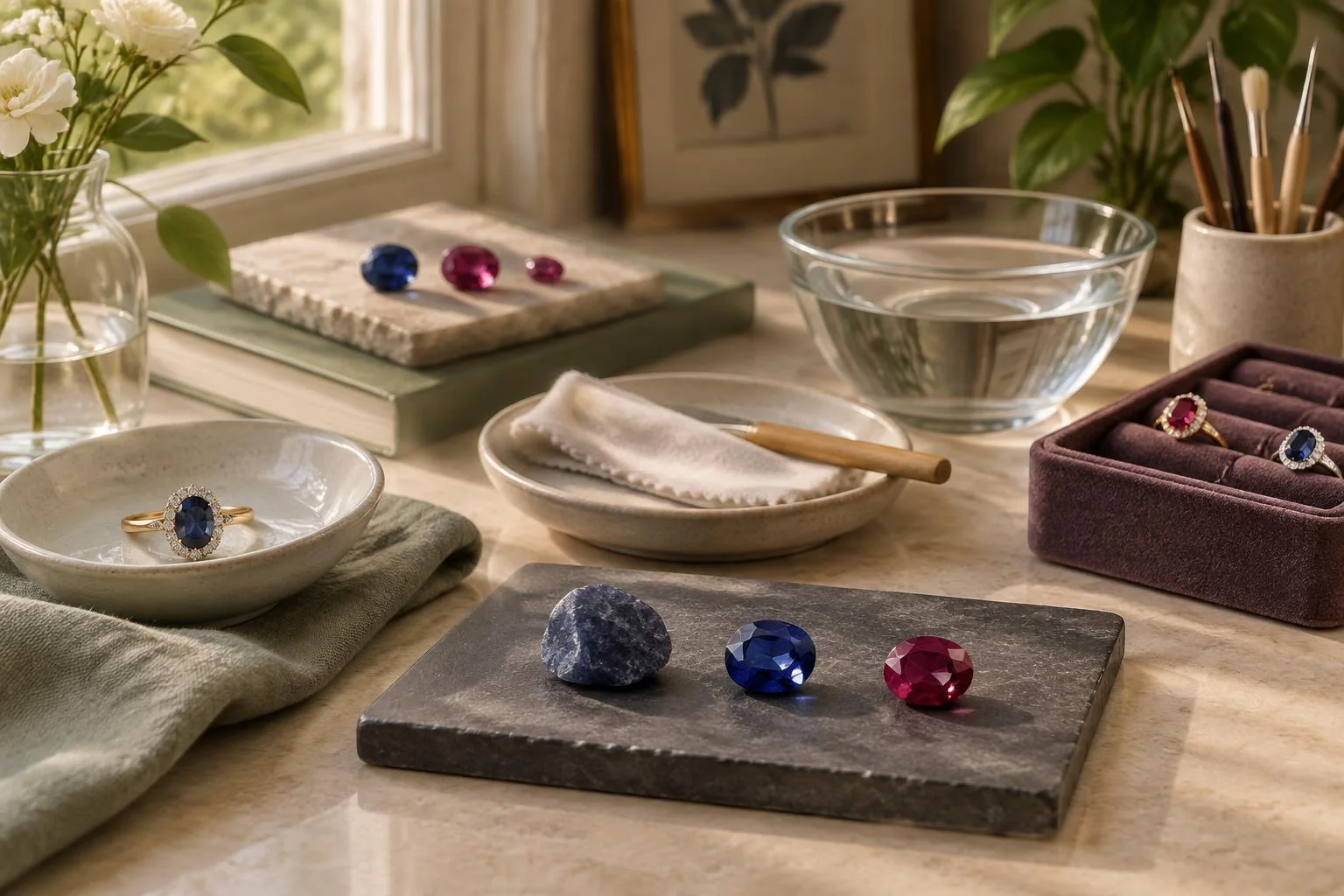
Two properties, two different questions
When discussing a gemstone’s resistance, it is easy to use “hard” as a synonym for “difficult to damage.” However, hardness and toughness describe different behaviors. Hardness refers to resistance to scratching; toughness refers to resistance to breaking or fracturing. Distinguishing between them helps you make more reasonable decisions about wearing and caring for a piece of jewelry.
The difference can be expressed as two questions. How resistant is the gemstone’s surface to scratches? That is a question of hardness. What might happen if the piece takes an impact? That question relates to toughness. A favorable answer to the first does not automatically answer the second.
That is why a gemstone may keep its surface in good condition in certain everyday situations and still be vulnerable to a blow. Hardness does not serve as a general guarantee that a piece will remain intact. Nor is it, on its own, enough to decide how to clean it: the gemstone, its possible treatments, and how it is set all matter.
What the Mohs scale means
The Mohs scale expresses hardness comparatively, rather than in equal intervals. The difference between two adjacent positions does not always represent the same increase in actual resistance. Reading its values as though they were uniform steps can create a mistaken impression of how much one gemstone differs from another.
For everyday care, there is no need to turn this scale into an absolute prediction of what will happen to a piece of jewelry. Its value lies in discussing scratch resistance within a comparative framework, not in certifying that a piece is indestructible or describing every risk associated with impacts, settings, or treatments.
Editorial example: If someone compares two gemstones because they have heard that one ranks above the other in a hardness classification, the prudent conclusion is limited: the comparison refers to scratching according to the scale. It does not establish which gemstone will better withstand every kind of impact or which can be cleaned in the same way.
Corundum: a resistant surface does not eliminate other care considerations
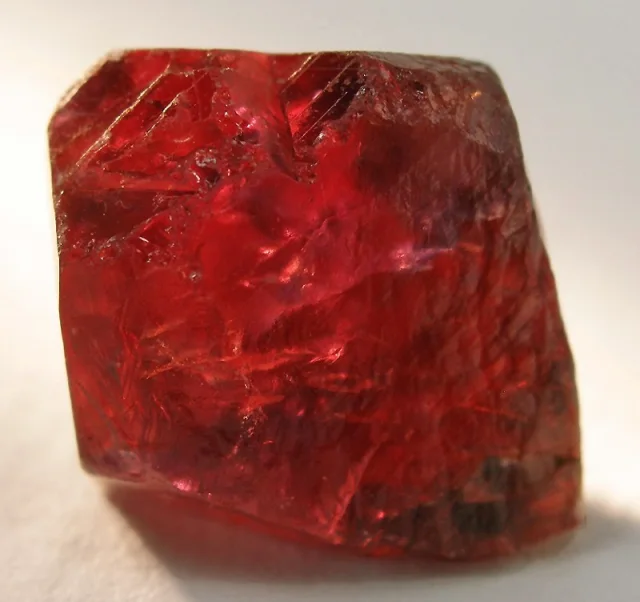
Ruby and sapphire belong to the corundum family. Corundum has high hardness, a characteristic that makes it resistant to everyday scratches. This advantage should be understood within its scope: it describes scratch resistance, not immunity to impacts or fractures.
It is also important to know whether the gemstone has been treated or has fillings. These can change the piece’s properties and, therefore, the appropriate care. So two pieces of jewelry informally identified as sapphires should not necessarily be treated identically: the gemstone’s name alone does not provide all the information needed to choose a cleaning method.
Editorial example: Someone inherits a ring they believe contains a ruby. Although corundum has high hardness, that does not confirm the stone’s treatment, the condition of its setting, or whether using water or a product would be appropriate. Before cleaning it, they would benefit from reviewing the available documentation and finding out these details; if they cannot, the practical option is to ask a professional for guidance rather than improvising a procedure.
A practical reading of hardness and toughness
The following comparison summarizes the question each property answers and how to apply it when making decisions. It is an editorial guide, not an assessment of a specific piece of jewelry.
| Criterion | Hardness | Toughness |
|---|---|---|
| Main question | How resistant is the gemstone to scratching? | How resistant is it to breaking or fracturing? |
| What it helps explain | The surface’s response to scratching | The difference between resisting a scratch and withstanding an impact |
| What it cannot establish on its own | That the gemstone cannot break or that every cleaning method is suitable | That a gemstone has a more scratch-resistant surface |
| Practical use in caring for the piece | Helps discuss scratching without turning it into a general guarantee | Reminds us that scratch resistance is not the same as protection against impacts |
The table focuses on the scope of each term. Neither property, considered separately from the rest of the information about the piece, replaces identifying the gemstone, reviewing its treatments, or considering its setting.
Care starts with identifying the piece
There is no universal cleaning procedure suitable for all jewelry. The gemstone and its treatments can affect care, and settings also vary from piece to piece. It is therefore preferable to gather information before deciding how to clean an item, rather than choosing a method just because it seems gentle or is commonly used on another piece of jewelry.
A practical sequence is to start with the available documentation. This may include information received when the piece was purchased or details that came with it. Check which gemstone is identified, whether any treatments or fillings are mentioned, and whether there are specific care recommendations. Then consider the setting, since cleaning affects the jewelry as a whole, not just the stone.
Editorial example: Imagine two rings with stones a family calls “sapphires.” One has documentation about the gemstone and its care; for the other, the identification and treatments are unknown. It would not be reasonable to assume that the same product or procedure is suitable for both just because they are given the same name. The useful distinction is not about guessing by sight, but recognizing what information is missing before taking action.
If these details are unavailable, consult documentation or a professional when relevant information is unknown. This can help guide care for the specific piece; there is no need to try to resolve every question from a photograph or an assumption based on appearance.
A checklist before cleaning
These questions turn the distinction between properties into a simple routine for considering each piece separately. They are practical editorial criteria, not a technical cleaning procedure.
- Do I know what gemstone it is, or is the identification based only on an assumption?
- Does the documentation say whether it has been treated or has fillings?
- Do I know what type of setting it has and whether it is compatible with the method I am considering?
- Is “hard” being interpreted only as resistance to scratching, or as a guarantee it does not provide?
- Do I have specific care information for this piece of jewelry, rather than simply transferring instructions from another piece?
- If I cannot answer, can I find the documentation or consult a professional before cleaning it?
These questions cannot authenticate a gemstone or assess its integrity remotely. Their purpose is to identify when there is not yet enough information to choose an appropriate care method.
What an image and a label cannot resolve
An image can show the visible appearance of a piece of jewelry, but it is not enough to confirm the gemstone’s treatments or its structural integrity. For this reason, it is best not to authenticate or evaluate a piece based solely on a photograph. Similarly, an informal label such as “ruby” or “sapphire” does not necessarily provide all the relevant information needed to decide how to clean it.
The distinction between hardness and toughness also limits the conclusions that a product description or conversation can support. Saying that a gemstone is hard tells you about its resistance to scratching; it does not prove that it cannot chip or fracture upon impact. For the care of an individual piece, identification, treatments, and setting remain important.
Choosing the next step with care
In practice, caring for a gemstone starts by separating what is known from what is assumed. Hardness describes resistance to scratching; toughness refers to resistance to breaking or fracturing. The Mohs scale offers a relative, nonlinear comparison, and corundum’s high hardness does not eliminate the need to consider impacts, treatments, or setting.
The most useful approach is to review the documentation, identify what information is missing, and avoid adopting a universal cleaning method. If the treatments or setting are unknown, consulting a professional can help guide the next step. This way, a gemstone’s property is used to understand it better, not to attribute a degree of resistance to the jewelry that the property alone does not promise.